Argumentative Essay

HOW TO WRITE AN ARGUMENTATIVE ESSAY

Some students may struggle when it comes to argumentative essays. Usually, this task is assigned to students on the SAT, ACT, IELTS, and TOEFL tests. Professors also assign this type of essay as coursework. Without knowing the correct steps to write a good argumentative essay, it can be very tough and time-consuming.

Many students around the US face this task annually. All it takes is gathering information and applying the correct citation format. The rest is a piece of cake! Follow this guide to learn how to write an argumentative essay. Learning this style of writing is the start of your journey to getting the grades you deserve.

TABLE OF CONTENTS

  • Argumentative Essay Definition
  • Argumentative Essay Topics
  • Creating An Argumentative Essay Outline
  • The Writing Process
  • Tips For Success
  • Some Good Examples

What is an Argumentative Essay?

Argumentative essay is a style of academic writing where the author presents both sides of an argument or an issue. The purpose is to inform rather than convince. That’s why an argumentative essay is not to be confused with a persuasive essay.

The thesis includes all counterpoints from both opposing arguments. It’s almost like a political debate with oneself.

There are two ways to come across this form of the essay:

  • One of the ways is to present both arguments equally
  • The other way is to give one argument more forcefully than the opposing factors

By practicing argumentative writing, students can evaluate issues from multiple perspectives. When writing an argumentative essay, it’s important to focus on facts and information rather than personal ideas or preferences.

The author may present arguments equally, or support one in favor of others. Regardless, the thesis must include all the primary points (and counterpoints) which will appear in the essay.

Argumentative Essay Topics

Just like with all other essay types, there are tons of topics to choose from when writing an argumentative essay. However, it is important to remember that they must be in a debate format. In other words, explain why option A is better than option B, or vice versa.

Here are some good argumentative essay topics to get you started:

  • Apple vs. Microsoft: Which software brand is more useful for students?
  • Do violent video games have a negative psychological impact on children?
  • From a financial perspective, should one invest in cryptocurrencies?
  • From an economic standpoint, are electric cars better overall?
  • Has society become too reliant on technology?

Interesting Argumentative Essay Topics for High School

As students will begin writing this type of content in school, it is essential to give them easy essay topics so they can get a grasp of the task. Here are some examples:

  • What is the most important second language to know as a US student?
  • Should the minimum driving age be lowered?
  • Are standardized tests a fair reflection of students skills?
  • Are athletes overpaid for their skills?
  • Should high school students be free to choose their classes?

Topics for College

As we transition to the university level, the question asked alongside the complexity of content should increase. With that being said, here are some challenging topics for college students.

  • Is there enough evidence to prove that news sources have a biased agenda?
  • Would the legalization of marijuana as a recreational drug be economically justifiable?
  • Can we constitute Russia as a superpower alongside the USA and China?
  • What was the most influential technological advancement in the history of humanity?
  • Should we sacrifice some public services for lowered tax brackets?

Argumentative Essay Outline

Now that we understand what this type of writing is all about, we can start putting pieces of the argumentative essay outline together. Usually written in the five-paragraph structure, this argumentative essay outline will consist of an introduction, 2-3 body paragraphs, and a conclusion. Logically, each of those three sections will have a unique structure, so understanding them on an individual level will help ensure a smooth writing process.

We will be using “the internet” as the most significant technological advancement in society as an example

Introduction (3 Parts)

  1. How To Start An Argumentative Essay Outline (Hook Statement): As with most other types of essays, one should attempt to captivate the reader’s interest from the very beginning. To do this, create a sentence that stands out from the rest of the text. Consider something such as a rhetorical question, funny quote or intriguing idea. The goal is to get your audience reaching for that bag of popcorn right after reading the hook!
  2. Background Information: After gathering the audience’s attention, the next step is to present any necessary context to narrow the focus. This information should not reveal any of the main arguments from your body.Also, it should ideally transition the train of thought towards the thesis statement.
  3. Thesis Statement: The last sentence of the introduction should present the focal point/central argument of your entire essay. It is essential to writing a thesis correctly, and this is accomplished through proper phrasing. Remember: your primary objective is to defend your idea, so the thesis must DIRECTLY state what your idea is and why it is correct.

Body Paragraphs (4 Steps)

  1. Topic Sentence: Start with a sentence that transitions the focus from the previous paragraph to the current one; it should also introduce the main sub-argument for that particular section.
  2. Claim: After presenting your topic sentence, it is time to link your main sub-argument with the thesis statement. The goal is to explain how this point validates and strengthens your central message.
  3. Evidence: After providing a valid claim, you must defend it with factual support. Examples of this can be statistics, references or logical ideas that support ones claim since they are getting information from external sources, adding to the essays overall validity.
  4. Concluding Statement: After presenting a defendable claim and supporting it with evidence, one must end the body paragraph with a concluding statement. The primary goal of this sentence is to summarize the overall significance of the claim to the thesis. In other words, why was this particular point so essential?

Note that this structure works for each body paragraph. The main difference comes with the actual claim, supporting evidence, etc.

Conclusion (3 Steps)

  1. Restate The Thesis: The first sentence of any conclusion should always be a restatement of your central message (thesis statement). Using assertive language, restate your thesis in an “I have 100% proven this point” type of way. When information is presented to an audience with confidence, they are subconsciously more inclined to believe that it is in fact, true.
  2. Brief Summarization of Sub Arguments: Most likely, the audience has already forgotten some of the information you presented. For this reason, go back through and review your main points, giving your argument closure.
  3. Overall Concluding Statement: To end an argumentative essay outline with a bang, present a memorable concluding statement. Usually, this sentence will express the universal importance of the information and should leave the reader with a call to action for further investigation.

The Writing Process

When it comes to sitting down and writing an argumentative essay, the author has four primary objectives:

  1. Brainstorm + Topic Selection: Obviously, before one can start putting pen to paper, they have to figure out what they will be writing about. Unless one has been given a predetermined topic, they will usually have freedom of choice. EssayPro always recommends that students choose a passionate theme; doing so will naturally give the author more enthusiasm and motivation to do a good job.
  2. Research, Research, Research: Even if you are savvy in the field of choice, there is a bundle of information out there that is unknown to you. Use various sources such as reliable internet articles, encyclopedias, historical documents, and other related materials to gain a well-rounded understanding of a topic and what avenue you will approach.
  3. Writing A Rough Draft: Now that you have a thesis and valid external information, you can start putting pen to paper (or fingers to keyboard.) Follow the outline laid out above for guaranteed success and keep in mind the following things:
  4. Writing a Final Draft: After finishing your rough draft, take some time away from the essay. Let your brain recover and come back to it the next day (or a few hours later, depending on how bad of a procrastinator you are) with a fresh perspective. More likely than not, you will see flaws in grammar, vocabulary, and logic. Make those final amendments and read your essay out loud for a final polish. If it sounds good, then looks like you are finished!

Final Tips

Referring to tips can help you to write a good argumentative essay in many ways. When it comes to writing and constructing your final draft, make sure all of these tips are considered, below. Once these writing tips have been revised and applied, you are one step closer to mastering the art of argumentative essay writing.

  • Find a topic and make sure it has counter arguments
  • Gather of research on both sides of the argument to avoid sounding biased
  • Make sure all of the facts included in your argumentative essay are accurate
  • Follow guides that illustrate how to write an argumentative essay step by step to improve the way your performance on these assignments
  • Structure the essay properly with: Introduction, Body, and Conclusion or you will lose marks
  • Before writing, list all information in an outline
  • Remember to cite the sources used and avoid plagiarism
  • Get other people to read your work to see if they’re persuaded by your writing
  • Don’t include your own opinion in the work. Stick to key facts and evidence
  • Run your paper through a grammar checker – just in case!

Argumentative Essay Examples

Down below you can find some good argumentative essay examples. The first essay talks about the value that comes with the freedom of strikes for public workers. The second essay discusses the importance of economic equality in a nation, alongside possible repercussions and potential threats if not met.

Both present fantastic arguments that students in need of help can learn from!

DOWNLOAD

DOWNLOAD

Argumentative Essay Topics

85 UNIQUE ARGUMENTATIVE ESSAY TOPICS: HOW TO PICK OUT TOPIC

Argumentative essays are a means of proving an argument valid, hence turning theory into fact.

It is often visible if the writer has spent time developing their argument. Experienced writers build their own set of principles to maximize clear delivery. The validity of any argument relies on its source material. Simple issues may need a more straightforward approach. When you’re tackling controversial matters, it’s best to use plenty of sources for backup.

TABLE OF CONTENTS

  • How To Pick A Topic
  • Easy Argumentative Essay Topics
  • Argumentative Essay Topics For College
  • Topics By Category
  • Funny Argumentative Essay Topics

What Is an Argumentative Essay?

An argumentative essay is a type of academic paper that introduces arguments (claims) about both sides of a particular topic. Both sides could be balanced, or one may be dominating. The tone of the paper depends on the writer’s position towards the observed issue.

The primary function of an argumentative paper is to introduce a case to the readers in a convincing manner trying to change their opinions if they have a position different from the writer’s. The idea is to show the full picture.

Experts tend to highlight three models of argumentative writing:

  • Toulmin model

This paper will need an intro with a thesis statement followed by background information supported by the evidence collected from sources. A writer will have to list the reasons to support the central argument & rebuttals.

  • Rogerian model

Unlike the previous one, this model of argumentative paper requires weighing both alternatives, listing the pros & cons of each, and providing a piece of advice after in-depth evaluation.

  • Classical model

The writer has to introduce the issue, offer a personal solution, and make an attempt to persuade the audience that this particular solution is the correct one. The idea is to make the readers care about the suggested topic.

How to Pick Out the Good Argumentative Essay Topics

Finding good topics for an argumentative essay isn’t finding a needle in a haystack – as long as you take care to follow a few core principles.

Many controversial argumentative essay topics are prone to prejudice. They often have an unconscious aim to prove already assumed facts. When writing an essay, it is always crucial to understand both sides. Try picking a neutral topic to which you are mostly in different.

The basic tips to follow while selecting the ideas to discuss in your work are:

  • Think about issues of your interest. Make sure that you possess in-depth knowledge of the chosen theme. Can you express the opinion about it?
  • Follow the recent trends. Type some keywords in the search field of Google Trends to find out what issues related to your subject are actively discussed.
  • Check access to primary & secondary sources. Surf the web to decide whether you can obtain enough credible sources to use in your piece.
  • Avoid themes with a broad/general focus. Research paper is limited by the number of words or pages, so make the topic narrow & specific.
  • Stay away from the emotionally-charged subjects. Argumentative writing is about staying calm and sober with judgments.
  • Consider the target audience. Think about people that you plan to reach. Would they accept your point of view or would it result in a debate?
  • Brainstorm the final list of ideas. Discuss the final list of the possible topics. Pick the idea the majority will vote for.
  • Take a risk. Selecting a debatable issue has certain risks, but if a writer proves a personal position, it will result in the highest grade!
  • Take your experience into account. How well do you know the topic? Did you have a relevant experience to share?

Tip from EssayPro Expert:

“It is recommended that a writer should possess an interest in the subject they cover, but the argument should not be one that they accept as the truth.”

Easy Argumentative Essay Topics

There are topics that are discussed and debated on a daily basis. It is not uncommon that most of them are banned from classrooms being cliche. If you believe you have some fresh insights on the matter, try to convince your teacher into letting you do it.

  • Should Guns Be Legal?
  • Should Marijuana Be Legal?
  • Should Abortion Be Legal?
  • Should Gay Marriage Be Legal?
  • Should ‘They’ Lower the Drinking Age?

Middle School

Teachers engage middle-schoolers in the debate to give them an insight into high-school level writing. These middle school argumentative essay topics often discuss the fairness of school rules and alternative curriculums.

  • Should Schools Have Dress Codes?
  • Should Teachers Assign Less Homework?
  • Is Music Class Necessary?
  • Real School vs. Homeschool.
  • How Important Is Arts Education?

High School

Argumentative essays are most rewarding in high school and are a lesson in seeing all sides of the spectrum. Here are some common argumentative essay topics for high school.

  • Should High School Students Be Drug Tested?
  • Banning Classical Literature Containing Offensive Language in School.
  • What Is The Greatest Invention of All Time?
  • Should Clothes Define Who You Are?
  • Should Sex Education Appear in School Curriculums?

Argumentative Essay Topics For College

Did you know that Barack Obama only finished paying his student loans in the second year of his presidency? The value of college degrees is being questioned now more than ever. Argumentative essay topics for college require attention to details of contemporary life.

  • When Do Halloween Costumes Become Over-The-Top?
  • Should Companies Collect Personal Data of Users?
  • When Does Comedy Become Over-The-Top or Offensive?
  • What Does the College Admissions Scandal Reveals About Society?
  • How Close Are We to the ‘Black Mirror’?
  • For or Against Allowing Students to Carry Guns to College.
  • Are Schools Doing a Good Job at Addressing Cyberbullying?
  • Should School Newspapers Get Reviewed Before Publishing?
  • Do Schools Help Students Explore Their Creativity?
  • Is Taking Adderall to Study Unfair?
  • Has the Internet Made College Education Unnecessary?
  • Is It Fair to Judge a Students’ Potential by Their SAT Score?
  • Are Certain Colleges Overrated Because of Their Historical Significance?
  • Should the Cost of College Depend on the Degree?
  • Should Admissions Officers Read College Applicants’ Social Media Pages?

Argumentative Essay Topics By Category

We have listed some topics from popular fields of study. Feel free to tackle any subject on the list – or even better – use this list as inspiration and find your topic of interest. If you need more guidance, we have hundreds of essay writers online and ready to help you out.

Social Media

While some may find social media a necessary component of daily life, others struggle with procrastination as a direct result. It has arguably influenced critical political decisions and has made social media a significant and relevant field of study.

  • Does Instagram Make People More Narcissistic?
  • Why Are Women’s Nipples Banned in Social Media?
  • Is Fake News Dangerous?
  • Must Social Media Play a Role in Education?
  • How Should Social Media Networks Tackle Online Bullying?
  • Is Anonymous Social Media Dangerous?
  • Is Proper Punctuation Important on Social Media?
  • Should Social Media Pay Users in Exchange for Their Privacy?
  • Should Companies Fire Clients Over Inappropriate Social Media Behavior?
  • Should There Be a ‘Dislike’ Button on Facebook?

TV, Movies, Video Games

Hollywood produces heaps of content. It is no surprise that lots of it don’t undergo extensive evaluation before release. This results in students questioning the industry’s promotion of harmful stereotypes. Here you can find plenty of unique essay topics.

  • Do Hollywood Movies Romanticize Sexual Harassment?
  • Does American TV Capture the Country’s Diversity?
  • Should Cybersports Be Considered Sports?
  • Does Violence in Video Games Cause Kids To Be Violent?
  • Is the Gaming World Sexist?
  • What Makes a Good Children’s Cartoon?
  • Do Hollywood FIlms Promote a Certain Set of Values?
  • Can Good Commercials Be Considered Works of Art?
  • Why Are There So Few Female Film-Makers?

Music, Literature, Art

Has digitization degraded music into a mere form of entertainment? Music argumentative essay topics have plenty of room for discussion. They touch on issues of authenticity which can also be relevant in the fields of literature and art.

  • Modern Pop Music Is Recyclable — Does That Make It Good or Bad?
  • In Music — When Does ‘Borrowing’ Become ‘Stealing’?
  • Should Explicit Language in Classic Literature Be Filtered Like Explicit Language in Pop Song Lyrics?
  • Should We Consider Banksy as an Artist?
  • Are Libraries Still Necessary?
  • Does Rap Count as Music?
  • Is Graffiti An Art?
  • Is It Right to Display Art in Public Places?
  • Should Society Support Aspiring Artists?
  • Is Modern Art Timeless?
  • Are Mark Rothko Paintings Worth Their Cost?

Health

Abstaining from eating sugar or drinking alcohol can feel like a significant accomplishment. Some people find great pride in living a healthy lifestyle. Online health blogs and web stores take advantage of this trend, so let’s check out health care argumentative essay topics.

  • Are Anti-Smoking Ads Effective or Too Disturbing?
  • Should Universities Penalize Students for Drinking?
  • Is 21 a Fair Drinking Age?
  • Should Government Review Nutritional Guidelines and Menu Compositions for School Feeding Programs?
  • Are Models Abnormally Skinny?
  • Should Government Regulate Sugar in Sugary Products?

Science and Technology

Space exploration has historically led to significant developments in technology. Did you know that velcro and microwaves were invented during the Moon Landing programs? Here are some science and technology argumentative essay topics relevant to daily life.

  • Is Human Chipping an Absurd Concept?
  • How Concerned Should We Be About Climate Change?
  • Should the Development of Nuclear Weapons Be Outlawed Internationally?
  • Is It Ethical to Slow Aging with Science?
  • Manipulating the Human Body With Technology — When Is It Okay?

Animals

Animal testing has led to many developments in fields such as medicine and cosmetics. However, this method is often questioned from a moral standpoint. Argumentative essays about animals and their rights touch on various ethical issues.

  • Ethical Questions Concerning Genetically Engineered Animals.
  • Should Animal Rights Issues Apply to Insects?
  • Should Animal Zoos Be Upgraded or Outlawed?
  • Argue for or Against Banning Animals in Circuses.
  • Are Safari Parks Better Than Zoos?
  • Ethical Questions Concerning Altering Animals or Bugs with Technology.

Government

  • Ethical Questions Concerning Genetically Engineered Animals.
  • Should Animal Rights Issues Apply to Insects?
  • Should Animal Zoos Be Upgraded or Outlawed?
  • Argue for or Against Banning Animals in Circuses.
  • Are Safari Parks Better Than Zoos?
  • Ethical Questions Concerning Altering Animals or Bugs with Technology.

Funny Argumentative Essay Topics

The point of the exercise is to practice persuasive writing – therefore it is not necessary to write about something fun. However, let’s face it – some of these topics can be pretty dull to research. A solution would be picking a borderline humorous topic to light up the mood of your readers or audience. Here are some funny argumentative essay topics that will get your audience hooked merely out of curiosity.

  • How The Simpsons Illustrate a Typical American Family.
  • Should Parents Isolate Kids From Internet Pornography?
  • Does the World Need Superheroes?
  • Should Prostitution Be Legal?
  • Who Would Win In a Fight – Batman or Iron Man?

Cause and Effect Essay

HOW TO WRITE A CAUSE AND EFFECT ESSAY

Cause: Peter Parker stumbled into a hi-tech science lab and was bitten by a radioactive spider.
Effect: Peter became Spider man and started fighting crime in New York City.

What Is a Cause and Effect Essay

As you can tell from the example, the cause is the reason for something to happen. The effect is the outcome and the impact it makes. That’s cause and effect in a nutshell.

However, if you’re trying to write a proper essay, there are a few formal structural aspects to consider.

In this blog, we explore the cause and effect essay. As usual, we’ve got a list of topics up-front to help you brainstorm. Then we will dive into a step-by-step writing process showing you how to write a cause and effect essay!

TABLE OF CONTENTS

  • Cause and Effect Essay Topics
  • Cause and Effect Essay Structure
  • Writing Process
    • Introduction
    • Body Paragraphs
    • Conclusion
  • Final Tips
  • Examples

Cause and Effect Essay Topics

Essays push students to understand problems, their cause, and the impact they make on the community. Look for cause and effect essay ideas in the mundane issues that your school, university or hometown faces.

Good cause and effect essay topics observe and illustrate problems

For example, say your hometown always had a problem with garbage and homeless people, but the government didn’t care (background information).

Until one day, the stench had reached your local government building, finding its way through the ventilation shaft and into the board meeting. That’s when the government finally accepted that this is a problem (cause).

On that very meeting, they created a plan which consists of paying homeless people to clean up the garbage. As they say, two birds with one stone (effect).

Here is a list of other relevant and preferred cause and effect essay topics:

  1. The causes and effects of slavery in America.
  2. Early divorce in families, how does it affect developing children?
  3. Escapism. Who do certain people have a stronger addiction to drugs?
  4. What causes people to often pick violence over communication?
  5. Growing up in poverty: how does it affect teens’ lifestyle choices?
  6. What causes certain people to turn to religion?
  7. What are the effects of colleges promoting themselves on social media?
  8. What causes stress and how does it affect health?
  9. What are the effects of Apple releasing the same product every year?
  10. The causes and effects of students hating school.

We hope you have found this list helpful! If you have a new cause and effect essay ideas, write them in the comments, and we will include them in this post.

Cause and Effect Essay Outline

Now that we’re done with theory let’s go over the cause and effect essay structure. In every essay, it is essential to draft the outline first.

The cause and effect essay outline can be done in three different ways.

There are three common ways to organize a cause and effect essay: Multiple Causes One EffectOne Cause Multiple Effects, and the Domino Pattern.

Below, we explore these three patterns with examples from a piece about bullying.

Make sure to choose the one that fits your topic best!

Multiple Causes One Effect

This is a structure perfect for essays in which multiple causes come together to create one effect.

Let’s explore the causes and effects of bullying.

  • Introduction (Bullies are lonely and misunderstood)
  • Cause 1 (Kid is screamed at by his dad)
  • Cause 2 (Kid gets terrible grades and lots of detention)
  • Cause 3 (Kid is attracted to kids like him, becoming a bully)
  • Conclusion (The bully takes his anger out on the nerdy kid)

One Cause Multiple Effects

This structure is perfect for essays where one lousy choice sparks a chain reaction of effects.

  • Introduction (A bully takes their anger out on the nerdy kid)
  • Effect 1 (The nerdy kid becomes a punching bag)
  • Effect 2 (The nerdy kid starts hating other kids, staying away from parties, etc.)
  • Effect 3 (The nerdy kid invests time into working on their dream)
  • Conclusion (The nerdy kid invents insane new gadget and makes it to Forbes Under 30 List)

Domino Pattern

This pattern is like a fast-paced action movie. One thing leads to another, leads to another, and so on.

  • Introduction (Bully is shouted at by his father)
  • Causal link 1 (Bully goes to school sad and does poorly in class)
  • Causal link 2 (Bully’s bad performance puts him in detention)
  • Causal link 3 (After the arrest, he sees the nerdy kid on the playground having fun, making him angry)
  • Causal link 4 (Bully makes fun of the nerdy kid, and feels better afterward, having let off some steam)
  • Causal link 5 (Bully goes back to his depressing home, the cycle repeats the next day)
  • Conclusion (Bad parenting can turn good kids into bullies, harming the community)

If you want to take your reader on a rollercoaster ride through your essay, this is your structure.

Outlines are great! Why may you ask? They make the writing process super simple!

Writing Process

Now that you have the cause and effect essay outline template done let’s write the essay.

This next section will explore how to write a cause and effect essay step-by-step.

Follow our tips to make it great!

Introduction

The intro will determine whether your reader will continue reading your paper. That is why it is the most critical part of your essay. The Your job here is to hook the reader and give them enough background information to understand the topic.

So how do we start a cause and effect essay? In this essay, your introduction will be different depending on which pattern you chose. Here are some examples of brief cause and effect essay introductions:

Multiple Causes, One Effect: Bullies aren’t born bullies, they become them. Bad parenting, inadequate schooling, and lousy peer influence can cause any good kid to become a bully. I aim to explore this thesis and present the effects that bullies have on the community in conclusion.

One Cause, Multiple Effects: The effects of bullying are diverse. Kids become outcasts and punching bags at school. However, this essay will prove how one embarrassing bullying incident can turn that nerdy kid into the next Steve Jobs.

As you can see, the cause and effect essay introduction allows the reader to interpret how arguments will be presented in the essay.

Body Paragraphs

The body paragraphs are where you explore your causes and effects in detail. You want to give the reader a full understanding of your issue. A classic body paragraph must do the following:

  • Present a topic sentence;
  • Present evidence through primary or secondary sources;
  • Offer your evaluations and conclusions based on supporting evidence.

Here are some examples based on cause and effect essay patterns:

Cause Body Paragraph: (Topic Sentence) Bad parenting can lead to kids becoming bullies. (Evidence) Reliable Source 1 shows a statistic that 85% of bullies are a direct result of domestic violence. (Evaluations) In the age of the internet, we must do a better job in educating parents to teach good morals to their children.

Effect Body Paragraph: (Topic Sentence) Kids become outcasts as a result of bullying. (Evidence) Reliable Survey 1 talked to 50 outcast kids who said that they prefer to spend time alone. This is a result of being picked on and humiliated by other kids. (Effect and evaluation) There is a positive effect on this, as these kids spend more time on self-development which can benefit their future.

Conclusion

In a cause and effect essay, the conclusion is super important. When using one of the above mentioned patterns, your effects or evaluations will be stated in conclusion.

There are three things you must do in your conclusion:

  • Restate the thesis;
  • Show the implications of your cause or effect;
  • Leave the reader with something to think about; offer a call to action if needed.

We have an entire blog post dedicated to writing great conclusion paragraphs. Be sure to check it out!

Bullying Cause and Effect Essay Conclusion: (Restating Thesis) Good kids can quickly grow up to be bullies. Statistics show that their transformation is usually a result of their surroundings. (Implications) As a result, they take their anger out on other kids, hurting the community. (Food for thought) Perhaps to become good again, every bully needs a friend.

Wrapping It Up: Final Tips

Now that you know how to write a cause and effect essay, it’s time to look at some tips. An excellent essay is not only about writing. The real craft lies in proofreading and editing.

Hopefully, this guide has been helpful, and now you can quickly write a cause and effect essay. That being said, here are some final tips that you should consider:

  • Pick a topic that is significant or fun for you. If you pick a boring topic, your writing will suffer from a distinct lack of interest. Writing an essay is not exactly the most fun experience. Writing on a topic, you don’t like can be a downer.
  • Brainstorm before writing. Getting all your creative ideas out on paper will help organize your essay in the long run. If you care about the quality of your piece, brainstorming is the first thing you should do, before even writing an outline.
  • Make a catchy essay title. We’ve got one: Kanye must be crazy: what are the effects of not taking medication for mental health? It’s both trendy and academic!
  • Use software to check for grammar and make your text easy to read. Grammarly, Hemingway, and Thesaurus are your best friends when it comes to essay writing!
  • Check your formatting! We have a formatting guide on our blog for reference.
  • You should leave your essay for a weekend and come back to proofread it with a fresh mind!
  • Family and friends might offer some ideas you’ve never thought about. Don’t be shy to show your work to them.

And there you have it!

After this guide, when you are writing a cause and effect essay is like a walk in the park. You can do it!

Cause and Effect Essay Examples

Check out our cause and effect examples for college, we hope these items should answer some of your questions.

The Effects Of Sleep Deprivation

DOWNLOAD

Cause And Effect Of Homelessness

DOWNLOAD

Classification Essay

HOW TO WRITE A CLASSIFICATION ESSAY

There are some artists who do it for the money, and some artists who do it for the fame. The best artists are independent of the above, and they do it because art is what makes them live and breathe. This could be a great topic for a classification essay – one that sorts ideas, objects, and people into particular classes or groups.

After picking your topic, it is necessary to decide on the classification criteria to give your essay structure. Following these established criteria for every class or group will provide a smooth reading experience for your reader.

Consider implementing the following patterns to make your classification process more effective:

  • Sort things into categories by their usefulness;
  • Make sure to use the same sorting technique for each category;
  • Provide examples that can fall into each category.

Looking For Categories

After making a list of subjects that piqued your interest, take note of how you can categorize each subject. The best way is identifying different categories under which things fall.

For example, you are at a sports game, and you choose to inspect the various types of sports fans. Right away you’ll see the active viewers- passionate fans with face paint in the front rows who know every player, the aspiring young sportsmen, money-motivated people who bet on their teams, and the loud and aggressive hooligans. Upon taking a closer look, you’ll see the more passive viewers- families taking their kids for an experience or people who were dragged along to the game by their friends. All of these are sorting categories which you will use if you write a classification essay about the various types of sports fans.

Now that we’re done with categorization, it’s crucially important to tell you more about.

Crafting A Thesis Statement

The thesis statement should be at the end of the paper introduction. It must concisely present the main goal of your topic and show the classification criteria you’re going to use.

Here is an example of a short paper introduction containing a thesis statement at the end:

Example: It’s a warm August morning in Rome. Tourists from all over the world leave their hotels to start a day-long walk through the Eternal City’s numerous iconic sights. These tourists have different motivations, experiences, and personal goals for their visit to Rome. Nevertheless, they are all equally bound to visit the following sites: Vatican City, The Pantheon, and the Colosseum.

How To Write An Outstanding Classification Essay

Below are some tips on how to make your paper a true masterpiece.

Have a clear vision

For example, once you have talked about Rome’s top attractions, it doesn’t mean that you should exclude the Trevi Fountain, another one of Rome’s highly visited sites. Without mentioning it, your story is going to be incomplete. On the other hand, it doesn’t mean that you should have a list of places (in our case top sights) that relate to each other.

Stick to one principle

If the essay writer has started talking about the top sights of Rome, it would not be a good idea to change the subject and start classifying local restaurants.

Classification Essay Topics

At first sight, it might be difficult to choose an interesting classification essay topic. Nevertheless, there are a plenty of interesting paper topics that you can explore through classification.. Here are few examples of the most interesting topics from EssayPro that you might want to write about:

  • Types of Roommates
  • Online Educational Resources
  • Types of Dancers
  • Video Games
  • Shoppers
  • People waiting in line
  • Reasons for attending (or not attending) college
  • Ways of saving money
  • Politicians
  • Dancing Styles
  • Vacations

Conclusion

In the Classification Essay conclusion, it is necessary to emphasize the overall purpose of the classification. As you draw together the various points you have been examining, it is crucial to summarize the values or limitations of each category. Like in any paper conclusion, you must briefly summarize the points you have been discussing and offer a final comment.

Compare and Contrast Essay

COMPARE AND CONTRAST ESSAY: FULL WRITING GUIDE

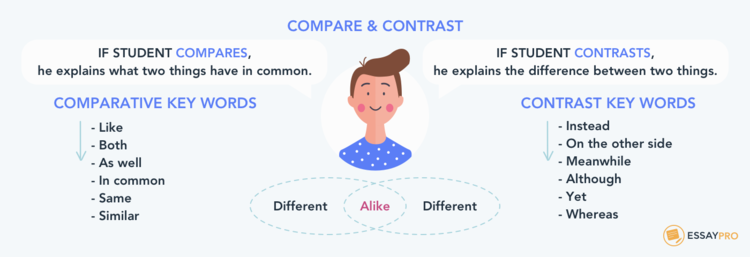
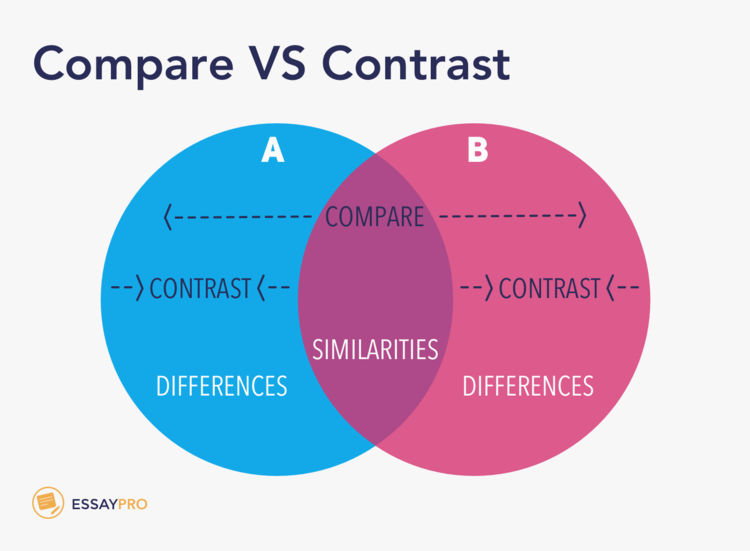
A compare and contrast essay sees the student use critical analysis skills to establish similarities and differences between two or more subjects.
Analyzing and evaluating information is a part of everyday life for a student. That is why being able to write a good compare and contrast essay is such a valuable skill. In this article, we dive into the type of essay with topic examples.

In this article, we dive into the type of essay with topic examples and a few simple writing tips from professional writers.

TABLE OF CONTENTS

  • Compare And Contrast Essay Definition
  • Finding the Best Compare and Contrast Essay Topics For You
  • Finding a Central Theme
  • Compare and Contrast Essay Outline
  • Helpful Final Tips
  • Compare and Contrast Essay Examples
  • Need Urgent Help with Writing?

TABLE OF CONTENTS

Compare And Contrast Essay Definition

So what is a compare and contrast essay? It’s an academic paper in which a student analyses two or more subjects with each other.
To compare means to explore similarities between subjects. To contrast means to look at their differences.

Good compare and contrast papers focus around a central point, explaining the importance and implications of this analysis.

A compare and contrast essay thesis must make a meaningful comparison. Find the central theme of your essay and do some brainstorming for your thesis.

Finding the Best Compare and Contrast Essay Topics For You

Firstly, choose a topic which you’re passionate about. You never want to come across dull and uninspiring in your work.
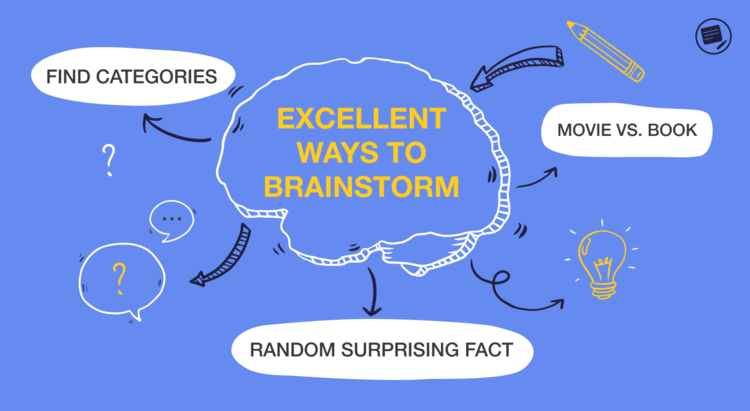
Here are some excellent ways to brainstorm for a topic:

Find categories: Choose a type (like animals, films or economics) and compare subjects within that category: wild animals to farm animals, Star Wars to Star Trek, private companies to public companies, etc.

Random Surprising Fact: Dig for fun facts which could make great topics. Did you know that chickens can be traced back to dinosaurs?

Movie vs. Book: Most of the time, the book is better than the movie – unless it’s Blade Runner or Lord of the Rings. If you’re a pop culture lover, compare movies vs. books, video games, comics, etc.

Looking to steal a topic from us? Here are some good compare and contrast essay topics by our top writers. Feel free to get ideas and get creative!

25 Great Compare and Contrast Essay Topics for College Students

College brings out the individual in everyone. This is the time to look at some challenging and controversial essay topics. Make your writing relatable to the college experience, and you’re guaranteed to gain the attention of your peers.

  • Studying hard vs. studying smart- how do you learn more?
  • Compare an Ivy League college to a standard one.
  • Homeschooling vs. college in 2018.
  • Similarities and differences between a teenager and a young adult.
  • Reading books vs. listening to audiobooks.
  • Native English speakers vs. international English speakers – is there a huge difference?
  • American vs. Japanese school system.
  • American tradition vs. Native American tradition – how are they different?
  • Adderall vs. proper sleep – which helps you study better?
  • Studying home vs. studying abroad.

Sports

Many college students do sports. It balances out the monotony of studying and keeps the mind and body fresh. Here are some excellent sports-related topics:

  • Working out alone vs. going to the gym.
  • Running vs. biking.
  • Traditional sports vs. cybersports.
  • Dota 2 vs. Chess.
  • American sports vs. European sports.

Media

Communications studies include film, journalism, music, art, and much more. Pop culture is an inexhaustible source of compare and contrast essay ideas!

  • Blockbuster movies vs. ‘meaningful’ films.
  • Pop music vs. underground or alternative music.
  • Esthetic art vs. provocative art.
  • The portrayal of heroes vs. villains in pop culture.
  • 50s music vs. 60s music.

History and Politics

Political science presents many topic ideas. Analyzing the definition of ‘justice’ in different countries can generate a debate that will have Plato scratching his head.

  • Compare and contrast Europe before and after the Renaissance.
  • Nazism vs. Soviet Union ‘Communism’.
  • Donald Trump vs. King Jong Un
  • American vs. Ancient Greek Democracy.
  • American North vs. South Upbringing Mentality Before the Civil War.

Finding a Central Theme

When looking at similarities and differences in two subjects, it’s essential to tie your observations into a central theme.
Let’s say we’re looking at Pepsi vs. Marlboro. Without a central issue, the comparison would look like this:

Pepsi produces sugar drinks while Marlboro produces cigarettes.

This is one of the cases when the reader asks “So What?” The central theme is important because it answers that question.
Let’s say we’re looking at Pepsi vs. Marlboro with the central theme of addiction:

“A can of Pepsi shares no similarities with a pack of Marlboro cigarettes at first glance. However, if we look for points of comparisons, we notice that both are mass produced products. Both product designs are iconic, the Pepsi logo, and the Marlboro logo. Both products contain additives that have been found to cause addiction, and their over-consumption can lead to severe health issues. Cigarettes increase the chances of lung disease. Canned soda drinks with a lot of sugar can cause obesity. Marlboro cigarettes have almost erased their logo from the packet and launched anti-smoking ads across the world. On the other hand, Pepsi has gone full retro, releasing bottles and cans with classic 20th-century designs. They frequently sponsor events and promote their company through various means. Can we conclude that Pepsi takes advantage of substance abuse to increase their profit? “

This is a much more detailed comparison because of it all ties to a central theme.

Try it yourself! Find compare and contrast paper ideas and do some brainstorming to find a central theme. This will help you a LOT with forming your argument.

Classic Essay Outline

Before we learn how to write a compare and contrast essay, let’s refresh the classic 5-paragraph-essay structure:

Introduction. The intro must be captivating and present a thesis, stating the purpose and direction of the paper. When thinking about how to start a compare and contrast essay – make it memorable.

Body. Share the main information shown in the essay outline. Introduce a topic sentence in each paragraph, and make every argument flow logically into the next. Make sure you are using the correct compare and contrast essay format!

Conclusion. Summarize your essay and present final thoughts on the compare and contrast essay topic. Offer a solid argument and give the reader something to think about. What was the purpose of this essay? Why was this comparison significant?

Compare and Contrast Essay Outline – Point-by-Point and Block Methods

Compare and contrast papers rely heavily on factual analysis. Two outline methods can help you organize your facts.
Use the block method or point-by-point method to write a compare and contrast essay outline.

Point by Point Method

Intro

  • Introduce the topic;
  • Specify your theme;
  • Thesis – Cover all areas of the essay in one sentence: Cars and motorcycles make for excellent means of transportation, but a good choice depends on the person’s lifestyle, finances, and the city they live in.

Body Paragraph 1 – LIFESTYLE

  • Topic Sentence: Motorcycles impact the owner’s lifestyle less than cars.
  • Topic 1 – Motorcycles
    • Argument: Motorcycles are smaller and more comfortable to store.
    • Argument: Motorcycles are easy to learn and use.
  • Topic 2 – Cars
    • Argument: Cars are a big deal – like a second home.
    • Argument: It takes time to learn to be a good driver.

Body Paragraph 2 – FINANCES

  • Topic sentence: Cars are much more expensive than motorcycles
  • Topic 1 – Cars
    • Argument: Parts and service are expensive if something breaks.
    • Argument: Cars need more gas than motorcycles.
  • Topic 2 – Motorcycles
    • Argument: You can buy a good motorcycle for under 100$.
    • Argument: Fewer parts, more accessible to fix.

Body Paragraph 2 – CITY

  • Topic sentence: Cars are a better option for a bigger city with wider roads.
  • Topic 1 – Cars
    • Argument: Big cities are easier and comfier to navigate by car.
    • Argument: With a car, traveling outside the city is much easier.
  • Topic 2 – Motorcycles
    • Argument: Riding motorcycles in a big city is more dangerous than cars.
    • Argument: Motorcycles work great in a city like Rome, where all the streets are narrow.

Conclusion

Block Method

Intro

  • Introduce the topic;
  • Specify your theme;
  • Thesis – Cover all areas of the essay in one sentence: Cars and motorcycles make for excellent means of transportation, but a good choice depends on the person’s lifestyle, finances, and the city they live in.

Body Paragraph 1

  • Topic Sentence: Motorcycles are cheaper and easier to take care off than cars.
  • Aspect 1 – Lifestyle
    • Argument: Motorcycles are smaller and more comfortable to store.
    • Argument: Motorcycles are easy to learn and use.
  • Aspect 2 – Finances
    • Argument: You can buy a good motorcycle for under 100$.
    • Argument: Fewer parts, easier to fix.
  • Aspect 3 – City
    • Argument: Riding motorcycles in a big city is more dangerous than cars.
    • Argument: Motorcycles work great in a city like Rome, where all the streets are narrow.

Body Paragraph 2

  • Topic sentence: Cars are more expensive but more comfortable for a big city and travelling.
  • Aspect 1 – Lifestyle
    • Argument: Cars are a big deal – like a second home.
    • Argument: It takes time to learn to be a good driver.
  • Aspect 2 – Finances
    • Argument: Parts and service are expensive if something breaks.
    • Argument: Cars need more gas than motorcycles.
  • Aspect 3 – City
    • Argument: Big cities are easier and comfier to navigate by car.
    • Argument: With a car, traveling outside the city is much more comfortable.

Body Paragraph 3

Use the last paragraph to evaluate the comparisons and explain why they’re essential. Giving lots of facts can be intense. To water it down, try giving the reader a real-life application of these facts.

Conclusion

There are other methods of writing a compare and contrast essay, but these two are the most widespread. They are easy to write, and they give a coherent structure to your essay.

Important Details That Will Get You The Top Grade

Now that you’ve got the outline it’s time to create a rough draft.

The devil is in the details. Points get deducted for incorrect use of the format, title, and bad grammar. Make sure you pay attention to the following parts of your essay not to lose points!

Title

The title has to be informative and grab the attention of your reader. If you’re presenting your essay to a class, grab their attention with a joke. In a more serious setting, keep it informative and professional.

Good essay titles are an art, and we have an entire blog post dedicated to essay titles!

Format

Most academic assignments are in MLA format. Use our blog guide to MLA format if you need some reference. It was done by pro essay writers who write in MLA all the time.

Proofreading & Finalizing

After you’re finished writing it’s best to leave your essay for a while.

Come back to it and proofread it with a fresh mind. Also, try giving your piece to a fellow student or parent for an outside opinion.

Helpful Final Tips

The biggest tip we could give you is to have the right attitude when writing a compare and contrast essay and actively engage the reader in the discussion. If you find it interesting, so will your reader!

Here are some compare and contrast essay tips that will help you polish yours up:

  • Compare and contrast essays make powerful use of transitions. Try learning more about transition sentences.
  • Cue words such as ‘likewise, similarly, nevertheless, despite, on the other hand,’ etc., can tell the reader whether you’re comparing or contrasting.
  • Always clarify the concepts you introduce in your essay. Always explain lesser known information – and don’t assume the reader must know it!

Compare and Contrast Essay Examples

You’ve learned what is a compare and contrast essay is. Now let’s take a look at some compare and contrast essay examples to solidify your knowledge. These have been written by our top essay writers and feature all of the structural requirements of a classic academic essay.

  1. COMPARISON BETWEEN THE UNITED KINGDOM AND CHINA

Different countries across the world have diverse cultural practices, and this brings out the difference in work relationships and development. Geert Hofstede came up with a structured way of comparing cultural dimensions…

2. ORGANIC AND NON-ORGANIC FOODS

In fact, the popularity of organic foods has exploded tremendously with consumers spending a considerably higher amount of money on them as compared to the amount spent on inorganic foods. Besides, the US market registered an increase in sales of more than 10% between 2014 and 2015 (Brown, n.p).

Compare and Contrast Essay Topics

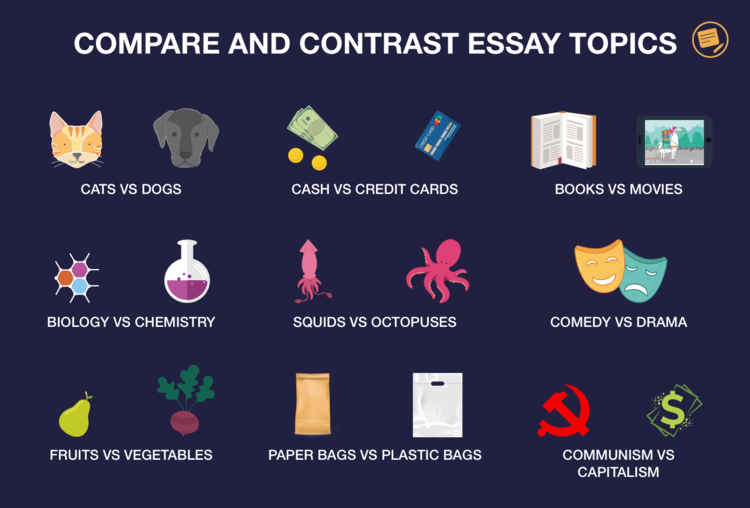
150 GREAT COMPARE AND CONTRAST ESSAY TOPICS

Compare and contrast essays may be hard to write for some. It is a good idea to improve your critical thinking skills.As the idea behind this type of essays is to create analogies to explain certain points. They are not used to emphasise personal opinions. In order to complete the assignment of writing a compare and contrast essay, it is important to approach all kinds of topics.

Consider following our example topics for compare and contrast essay. They are common essay topics that some professors may prescribe. Feel free to use these topics.

How to Choose a Great Compare and Contrast Topic

College students should consider providing themselves with a chance to use all topic examples. With enough revision, an advantage is gained. As it will be possible to compare arguments and contrast their aspects. Also, discuss numerous situations to get closer to the conclusion.

For example:

  1. Choose a topic from the field of your interests. Otherwise you risk failing your paper.
  2. It is a good idea to choose a topic based upon the class subject or specialist subject. (Unless the requirements says otherwise.)
  3. Analyze each argument carefully. Include every detail for each opposing idea. Without doing so, can definitely lower grades.
  4. Write a conclusion that summarizes both arguments. It should allow readers to find the answer they’re looking for.
  5. It it up to you to determine which arguments are right and wrong in the final conclusion.
  6. Before approaching the final conclusion, it’s important to discuss each argument equally. It is a bad idea to be biased, as it can also lower grades.

150 Compare and Contrast Essay Topics to Consider

Compare and Contrast Essay Topics For College Students

When attending a college, at any time your professor will assign you the task of writing this form of essay. Consider these topics for college students to get the grades you deserve.

  1. Attending a College Course Vs. Distance-Based Learning.
  2. Writing a Research Paper Vs. Writing a Creative Writing Paper. What are the differences and similarities?
  3. The differences between a Bachelor’s Degree and a Master’s Degree.
  4. The key aspects of the differences between the US and the UK education systems.
  5. Completing assignments at a library compared with doing so at home. Which is the most efficient?
  6. The similarities and differences in the behaviour among married and unmarried couples.
  7. The similarities and differences between the EU (European Union) and ASEAN (The Association of Southeast Asian Nations)?
  8. The similarities and significant differences between American and Canadian English.
  9. Writing an Internship Report Vs. Writing a Research Paper
  10. The differences between US college and colleges in the EU?

Interesting Compare and Contrast Essay Topics

Some topics for the compare and contrast essay format can be boring. To keep up motivation, have a look at these topics.

  1. Public Transport Vs. Driving A Car. Which is more efficient?
  2. Mandarin Vs. Cantonese: What are the differences between these Chinese languages?
  3. Sports Cars Vs. Luxurious Family Cars
  4. Wireless Technology Vs. Wired Devices
  5. Thai Food Vs. Filipino Cuisine
  6. What is the difference and similarities between a register office marriage and a traditional marriage?
  7. The 2000s Vs. the 2010s. What are the differences and what makes them similar?
  8. Abu Dhabi Vs. Dubai. What are the main factors involved in the differences?
  9. What are the differences between American and British culture?
  10. What does the New York Metro do differently to the London Underground?

Compare and Contrast Essay Topics for High School Students

When writing essays for high school, it is good to keep them informative. Have a look at these topics.

  1. Highschool Life Vs. College Life
  2. Paying College Fees Vs. Being Awarded a Scholarship
  3. All Night Study Sessions Vs. Late Night Parties
  4. Teenager Vs. Young Adult Relationships
  5. Being in a Relationship Vs. Being Single
  6. Male Vs. Female Behavior
  7. The similarities and differences between a high school diploma and a college degree
  8. The similarities and differences between Economics and Business Studies
  9. The benefits of having a part-time job, instead of a freelance job, in college
  10. High School Extra Curricular Activities Vs. Voluntarily Community Services

Compare and Contrast Essay Topics for Science

At some point, every science student will be assigned this type of essay. To keep things at flow, have a look at best topics for all sciences.

  1. Undiscovered Species on Earth Vs. Potential Life on Mars: What will we discover in the future?
  2. The benefits of Gasoline Powered Cars Vs. Electric Powered Cars
  3. The differences of the Milky Way Vs. Centaurus (Galaxies).
  4. Earthquakes Vs. Hurricanes: What should be prepared for the most?
  5. The differences between our moon and Mars’ moons.
  6. SpaceX Vs. NASA. What is done differently within these organizations?
  7. The differences and similarities between Stephen Hawking and Brian Cox’s theories on the cosmos. Do they agree or correspond with each other?
  8. Pregnancy Vs. Motherhood
  9. Jupiter Vs. Saturn
  10. Greenhouse Farming Vs. Polytunnel Farming

Sports & Leisure Topics

Studying Physical Education? Or a gym fanatic? Have a look at our compare and contrast essay topics for sports and leisure.

  1. The English Premier League Compared With The Bundesliga
  2. Real Madrid Vs. Barcelona
  3. Football Vs. Basketball
  4. Walking Vs. Eating Outside with Your Partner
  5. Jamaica Team Vs. United States Team: Main Factors and Differences
  6. Formula One Vs. Off-Road Racing
  7. Germany Team Vs. Brazil Team
  8. Morning Exercise Vs. Evening Exercise.
  9. Manning Team Vs. Brazil Team
  10. Swimming Vs. Cycling

Topics About Culture

Cultural can have several meanings. If you’re an Religious Studies or Culture student, take a look at these good compare and contrast essay topics about culture.

  1. The fundamental similarities and differences between Pope Francis and Tawadros II of Alexandria
  2. Canadian Vs. Australian Religion
  3. The differences between Islamic and Christian Holidays
  4. The cultural similarities and differences between the Native Aboriginals and Caucasian Australians
  5. Native American Culture Vs. New England Culture
  6. The cultural differences and similarities between Italians and Sicilians

&. In-depth: The origins of Buddhism and Hinduism

  1. In-depth: The origins of Christianity and Islam
  2. Greek Gods Vs. Hindu Gods
  3. The Bible: Old Testament Vs. New Testament

Unique Compare and Contrast Essay Topics

What about writing an essay which is out of the ordinary? Consider following these topics to write a compare and contrast essay on, that are unique.

  1. The reasons why some wealthy people pay extortionate amounts of money for gold-plated cell phones, rather than buying the normal phone.
  2. The differences between Lipton Tea and Ahmad Tea
  3. American Football Vs. British Football: What are their differences?
  4. The differences and similarities between France and Britain
  5. Fanta Vs. 7Up
  6. Traditional Helicopters Vs. Lifesize Drones
  7. The differences and similarities between Boston Dynamics and the fictional equivalent Skynet (From Terminator Movies).
  8. Socialism Vs. Capitalism: Which is better?
  9. Curved Screen TVs’ Vs. Regular Flat Screen TVs’: Are they really worth big bucks?
  10. Is it better to wear black or white at funerals?

Good Compare and Contrast Essay Topics

Sometimes, it may be a requirement to take it back a notch. Especially if you’re new to these style of writing. Consider having a look at these good compare and contrast essay topics that are pretty easy to start off.

  1. Is it a good idea to work on weekdays or weekends?
  2. Black of White Coffee
  3. Becoming a teacher or a doctor? Which career choice has more of an impacton society?
  4. Air Travel Vs. Sea Travel: Which is better?
  5. Rail Travel Vs. Road Travel: Which is more convenient?
  6. What makes Europe far greater than Africa. In terms of financial growth, regulations, public fund, policies etc…
  7. Eating fruit for breakfast Vs. cereals
  8. Staying Home to Read Vs. Travelling the World During Holidays. Which is more beneficial for personal growth?
  9. Japanese Vs. Brazilian Cuisine
  10. What makes ASEAN Nations more efficient than African Nations?

Compare and Contrast Essay Topics About TV Shows, Music and Movies

We all enjoy act least on of these things. If not, all of them. Why not have a go at writing a compare and contrast essay about what you have been recently watching or listening to?

  1. Breaking Bad Vs. Better Call Saul: Which is more commonly binge watched?
  2. The differences between Dance Music and Heavy Metal
  3. James Bond Vs. Johnny English
  4. Iron Man Vs. The Incredible Hulk: Who would win?
  5. What is done differently in modern movies, compared to old black and white movies?
  6. Dumber and Dumber 2 Vs. Ted: Which movie is funnier?
  7. Are Horror movies or Action Movies best suited to you?
  8. The differences and similarities between Mozart and Beethoven compositions.
  9. Hip Hop Vs. Traditional Music
  10. Classical Music Vs. Pop Music. Which genre helps people concentrate?

Topics About Art

Sometimes, art students are required to write this style of essay. Have a look at these compare and contrast essay topics about the arts of the centuries.

  1. The fundamental differences and similarities between paintings and sculptures
  2. The painting different styles of Vincent Van Gogh and Leonardo Da Vinci.
  3. Viewing Original Art Compared With Digital Copies. How are these experiences different?
  4. 18th Century Paintings Vs. 21st Century Digitally Illustrated Images
  5. German Art Vs. American Art
  6. Modern Painting Vs. Modern Photography
  7. How can we compare modern graphic designers to 18th-century painters?
  8. Ancient Greek Art Vs. Ancient Egyptian Art
  9. Ancient Japanese Art Vs. Ancient Persian Art
  10. What 16th Century Painting Materials were used compared with the modern day?

Best Compare and Contrast Essay Topics

Almost every student at any stage of academics is assigned this style of writing. If you’re lacking inspiration, consider looking at some of the best compare and contrast essay topics to get you on track with your writing.

  1. The United States and North Korea Governmental Conflict: What is the reason behind this phenomenon?
  2. In the Early Hours, Drinking Water is far healthier than consuming soda.
  3. The United States Vs. The People’s Republic of China: Which economy is the most efficient?
  4. Studying in Foreign Countries Vs. Studying In Your Hometown: Which is more of an advantage?
  5. Toast Vs. Cereal: Which is the most consumed in the morning?
  6. Sleeping Vs. Daydreaming: Which is the most commonly prefered? And amongst who?
  7. Learning French Vs. Chinese: Which is the most straightforward?
  8. Android Phones Vs. iPhones
  9. The Liberation of Slaves Vs. The Liberation of Women: Which is more remembered?
  10. The differences between the US Dollar and British Pound. What are their advantages? And How do they correspond with each other?

Easy Compare and Contrast Essay Topics

In all types of academics, these essays occur. If you’re new to this style of writing, check our easy compare and contrast essay topics.

  1. The Third Reich Vs. North Korea
  2. Tea Vs. Coffee
  3. iPhone Vs. Samsung
  4. KFC Vs. Wendy’s
  5. Laurel or Yanny?
  6. Healthy Lifestyle Vs. Obese Lifestyle
  7. Forkes Vs. Sporks
  8. Rice Vs. Porridge
  9. Roast Dinner Vs. Chicken & Mushroom Pie
  10. What’s the difference between apples and oranges?

Psychology Compare and Contrast Essay Topics

Deciding upon good compare and contrast essay topics for psychology assignments can be difficult. Consider referring to our list of 10 psychology compare and contrast essay topics to help get the deserved grades.

  1. What is a more severe eating order? Bulimia or Anorexia
  2. Modern Medicine Vs. Traditional Medicine for Treating Depression?
  3. Soft Drugs Vs. Hard Drugs. Which is more dangerous for people’s psychological well-being?
  4. How do the differences between Lust and Love have an effect on people’s mindsets?
  5. Ego Vs. Superego
  6. Parents Advice Vs. Peers Advice amongst children and teens.
  7. Strict Parenting Vs. Relaxed Parenting
  8. Mental Institutions Vs. Stress Clinics
  9. Bipolar Disorder Vs. Epilepsy
  10. How does child abuse affect victims in later life?

Compare and Contrast Essay Topics for Sixth Graders

From time to time, your teacher will assign the task of writing a compare and contrast essay. It can be hard to choose a topic, especially for beginners. Check out our easy compare and contrast essay topics for sixth graders.

  1. Exam Preparation Vs. Homework Assignments
  2. Homeschooling Vs. Public Education
  3. High School Vs. Elementary School
  4. 5th Grade Vs. 6th Grade: What makes them different or the same?
  5. Are Moms’ or Dads’ more strict among children?
  6. Is it better to have strict parents or more open parents?
  7. Sandy Beaches Vs. Pebble Beaches: Which beaches are more popular?
  8. Is it a good idea to learn guitar or piano?
  9. Is it better to eat vegetable salads or pieces of fruit for lunch?
  10. 1st Grade Vs. 6th Grade

Funny Compare and Contrast Essay Topics

Sometimes, it is good to have a laugh. As they always say : “laughter is the best medicine”. Check out these funny compare and contrast essay topics for a little giggle when writing.

  1. What is the best way to waste your time? Watching Funny Animal Videos or Mr. Bean Clips?
  2. Are Pug Dogs or Maltese Dogs crazier?
  3. Pot Noodles Vs. McDonalds Meals.
  4. What is the difference between Peter Griffin and Homer Simpson?
  5. Mrs. Doubtfire Vs. Mrs. Brown. How are they similar?
  6. Which game is more addictive? Flappy Bird or Angry Birds?
  7. Big Shaq Vs. PSY
  8. Stewie Griffin Vs. Maggie Simpson
  9. Quarter Pounders Vs. Big Macs
  10. Mr. Bean Vs. Alan Harper

Creative Essay

HOW TO WRITE A CREATIVE ESSAY

Creative writing is one of the most open-minded, and free-spirited writing prompts that a student will face in either high school or college. This essay falls into the category of narrative essays, since it gives students the freedom of self-expression, and trains them to stretch their imagination. In other words, this would be the antonym of an analytical or persuasive essay, because it does not use technicalities.

TABLE OF CONTENTS

  • What Is A Creative Essay?
  • Topics
  • General Tips Pre-Writing
  • Title
  • Outline
  • Post-Writing Tips
  • Example

What Is A Creative Essay

As stated previously, this is a style of essay that forces a student to look past guidelines and set structures. In this scenario, your job is to create a story. Not just any story, but one that has an interesting plot as well as a compelling path! The beautiful thing about this is that there are not any topic restrictions; you actually get to be creative! Sometimes, a professor may narrow down the topics into an individual category, but when it comes to writing out the paper, you must create your own path!

Topics And Ideas

Before putting yourself into work, you should pick the right paper topic that you will be talking about. Here we got some fresh creative essay topics from our top writer to make your choice easier:

  • Explain an event in your life that spiraled out of control and flipped its course.
  • Create a scenario that directs the end of the world.
  • Camouflage the concept of love in a story that is completely irrelevant.
  • Design in a story in which one person’s beliefs or ideas helped reform the future of society.
  • Propose a scenario in the distant future in which technology controls all.
  • Describe something that you can’t live without; it might be your hobby or a thing that you are dedicated to.
  • Express your thoughts about a topic that hurts you.
  • Imagine that you became invisible for one day, what would you do?
  • What would your reaction be if one day you woke up in someone else’s body

Naturally, you can create one that is completely unique to you and the ideas that you form. These are here to get you started on the right path towards a brilliant story!

General Tips Pre-Writing

I know, you might be eager to start jotting down notes and ideas right away since this is such a liberating assignment, but it would be intelligent to organize your efforts. Here are some creative writing steps to take before you start working on the next Wizard of Oz!

  • Choose Your Subject/Topic: Before you begin anything else, set your telescope on the theme that you would like to write about. It does not necessarily have to be one that you are well-versed in; rather, pick a topic that intrigues you but also one that can teach you a thing or two. This leads us to our next step!
  • Do Some Research: Even if you have chosen a subject that is second nature to you, it is always important to investigate deeper into the topic. Every time you start carefully studying an issue, you will find more facts and key points that will be included in your creative masterpiece! Use several sources and mix them together to create the best sounding story of your writing career!
  • Plan Out the Essay (How, What, When, Where, Who): These are five questions that must be answered while typing out your story. Make sure that a precise setting is introduced and keep your audience tuned into the story. Boredom is your worst enemy! * Formatting the story ahead of time allows for a clear thought process as well as having an excellent preview of what is to come.
  • Record Ideas (Keep a Log): Outside of the time that you are working on the story, it is a good idea to keep a journal. Sometimes, out of the blue, thoughts and ideas will come into your mind that could improve the style of your essay. Even if it may seem unfitting, writing them down at a constant rate could mix two ideas that create something exceptional!
  • Write a rough draft: Try to focus on the flow of the information and put some of your ideas on paper in chronological order, don’t hurry, stay cool-headed and from time to time reread what you have already written.
  • Put everything in right order: Read your rough draft again, exclude all unnecessary information, lay out your thoughts in chronological order, watch the flow of your ideas, provide a smooth transition from one idea to another, your essay shouldn’t be messy.
  • Start Writing the Essay: Once you have a format that is satisfactory, it is time to put pen to paper (or fingers to keyboard) and gradually build your tale. As you use your structure to guide you along the way, it may be possible that things do not flow as nicely as you may have expected. This is not a problem and editing the planner is definitely an easy and effective way of making sure that the writing is still focused on your initial plans.

Title

When you have already chosen what you are going to write about, you should design a creative essay title. It’s a big question, which might take you plenty of time to think of about. Below you will be able to find some tips, the purpose of which will be simplifying the creation of the best title.

  • First and foremost your title should be catchy, the purpose of the title is to grab the reader’s attention as soon as he had read the title.
    One way of doing it is to use a “flashback” as the title of your creative essay, and it will let your future readers understand what kind of story you have written.
  • The other one is summing up the story that you have written in three words. If your essay is about love, your title might be “Love, Hate, Despair: The story of a broken heart.”
  • Likewise, you may use any quote which relates to your essay in general, but still, this quote should be powerful enough to grab your reader’s attention.
  • Also, your title may be the main idea of your essay, for example, if your essay is about your hobby or your biggest passion in life, then title may be “The quintessence of my life“

Outline

The creative essay outline follows the standard essay structure. It consists of an Introduction, a Body, and a Conclusion. Each one plays a major role in plot development, and the amount of variety that exists in the formatting of this essay is quite large! However, the most effective and commonly used procedure is the Oxford method which introduces the 3-Point-Structure. This involves: The Set Up -> Confrontation -> Resolution.

  • Set Up: Usually written in the intro, the set up includes the establishment of the characters and their relationships to each other. Who are friends with who? What are the predetermined connections between the members of the group? Allow the readers to start inferring about plot development with the information that you have laid out.
  • Confrontation: Written in the body, the story must have a Turning Point. This is a point of conflict where smooth sailing turns into a heavy storm. This moment can be expected by clue-giving plot development or can come out of nowhere. That depends on what you as the writer decide to do. For example, you can start hinting that things feel eerie and off in the plot but then straighten everything back to normal without changing anything major. Or, the story could be advancing smoothly, and all of a sudden, something major happens, and the plot makes a sharp turn!
  • Resolution: After passing the turning point, the drama in the story will have sharpened and slowly settled down. At some eventual point, the drama will kick up back up again and will reach a peak moment! Now, this can either be at the very end of the story (cliffhanger), or this can be told somewhere in the middle or beginning. Once again, this depends on you as the writer!

Introduction:

As with any narration, the first step that must be performed is setting up the scene. Describe the time of day, place or location, and give a background of the current situation. This initial set up is vital because it sets the mood and flow of the entire story. That being said, make sure to spark up the setting as much as possible to create an excellent illustration in the reader’s mind. Use vivid details; things such as personifications, metaphors, and symbols are a great way to shake up the story from the start! A very common tactic used by famous writers is to throw the reader right into the action. For example, the story could start out with somebody getting murdered, or it could be a flash forward into an event that will occur later on. Since this is your story, create an intro that is exciting to read and make it unique in accordance with your style!

Body Paragraph:

The bodies are used to develop the plot and move the story forward. However, these paragraphs can also be used to change up the mood and tempo. Since your great introduction set the base for those two aspects, it is not a bad idea to change it up. For example, if the story is moving at a slow rate, as the author you can input the confrontation right then and there. This catches the reader off guard and switches up the mood and tempo of the narration. You can also create a false confrontation, keeping your readers on their toes.

Pro Tip: Make Sure to Use Transitions! Words such as however, therefore, but and also are good ways to transition from one thought to another. What makes them especially useful in creative writing is the fact that they push emphasis onto whatever event that you are bringing about. This allows for more drama and suspense, while also keeping the story flowing smoothly!

Conclusion:

The conclusion usually allows the writer to tidy up the plot. Create a set-up, present a confrontation and sum things up with a resolution. Most of the time, the conclusion will not build up to the peak of the story, but many professional writers use cliffhangers. This is a writing technique that allows the author to leave the story unfinished and leave the audience in a cloud of suspense, never to be truly discovered. Movies and TV shows such as Inception, The Sopranos and 28 Days Later use this fascinating technique, and although it may seem infuriating, it is a brilliant way to end a story…. Or not! Overall, the goal of the conclusion is to leave a strong impression in the reader’s mind!

Post-Writing Tips

Immediately after finishing your work of art, take a mental break (trust me it is necessary). As a writer, you have drained a lot of mental energy on creating a story that is unique and exciting to read, so take some time off and remove your eyes from the screen! Afterward, make sure to do three essential tasks to have a fully finished custom creative essay!

  • Re-Read and Check the Tempo: When initially writing out the intro, the narration started out a certain pace. As the plot progressed, so did the flow of the story; it may have sped up or slowed down. The point is to make sure that the flow is satisfactory. On the one hand, having a bored reader is no fun, but neither is having one that cannot process everything being hurled at him!

  • Check for Grammatical Errors and Use a Thesaurus: Remember we talked about using vivid details? Yeah, this is rather important, so throwing a thesaurus into your game is not a bad idea as it adds style points to the story and allows you to explain things in a more illustrious manner. Also, having grammatical errors is never a good thing in any essay, so make sure they do not interrupt with the reader’s comprehension of your narration.
  • Have a Peer to do some Proofreading: It is practically impossible to catch every mistake you make as a writer. Have a friend or your teacher proofread your work for two main reasons: the first is to eliminate any unnoticed grammatical mistakes, and the second is to make sure the story makes sense to an outside party. Sure, as the writer, you know what you are trying to say, but a different brain may have trouble comprehending your word painting. If both of those traits are perfect, then you will have a second pair of eyes to let you know that it is good to go!
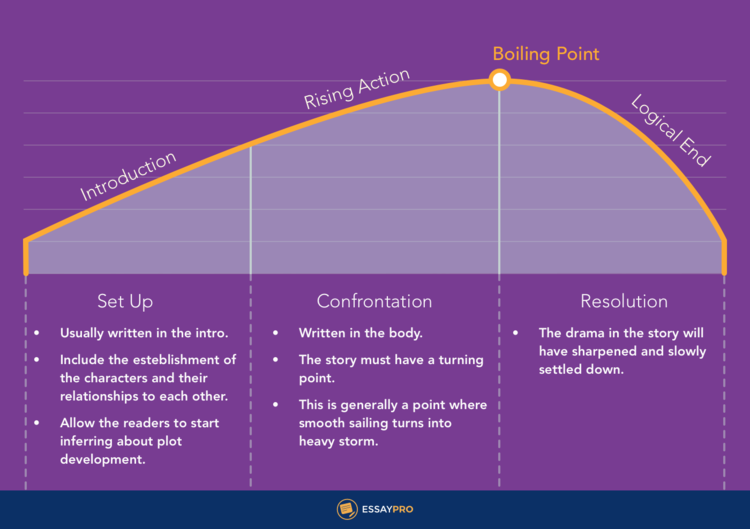
Example Of A Creative Essay

DOWNLOAD

Critical Essay

HOW TO WRITE A CRITICAL ESSAY

University instructors require students to write a critical analysis of a research paper, painting, literary piece, etc. Why is critical thinking an important skill? Students in the fields of Science & Arts have to make an expert analysis of previous works because these analyses will prove how well they have mastered a certain profession and use it as a basis to dissect work. What is a critical analysis essay?

TABLE OF CONTENTS

  • Definition
  • How to Write a Critical Analysis Essay
  • Outline
  • Writing an Introduction
  • 25 Critical Thinking Essay Topics
  • Examples

What is Critical Analysis Essay?

A critical analysis essay is best defined as an academic paper designed to understand a certain written work. What is critical thinking? It is an ability to think rationally and logically about various actions or beliefs. This kind of writing is subjective because a writer has to express personal opinions and share an experience as evaluation. Two major steps you have to make in this kind of essay are Critical Reading & Writing. How to write a critical analysis paper? You should be able to express personal opinions based on experience.
A critical thinking definition is basically the same as a critical essay meaning – it is a part of the process required to carry out an analysis paper. The tips below will help the students to understand the main idea of this type of academic writing with the help of vivid examples and guides.

How to Write a Critical Analysis Essay?

The initial step mentioned earlier in a critical path analysis is thorough reading. To read critically, identify the author’s purpose and analysis. Take note of the passage’s main ideas and the paragraphs supporting the main idea. Consult proper reference materials (both primary like books and secondary like interviews) for things that you do not comprehend. Write a description, outline, and a summary of the work. It’s important to consider the written work’s purpose (whether it is factual and if it is written to entertain). Is it written to express an opinion? Asking these questions will help you write and synthesize and evaluate if the author has achieved the purpose of his or her written work.

Critical Analysis Essay Outline

Most instructors will provide a sample outline to help students write a well-organized critical analysis. These outlines serve as a skeleton of how you want your written work to be structured. Before writing an academic paper, make sure you have an outline which organizes your thoughts into a coherent essay structure. If you are not provided with an outline, you can follow this outline below:

  • A hook sentence (optional). This one is to grab your reader’s attention.
  • Background Information: This is to make readers have an understanding or an overview of the work you’re going to evaluate. This is to ensure that important details are provided. This is an important part of the critical analysis essay because this will be your basis for evaluation.
  • Information about the work:
  • Title
  • Author
  • Publication information
  • Statement of topic and purpose
  • Thesis statement indicating writer’s main reaction to the work
  • Summary: This is another fundamental part of the critical analysis because to create a summary, you have to read critically.
  • Interpretation: Writing this part will vary from person to person. This interpretation should be subjective meaning it should be based on writer’s experiences and honest opinions based on the primary sources be it negative or positive. The way you will evaluate in this part of the essay will reflect who you are and your proficiency.
  • Discussion of the work’s organization
  • Discussion of the work’s style
  • Effectiveness
  • Discussion of the topic’s treatment
  • Discussion of appeal to a particular audience
  • Conclusion: After the body of your work, restate the thesis statement to remind the readers about the main point, summarize the arguments (topic sentences of each body paragraph), provide some implementations or forecast for the future, and finish with a hook sentence. It is best to end up with a rhetorical question.

Your project should answer the following questions:

Is there a controversy surrounding either the passage or the subject which it concerns?
What about the subject matter is of current interest?
What is the overall value of the passage and what are the strengths and weaknesses of the assessed piece of literature or another work of art?

Take note of the rubrics or guide questions given to you. These are meant to make sure you will not miss details in your analysis. Support your statements with the text given to you; remember that the purpose of the critical analysis is not merely to inform, but also to evaluate the worth, utility, excellence, distinction, truth, validity, beauty, or goodness of something. Although, you will be expressing your opinions, make sure that you will be fair and well informed. Explore different sides of the analysis yet stand firm on what you believe in. Express your opinions honestly. Your review should provide information, interpretation, and evaluation so that the offered information will help your reader understand the nature of the work under analysis. The interpretation will explain the meaning of the work, therefore requiring your correct understanding of it. The evaluation will discuss your opinions of the work and present valid justification for them.

Critical Analysis Essay Introduction Example

You need more than critical thinking skills alone to come up with the successful paper. It is important to stay creative. The best place in the text to show your creativity is an introduction. Start with a powerful hook sentence to catch an eye of the reader from the initial line:

  • A fact
  • Statistics
  • An allegory
  • A literary quote
  • A metaphor
  • A simile
  • A quotation of a famous person
  • A joke
  • An anecdote
  • A rhetorical question

The main idea is to make the readers understand why the research question matters. The goal is to make them WANT to read the full paper. This way, the teachers will be able to assess the work objectively. Here is a critical analysis essay introduction example to give you a hint:

“You know you’re in love when you can’t fall asleep because the reality is finally better than your dreams.” These words by Dr. Seuss describe this eternal feeling the best. Love is an emotion which all people have a concept of. At the same time, the majority of people may insist they have experienced the feeling of true love despite the accepted definition of this chemical reaction. Does a pure love exist? How can an average citizen of any country identify this contradictory feeling best of all? This paper examines the concept of love based on Shakespeare’s Sonnet 116.”

25 Cool Critical Analysis Essay Topics

Except for the advanced critical thinking skills, one has to possess great research skills to find some interesting topics to evaluate. Decide which topic suits critical thinking process the best. Make sure there are enough sources available in free access to provide evidence for your arguments. Consult the teacher to make sure the idea is relevant. The issue should be trendy and related to the studied subject.
Here are some of the top critical analysis essay topics to consider:

Culture Critical Thinking Topics

  1. Drug use in sports
  2. The role of college football in student’s academic performance
  3. Homelessness among young people in the US
  4. Anti-meth campaign and its consequences
  5. The difference in communication between males & females

Mass Media Topics

  1. Analyzing a film on a comic book
  2. Evaluating the best wedding dress TV show
  3. Observing the remake of a classic motion picture
  4. Examining the influence of the popular TV series on youth
  5. Selecting a favorite cooking program

Critical Evaluation Topics on History

  1. Secrets of the Ancient Greeks
  2. Colonization of the modern US territory
  3. Studying the pyramids of Giza
  4. Assessment of the Vikings trip to American in IX century
  5. The true origins of the Liberty Statue

Culture Critical Thinking Topics in Literature

  1. The way irony is used in Mark Twain’s stories
  2. The conventions of a specific genre (example: anti-utopia)
  3. Studying a setting in “The Lord of the Rings”
  4. The mood of Orwell’s “Animal Farm”
  5. The use of allegory in Shakespeare’s art

Culture Critical Thinking Topics in Sports

  1. Sports as they are shown by mass media
  2. Raising and Olympian
  3. The effectiveness of betting on sports
  4. Video gaming in the XXI century
  5. The significance of indoor games for children

Examples

You could go on and search for critical analysis examples if you were not given one in class. These examples should answer some of your questions. Avoid opening statements like “I think…” and “In my opinion…” Your essay should focus on the assessment itself and not on you.

DOWNLOAD

Definition Essay

HOW TO WRITE A DEFINITION ESSAY

When a new word catches your attention, naturally, the first reaction is to look it up in a dictionary. If you are extra curious about it, you may even research the term online to see its origins. After researching the term online, you find a proper definition that seems logical enough. This is the usual process of learning new words!

However, in some cases, a brief description of a term is not enough. Some words have complex and deep meanings and require an in-depth explanation. This is what the definition essay is all about!

TABLE OF CONTENTS

  • What is a Definition Essay
  • Types of Definitions commonly used in Definition Essay
  • Interesting Topics
  • Definition Essay Outline
    • Introduction
    • Thesis Statement
    • Body Paragraphs
    • Conclusion
  • Post-writing Tip

What is a Definition Essay?

This type of paper involves writing a formal explanation of one specific word. It is important to note the fact that this is an essay, which means you can not pick a simple term that can be described in a few words.

Definition essay is meant to describe a complex term that has significant background and historical origin and be a relatable term.

A word “love” is an excellent example of such term as it is seemingly impossible to explain this concept very briefly. This gives us a room to write an essay about it, which would give it an accurate and UNIVERSAL representation!

Approaching a Definition Essay

So you have found an exciting term with a complex background worth delving in to? Before you decide to make it a subject for your definition essay, consider what you can do with it.

Here are some ways to approach your definition essay:

  • Analysis: Break the subject into parts and define each element individually.
  • Classification: What classes does the issue belong to?
  • Comparison: Unusual things may be determined by showing its likeness to the common or its contrast from it.
  • Details: What are the characteristics and other distinguishing features that describe the idea of the paper?
  • Negation: Explain what it isn’t to clear the ground for what it is.
  • Origins and Causes: What is the origin of the theme? What is the background information? What is the history of the idea?
  • Results, Effects, and Uses: Describe the after effect and uses of the subject.

Interesting Defintion Essay Topics to Consider

  • What makes someone a Hero
  • Compare Love and Hate. Which one is a stronger emotion?
  • Analyze the definition of Beauty.
  • What is the opposite of Respect? Explain why.
  • How did a term Fidelity originate?
  • What are the origins of a term Parlay?
  • What is the opposite of Happiness and why?
  • How to describe Integrity?
  • Characterize an Antihero
  • What are the defining attributes of Royalty?
  • What makes someone a Villain and why?
  • What are the origins of the word Zenith?

These are just some common examples of definition essay questions and topicsthat is commonly asked on tests and coursework assignments. The goal here is to pick the best definition essay topic that as a student you feel comfortable explaining and portraying. It is time to become a word artist!

Steps to take Pre-Writing

Before you begin your writing, make sure that the word you chose to write about is worth writing about.

Here are a few tips to consider before choosing your golden term!

  • Choosing a Proper Term:
    • It is not productive to try to squeeze out an essay out of a simple word.

The Word Should be Multi-Dimensional:

  • Avoid using terms that are universal in every language!

Term Intimacy:

  • Choose a word that you know well and be confident in your essay!

Use history background on your definition essay:

  • The origin or etymology of a word has some historical reason for being the shape it is.

Definition Essay Outline

Every definition essay should be written in the classic Intro-Body-Conclusion format. According to the definition essay structure the introduction should address the central question within a thesis statement.

Depending on the term, however, the body part of a definition essay outline may vary in length and should include all of the points made by the writer as the conclusion should summarise all of the main ideas and suggest anything that can be done in future.

Introduction

In a definition essay, the introduction has two goals. You must give a “standard”, or the most common definition of the term, and introduce your thesis.

The initial section of the introduction should state the dictionary version. Because the standard definition will slightly vary from the thesis one, which allows for multi-dimensionality!

Thesis Statement

Your thesis statement is a part of introduction. For definition essay, the thesis is your version of what the term means. This can be a mix of the standard definition and your personal experiences and explanation style! Keep it short. Do not try to describe too much in this section. This is where you transition to the body of the essay.

Body Paragraphs

Break down the term into its core parts in the body of your essay. Analyze the term from different angles and provide relevant explanation. More than three paragraphs may be necessary depending on the nature of your assignment.

Here is an example of a good body paragraph structure:

  • Body Paragraph 1: History and Origin
  • Body Paragraph 2: Full dictionary explanation and use.
  • Body Paragraph 3: Personal definition created from experience.

Conclusion

Keep the conclusion simple. The main goal here is to summarize the main points of your argument. Rephrase your thesis as well as the main parts of the definition and sum up everything you said in the body of the essay.

The last thing that should be mentioned in your definition paper outline is how this term has impacted you. Usually, before even writing the essay, there is a reason a specific word is picked, and part of the reason has to do with personal experience.

Post-writing Tip

Mention how the definition you were talking about affected you.

If the term you define plays a specific part in your life and experiences, your final concluding comments are a great place to mention the role it plays concisely.

  • Thesis. Think about the purpose of the argument to form the thesis. The thesis being the claim of the paper.
  • References. Choose the most appropriate references.
  • Outline. Develop a Definition Essay Outline
  • Proofread. Remember to proofread your finished definition essay to make sure there are no typing errors – that can lower your grade.
  • Editing. It’s a good idea to make any necessary changes to the definition essay once proofread.
  • Sources. Remember that sources control the essay. Meaning, never choose inappropriate sources, so the audience doesn’t misinterpret the paper.

Definition Essay Examples

Here are some definition essay examples. Pay attention to the structure of these essays. Any of these essays can also be used as a definition essay template if you wish to have the same structure and format for your essay.

1. SUCCESS

Different people have different meanings of the meaning of success. In order to define critically the real meaning of success, maybe the first and most significant recognition, which any person can make, is that there exists no single defined formula, which outlines the way to personal success.

2. WHO IS A HERO

The term hero has been in use in the society for the longest time in history. Most of the fairy tales and other Disney productions revolve around the title as portrayed in the fictional characters. People use the term hero as a compliment in different contexts.

3. BEAUTY DEFINITION

Beauty is a simple word that has several definitions depending on the individual and the subject at hand. It is an abstract word that is mostly used to describe something that brings happiness or pleases an individual.

Descriptive Essay

HOW TO WRITE A DESCRIPTIVE ESSAY

…and so we lit a bonfire, purging the shadow from the forest.

Words can paint an image worth millions. Writers like Stephen King and Charles Dickens have created entire worlds using descriptive writing techniques.

descriptive essay is your gateway to immersive writing. Whether it’s for brilliant copywriting (For sale: baby shoes, never worn. – Hemingway), or great prose – learning how to write a descriptive essay will catapult you to storytelling heights.

In this article, we examine the descriptive essay and present a step-by-step writing guide. Stick around for helpful writing tips near the end!

TABLE OF CONTENTS

  • Descriptive Essay Definition
  • Descriptive Essay Topics & Ideas
  • Descriptive Essay Outline
    • Introduction
    • Body Paragraph(s)
    • Conclusion
  • Writing and Reviewing Your Descriptive Paper
  • Free Descriptive Essay Examples

What is a Descriptive Essay?

The descriptive essay definition explains that this paper is a type of composition which describes an object, a person, a process or an event.

The writer’s goal is to create:

  • vivid reading experience;
  • to show instead of telling.

Descriptive writing usually appeals to the five senses: taste, touch, smell, hearing, and sight. (Ex: Jack’s coffee mug exploded into tiny shards of glass, catching the attention of everyone at the office.)

Always appealing to the senses is key to writing a good descriptive essay.

Here’s a list of what your descriptive essay could be about:

  • People
  • Places
  • Memories
  • Experiences
  • Objects

When writing the descriptive essay, your goal will be to paint a comprehensive picture for the reader, appealing to the five senses.

Last but not least, your essay should have a purpose. It could be anything from a lesson you learned from experience to a story of how an object impacted your life.

It’s all about making your bright ideas come to life!

Descriptive Essay Topics & Ideas

Finding descriptive essay topics isn’t hard. You can describe pretty much anything, from your favorite car to the weather today.

We’ve gathered some ideas to help you get started. Hopefully, you’ll find good descriptive essay topics which will spark your imagination!

Choosing a person to describe

One idea for a topic is to describe a person. Choose a person who you know well; doing this gives you a lot to write about.

  • Family members, friends, teachers, etc.
  • A celebrity who exposes most of their private life to the media: The Kardashians, Kanye West, Taylor Swift, etc.
  • A famous superhero like Spider-Man. Such fictional figures have undergone many character studies from both academic and non-academic perspectives.

Describing an Object or a Place

You may also describe an object or a place with which you have a significant connection. This could be your high school, a playground, or a toy which used to scare you as a kid. Fictional places also count!

  • The city where you grew up
  • Buckingham Palace
  • A place that gives you the creeps
  • Your favorite dream car
  • Harry Potter’s wand

Describing an Emotion

Remember the most sincere emotion and turn it into a descriptive essay. You may choose a strong feeling like anger, happiness, loss, desire, or rage. It doesn’t have to be a personal emotion; it could be an observation.

  • Brotherly love
  • Kid getting frustrated while playing a video game
  • Feeling on top of the world

You can write a descriptive essay about anything you can describe according to human senses: touch, sight, taste, smell and hearing!

Creating a Descriptive Essay Outline

When thinking how to write a descriptive essay, remember that a structured paper outline is your golden ticket. Not only does it help you organize thoughts, but it will also help your essays flow better!

descriptive essay outline is composed of the following: an introduction, a body, and a conclusion. It is important to spent enough time considering the victim of description, because all of your illustrations will be based around it.

Introduction

The introduction serves to introduce your subject to the reader and give them enough context to fully understand your essay, but keep it brief and interesting to the reader.

When learning how to write a descriptive essay introduction, remember – the first paragraph of your paper is the part that makes your descriptive essay stand out from the others.

As with any college paper, a descriptive essay introduction must contain the following points:

  • Hook Sentence: Although the entire essay should be full of exciting and vivid descriptions, grabbing the reader’s attention from the very beginning is ideal!
  • Context / Background Information: Tell the reader what you’re about to describe and explain why it is crucial to you. Give them a brief context for your paper.
  • Thesis Statement: The descriptive essay thesis should be a short, but concise summary of the essay. It must include the subject of description, and your purpose for describing it.

For further information on how to write a thesis for a descriptive essay, check out the examples below.

PLACE
If you were writing an essay about Buckingham Palace: “Even though monarchy is long gone, Buckingham Palace serves to remind us of the aesthetic beauty which that era built.”

PERSON
For an essay describing Spider-Man: “The defining characteristics of Spider-Man are his youthfulness, New York City, and the fact that he talks to himself more than Hamlet.”

EMOTION
An essay about a personal experience of fear: “For many reasons, the dark forest is my greatest fear, though not a fear which is necessarily smart to face.”

Body Paragraph(s)

There are usually three body paragraphs in an essay. They cover three different points or arguments.

How many body paragraphs to include in your descriptive essay is entirely up to you. Sometimes it takes a sentence to tell a story while other times it takes books.

How to start a body paragraph for a descriptive essay:

  1. Start with a topic sentence: The orange looks familiar; it is around citrus fruit whose color matches its name.
  2. Sensory details: When describing the orange, appeal to relatable senses.
  3. Include actual details: Always include descriptive information within your body paragraphs.
  4. Finish a body paragraph by introducing the next: Transition sentences are essential because they create immersion within your writing. Better than reading a list of facts.

Conclusion

  • Reflection is Key: The first thing to do in the end is to reflect on the initial purpose of the essay. Spill the beans on why you decided to write about this subject, and how this subject has affected your life.
  • Signify the Importance of the Details: Next, go over some key moments of the essay. Give a summary of what you have covered, and prepare the audience for the clincher statement.
  • Clincher Statement: The clincher is the final sentence which reinforces an overall purpose or leaves your audience with an intriguing thought, question or quotation.

You’ve probably spent a lot of time thinking of a hook to pull the audience in! Do NOT allow the essay to escape their thoughts right after they finish reading it.

Here’s an excellent descriptive essay conclusion example for your reference.

According to the descriptive essay format, the conclusion should be a summary of all of the main points in the body text.

It’s a good idea to write a final sentence related to the main point.

Once this is done, the paper is now complete. It is advisable to proofread the descriptive essay to correct any grammatical errors.

Writing and Reviewing Your Descriptive Paper

The secret to writing great papers lies in the final step: reviewing your paper.

After you finish writing, take a break. It’s always best to clear your mind before editing your paper. When you come back to your descriptive essay, here are the questions to ask yourself:

  • Have you provided enough context in the introduction?
  • Is the paper easy to read?
  • Does the thesis correlate with the content of the paper?
  • Does the paper feature vivid, descriptive language?
  • Will the clincher statement leave a lasting impact?
  • Overall, if you were the reader, would this paper make sense to you?
  • Are there no problems with grammar and punctuation?

Sometimes web applications like Grammarly or Hemingway app can help you sort your grammar. However, it’s always best to master the rules yourself and become the best writer you could be.

When you’re convinced you to have the final draft, read it out loud or give it to a friend. Sometimes you need some constructive criticism to tie up loose ends in your writing.

Descriptive Essay Good Examples

DOWNLOAD

DOWNLOAD

This is a commonly assigned and most opted-for form of an essay. Why not have a look at our written descriptive essay examples. In this section, you can find some of the top examples and quotes followed by some critique.

Example # 1

“Last but not least, when it comes to the other archeological element which is the ectofact; representing remains from plants and animals. The archeologists in the course of their excavations will find some animal faeces, indicating that there was the existence of other life besides people (White, 2008). For instance, when the archeologists come across faeces of birds such as Blue Jey or North Cardinal, the inference, in this case, will be that birds were common during the period in subject. Apart from the animal remains, the archeologists will also come across flower seeds such as the pansy seeds. This will indicate that such flowers were common around buildings during the period in subject.“

The writer of this descriptive essay example is explaining that there was a lot of life before humans existed. The world was full of Blue Jey and North Cardinal birds that most probably ate pansy seeds as a stable diet.

Example # 2

“On the other hand, when it comes to features; which are non-portable artifacts as highlighted above, the archeologists in the process of their excavation will come across things like mysterious wooden poles with wires joining them at intervals. The interconnection between the poles by a wire is an indicator that something might have been passing through it. The conclusion arrived at, in such a scenario is that the wooden poles along with the wires were used for communication purposes between people and that the radio waves passed through them. Apart from that, the poles were used to hold electrical power, transferring it from one location or one building to the other. Such an evidence of the poles with the wires will thus indicate that the people of the 21st century had scientific abilities, and that communication was important to them.”

It in this example is it is clear that the writer has put himself/herself in a perspective of someone in the far future. He/she is describing how we were in the 21st century, and how we used the poles as communication portals.