1. Weekly Overview
This week covers how to write a good thesis statement. You will practice discovering the argument in others’ writing, as well as start your first draft of your essay.
2. Excerpts from the Online Materials
The following is a sample of key materials from this week’s lesson:
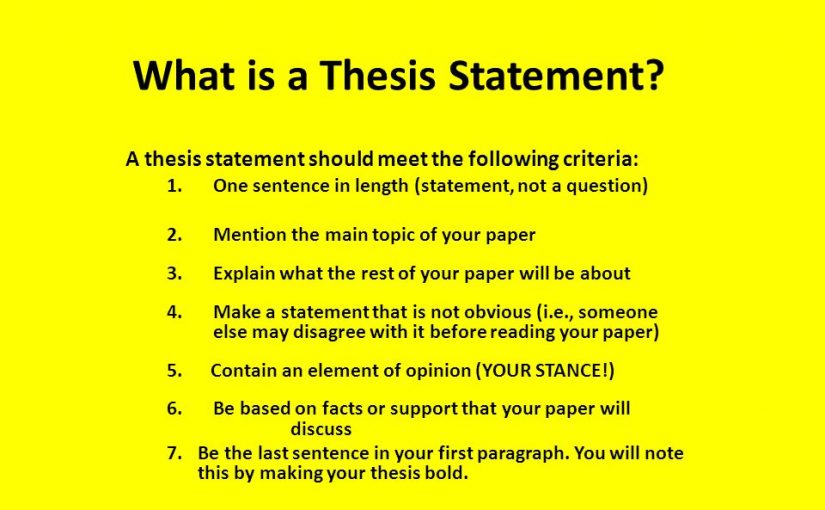
Every academic essay you write should have a main idea, which is supported through an argument or arguments you make. Your thesis statement will reflect the arguments you are making about your main idea in a clear way.
A thesis statement should present your argument in one or two sentences. A thesis generally has two parts: a statement of the topic, and an argument or position about that topic. Look at this example. The topic is underlined, and the argument is in bold:
Continuing changes in pension plans make it almost impossible to plan wisely for retirement.
The bold part of the sentence is the argument because it makes a specific claim about the topic. One way to test whether you have an argument or not is to ask whether a different claim could be made about it. For example, this thesis statement might also have been:
Continuing changes in pension plans save corporations and governments money that can be used more efficiently elsewhere.
or
Continuing changes in pension plans are necessary because of the smaller number of younger workers in the workforce.
If you cannot think of an alternative thesis statement, chances are that you have an observation about your topic, or an argument for which no one would have an alternative explanation. Look at these examples, and think about why they are not as effective:
In the current economy, pension plans are changing.
(This is true—but so what? Why is this interesting, important, or controversial?)
Jack London was the best American writer of his generation.
(This is too vague – what does “best” mean? It is nearly impossible to argue some- thing based completely on individual taste. What is best to you may not be best to me.)
One way to practice understanding thesis statements is to locate them in others’ writing. Look at each of the examples below – can you locate the thesis statement?
1. From George Orwell’s Politics and the English Language
Most people who bother with the matter at all would admit that the English language is in a bad way, but it is generally assumed that we cannot by conscious action do anything about it. Our civilization is decadent, and our language — so the argument runs — must inevitably share in the general col- lapse. It follows that any struggle against the abuse of language is a sentimental archaism, like preferring candles to electric light or hansom cabs to aeroplanes. Underneath this lies the half conscious belief that language is a natural growth and not an instrument which we shape for our own purposes.
Now, it is clear that the decline of a language must ultimately have political and economic causes: it is not due simply to the bad influence of this or that individual writer. But an effect can become a cause, reinforcing the original cause and producing the same effect in an intensified form, and so on indefinitely. A man may take to drink because he feels himself to be a failure, and then fail all the more completely because he drinks. It is rather the same thing that is happening to the English language. It becomes ugly and inaccurate because our thoughts are foolish, but the slovenliness of our language makes it easier for us to have foolish thoughts. The point is that the process is reversible. Modern English, especially written English, is full of bad habits which spread by imitation and which can be avoided if one is willing to take the necessary trouble. If one gets rid of these habits one can think more clearly, and to think clearly is a necessary first step towards political regeneration: so that the fight against bad English is not frivolous and is not the exclusive concern of professional writers. I will come back to this presently, and I hope that by that time the meaning of what I have said here will have become clearer. Meanwhile, here are five specimens of the English language as it is now habitually written.
2. From Nature by Ralph Waldo Emerson
To go into solitude, a man needs to retire as much from his chamber as from society. I am not solitary whilst I read and write, though nobody is with me. But if a man would be alone, let him look at the stars. The rays that come from those heavenly worlds, will separate between him and what he touches. One might think the atmosphere was made transparent with this design, to give man, in the heavenly bodies, the perpetual presence of the sublime. Seen in the streets of cities, how great they are! If the stars should appear one night in a thousand years, how would men believe and adore; and pre- serve for many generations the remembrance of the city of God which had been shown! But every night come out these envoys of beauty, and light the universe with their admonishing smile.
The stars awaken a certain reverence, because though always present, they are inaccessible; but all natural objects make a kindred impression, when the mind is open to their influence. Nature never wears a mean appearance. Neither does the wisest man extort her secret, and lose his curiosity by finding out all her perfection. Nature never became a toy to a wise spirit. The flowers, the animals, the mountains, reflected the wisdom of his best hour, as much as they had delighted the simplicity of his childhood.
3. From “The Modern Essay” by Virginia Woolf
Of all forms of literature, however, the essay is the one which least calls for the use of long words. The principle which controls it is simply that it should give pleasure; the desire which impels us when we take it from the shelf is simply to receive pleasure. Everything in an essay must be subdued to that end. It should lay us under a spell with its first word, and we should only wake, refreshed, with its last. In the interval we may pass through the most various experiences of amusement, surprise, interest, indignation; we may soar to the heights of fantasy with Lamb or plunge to the depths of wisdom with Bacon*, but we must never be roused. The essay must lap us about and draw its curtain across the world.
* Lamb is another essayist; Bacon was a philosopher
Sources for Writing Thesis Statements
Websites:
- Writing Tips: Thesis Statements http://www.cws.illinois.edu/ work-shop/writ-tips/thesis/sis/
- Purdue OWL: Creating a Thesis Statement https://owl.english.purdue.edu/owl/resource/545/01/
Books:
- The Simple Guide to Thesis Statements and Support (Volume 2), by Patri- cia Martin, Simple Guide Books, 2015.
- Techniques for College Writing: The Thesis Statement and Beyond, by Kath- leen Moore and Susie Lan Cassel, Cengage Learning, 2010.
3. Freewriting
Remember to write without editing yourself as you write. Take out a pen and paper, or sit at your computer and write on the following idea (or any idea you want) for 5-10 minutes without stopping. Do not edit yourself for grammar, spelling, or any other reason. Let the thoughts just spill onto your page or screen, without thinking about whether they are right or wrong, good or bad.
Freewriting topic 3: Do you enjoy reading essays or stories more? Why do you prefer one over the other?
4. Controlled Writing
Remember that in controlled writing, you need to pay close attention to form and structure, editing yourself for grammar, organization, and clear ideas. Write two or three paragraphs about this topic.
Controlled writing topic 3: What notable person would you like to meet? Why?
5. Editing
The following paragraphs have several errors in it. Identify the errors, and rewrite the paragraphs correctly. Go to the back of this book for one possible correct way to write the paragraphs.
Ellen Ochoa was born on May 10, 1958, in Los Angeles, California. She receive advanced degrees at Stanford University. She was chosen by NASA in 1990, and at 1991 she became the worlds’ first Latina astronaut. She has been on for space flights, logging more then 950 hours in space.
Ochoa’s technic assignments have include flight softwares and computer hardwares development and robotics development, testing and training. She has served as Assistant for Space Station, lead spacecrafts communicator in Mission Control, and Acting Deputy Chief of the Astronaut Office. She is now serves as Director of Flight Crew Operations at Johnson Space Center on Houston, Texas.
Ochoa’s many awards include NASA’s Exceptional Service Medal (1997), Outstanding Leadership Medal (1995) and Space Flight Medals (2002, 1999, 1994, 1993). Besides been a astronaut, Ochoa playing classical flute. She lives in Texas with his husband and they’re two childs.
6. Vocabulary Check
Here are some words from this week that were used in this week’s course mate- rials. Check (√), highlight, or note the ones you already know. Look up the ones you don’t know. For the ones you don’t know, write them out on cards, or add them to a notebook, along with the definition, written in your own words. Indicate the part of speech. Then write an example sentence in your own words.
___ admonishing
___ a chamber
___ decadent
___ an envoy
___ frivolous
___ to impel
___ inevitably
___ intensified
___ a pension
___ perpetual
___ to plunge
___ refreshed
___ regeneration
___ retirement
___ to rouse
___ sentimental
___ slovenliness
___ solitude
___ a specimen
Remember to share your work and comment on others’ work on the course web- site at http://edX.org.