An essay about yourself is an autobiographical piece focused on your (the writer’s) life. This type of writing falls into the nonfiction category. An autobiographical piece often means squeezing your whole life into a few paragraphs. The goal is to explore important moments and experiences from your life. Then you must condense them into a third person narrative. It should not sound boring and selfish. The best option is to focus on a specific accomplishment or experience. Note that most writers choose to write this essay in the third person.
TABLE OF CONTENTS
How To Start
How To Introduce Yourself
Writing The Body
Summing Up
Common Usage
Polishing Up
An essay about yourself should answer 6 simple questions:
Who are you?
What is your background?
What are your interests?
What are your talents?
What are your achievements?
What challenges have you faced?
In this article, we will follow some simple steps towards writing an autobiographical essay. At the end, you will have a clear understanding of how to write an essay about yourself. The following steps are:
Brainstorming On Ideas
Introducing Yourself
Writing The Body
Concluding
Polishing Up
How To Start An Essay About Yourself
If you’re not sure how to write an essay about yourself – begin by brainstorming. Write down a list of your talents, experiences, and achievements. Next, narrow it down to a more specific theme. Keep in mind that your essay opener must grab the attention of any audience. You can try starting off with an unusual experience or a valuable life lesson. Give your readers a taste of something new, or something to ponder on.
Topic Examples:
The moment your life changed forever;
A tough choice you have made;
A near-death experience;
The biggest loss you have experienced;
A thing you want to change about yourself.
It’s also important to avoid sensitive subjects because they can be controversial. These can be:
Gender
Religion
Political situation
Race and nationality
Income level
Introduce Yourself
Remember, this is a story of your life, so introducing yourself like: “My name is David,” “When I was born…”, “The best moment of my life was…” is too dull and trivial.
Instead, try a more original approach.
Example: “I was born the day before my grandfather died..” or “The point when my life changed was…”
Craft an introduction to your essay that will catch your reader’s attention. This will motivate them to read the rest of the story.
Writing The Body
In this section, you will talk about your background. Consider your interests, experiences, challenges, and achievements. Do not ramble too much around themes or subjects that you aim to highlight. Rambling can disinterest your reader.
Put everything you want to introduce in proper order before adding new details. Make sure to make smooth transitions from one subject to another. You want your audience to enjoy the reading experience.
Writing an essay about yourself could be a part of your admission process. In this case, it’s crucial to write the best college admission essay describing your goals, motivations, and challenges you’ve overcome.. Include your best qualities, studying attitude, productive hobbies, etc.
Summing Up
After you have done all the previous steps, it’s time to write a conclusion. For example, the main idea of your story was about learning a lesson from a specific situation. In this case, you may want to write about what you learned or how it changed your life. If this step doesn’t work for you, you can try the “so what?” technique. Read your essay one more time and ask yourself “so what?”. In most cases, the answer will come to you.
Common Usage
Several institutions request you to write a third person narrative about yourself. In the academic field, these essays are typical for college admissions. You have to convince admissions that you have been ‘destined’ to become a student in their college. You might also be asking that school for a scholarship.
In that case, your piece must boast your academic prowess. It must convince the college to pay for your education. They may also ask you to write a short essay about yourself for a job interview or a casting. In any of these cases, being able to write about yourself is a strong skill to own.
Polishing Up
There are other factors to consider in bringing your autobiographical essay to perfection. Our academic service has compiled some excellent advice to help you compose a winning piece:
Read your work several times. Proofreading will allow you to spot grammar errors and inappropriate use of language. Then read it once again but this time read it out loud and correct all punctuation and spelling errors.
Run it through an online grammar checking program. Such tools can spot small grammar mistakes that you might have missed. Moreover, it will show you errors in sentence structure if you’ve made any.
Get your family and friends involved. Ask your relatives and friends to read your paper. Use their feedback to make corrections.
Know yourself. Based on your writing, create a list of mistakes that you often make. You can later refer to that list every time you need to proofread your work.
History is always written by the victor; however, any topic, event or situation always has multiple viewpoints to it, depending on the angle of approach. It is rather hard to sway some ideology or way of thinking. So the most one can do is present an argument using statistics, logic, and evidence to showcase their idea as valid. This is what explanatory essay writing is all about.
What Is An Explanatory Essay?
An explanatory essay is a type of writing in which the author presents some point of view on a certain topic, event or situation. This view does not necessarily have to be one that the writer agrees with, but it must have some research and logic to make it feasible.
Usually, the author will decide upon a set topic; then they will approach the issue from a specific angle. This angle is typically complicated, giving it room for discussion. At this point, they must present a point of view of their choice that sufficiently explains why a certain outcome was reached.
A mistake that many writers make comes from the belief that they are defending one side of an argument in a debate or criticizing some perspective. Rather, explanatory essay writing is all about presenting a neutral point of view on the set topic by providing analysis from research and logically created self-theory. The overall goal is to clear up any confusion and present a lucid explanation as to why things happened the way they did. After finishing the essay, the reader should have a clear understanding of your idea, even if they disagree with it.
Explanatory Essay Example Topics
Almost any topic, event or idea can be described through an explanatory essay; here are a couple of good essay topics to get you started:
What were the key causes of the American Civil War?
From slavery to states rights and the aggravating feeling of power loss, this has been a question yet to be adequately answered.
How does depression affect the development of young children and teenagers?
Depression affects many people in various ways. From physical changes in diet to mental jumps in the form of mood swings, this topic still has much to uncover.
How has the overall development of technology impacted schools?
Although technology has significantly simplified lives for the entire world, has it brought with it a sense of laziness and reliance. Can it be considered as an addictive drug?
What positive and negative impacts have come from social media in today’s society?
Social media has turned everybody into a keyboard warrior nowadays. It does allow people to spread their thoughts and ideas freely, but what about the negative repercussions?
Define love
Your guess is as good as mine. Good luck!
Pre-Writing Steps
Before getting into the writing process of an explanatory essay, one must not forget to do proper research and data collection. Remember, the point of view being presented must be a combination of personal ideas and external information. Only then are one’s thoughts properly validated. So research your topic and find multiple sources that defend your thoughts.
After collecting the required information, the next and most important step is to create a feasible thesis statement. This statement lays down a concise version of your overall point of view about the topic. In other words, you are explaining what you will be showing to your audience. Remember, you are not arguing or criticizing, just merely stating facts.
After both steps have been taken care of, it is time to create an outline for your paper.
Explanatory Essay Outline
The outline of an explanatory essay will vary based on the length of the topic and the information you are trying to present. However, most essays tend to be a page or two in length, so the overall essay will be around five paragraphs long. The introduction will present the subject of discussion to the reader and the thesis statement. The body paragraphs will then follow, backing up your thesis statement with facts, logic, statistics, etc. Lastly, the conclusion will summarize the main points of your essay and should present an overall concluding statement. Now, let’s break down each section into more detail!
Introduction
The introduction for an essay is made up of three main components and serves as a gateway for the actual content of the essay. First of all, just like with most types of essays, get the reader interested in the topic by presenting a hook statement. This can be an interesting fact, relevant quote, or anything that would captivate the audience’s attention.
Afterward, offer any necessary background information that may not seem like general knowledge. This will help paint a clear picture for the reader to follow. Lastly, add the thesis statement at the end to fixate the focus of your essay. This should eliminate any confusion about what will be discussed in the body.
Body Paragraphs
Most likely, unless the topic is very in-depth, the body should contain three paragraphs, each with their point of approach. However, the general style of each body paragraph is identical. First of all, present a topic sentence that precisely explains what information you will be introducing. At the same time, this sentence should smoothly transition the writing from the previous point to the next.
Afterward, present a position or claim that directly supports the thesis. It’s important to make sure that the connection is evident, so the audience can easily connect the dots. Then, present the evidence found from the research you have done. This will validate your claim and enforce your position. Lastly, present a concluding statement that summarizes the significance of the claim in regards to the thesis statement. Follow this systematic approach three times for each one of your claims to complete your body.
Conclusion
When writing the conclusion, there are three main components that are crucial to properly finishing an explanatory essay. First of all, restate your thesis statement. This will bring the audience’s attention back to the main focal point as well as add strength to your presented point of view.
Next, make sure to summarize your three supporting points presented in the body paragraphs accordingly. It’s essential to restate the significance of each one concisely. This will show you that you have logically and correctly defended your thesis statement, increasing the strength of your overall writing. Last but not least, offer an overall concluding statement. This should explain the value of the specific point of view chosen from a global perspective. Leave your readers with a call to action, instinctively captivating them to study the subject further on. Once you have done that, you are ALMOST finished with your explanatory essay.
Polishing It Up
Before confidently submitting in your final work, make sure to take a couple of proactive steps to tie the knot around your essay.
Check The Clarity
Since the primary goal of an explanatory essay is to elucidate a topic or event, you want to ensure that your writing clearly explains and simplifies the comprehension level for the reader. The last thing you want is for your audience to be confused after reading the essay, questioning the overall point you were trying to make.
Reread and Edit
The worst thing a writer can offer is pesky grammatical and word usage mistakes that kill the eloquence of the text. Reread the essay several times and make sure it runs smoothly like a Sunday morning creek.
Get A Second Pair of Eyes
Just because your writing may make sense to you, does not mean that Bob down the street will understand it. Have friends, acquaintances or teachers read over your essay to give it some final touch-ups and adjustments. This is the cherry that goes on top of the cake!
Have you heard of a popular tool in the world of cinema called ‘exposition’? It is a technique that filmmakers often use to fill in the audience on key plot points of the movie. When looking at the expository essay definition, similar rules apply. Our Essay Writing APP is here to reveal the true meaning of this academic paper and write your essays upon your request.
Without further ado, let’s define expository essay and learn how to write a good one.
TABLE OF CONTENTS
What is an expository essay
5 main types of expository writing
Why do we write expository essays?
Finding expository essay topics
Topics and ideas
How to write an expository essay
Expository Essay Outline
Intro – ‘Say What You’re Going To Say’
Body – ‘Say It’
Conclusion – ‘Say What You Said’
Proofreading Your Work With an Expository Essay Rubric
Example of an Expository Essay
What Is An Expository Essay?
The term ‘expository’ comes from the word ‘exposition.’ According to the exposition essay definition this is ‘a type of writing meant to explain, inform, or describe.’ An expository essay is a structured academic paper investigating an idea. It consists of looking at evidence, expanding on an idea, and presenting the concept in simple language.
An expository essay is one of those essays that you find at the end of an exam or a semester. Professors love assigning it as it’s a perfect way to test a student’s knowledge. Knowing how to write an expository essay is a valuable skill, and you’ll write lots of them in college. It’s easy, but if you need some essay writing help – you can always rely on our service.
An expository essay usually builds on the simple 5-paragraph-essay structure. An attention-grabbing intro with a thesis, three body paragraphs, and a conclusion. Body paragraphs must have supporting evidence for every argument. As mentioned before, it is a standard genre used in exams and in-class writing. Students often write such essays fast with little to no preparation.
5 Main Types of Expository Writing
There are 5 main types of expository essays:
Descriptive Essay: This is an essay in which the writer is asked to describe something. This could be a person, place, experience, situation, etc. Descriptive Essays are unique in the sense that you have a lot of freedom when it comes to the content. You should present something exciting or beautiful, all the while keeping the reader interested.
Process Essay: The classic “How To” assignment. The purpose of this essay is to teach the reader about learning a process: How to build a car, how to edit a paper or even how to flirt with a girl!
Comparison Essay: Simple sounding enough, a comparison essay makes you critically analyze any two subjects, finding and explaining their similarities and/or differences.
Cause and Effect Essay: The “Knee-Jerk” reaction assignment. Cause and effect essays are concerned with why and or how things happen and what happens as a result.
Problem / Solution Essay: The universal standard prompt assignment. In this situation, we have a problem and are looking for solutions. The essay is broken down into a brief intro to the problem and filled with content about the solutions.
Why Do We Write Expository Essays?
Okay so we’ve learned what they are – let’s figure out why we write them. What is the purpose of an expository essay?
Apart from their lingering presence on every college exam ever, expository essays can serve as an introduction to expository writing. Being one of the four widely used rhetorical modes, expository writing branches out into many disciplines.
Journalism. Almost every news article fits into the ‘explain, inform, or describe’ definition. News is all about expository writing.
Business. Press releases, reports, and business letters are all exposition.
Sientific / Academic Writing. Some embodiments of the exposition essay in academia are: Cause and effect essays, definition and classification essays, compare and contrast essays, scientific journals, and term papers.
Look into an encyclopedia or at the text on the back of a juice bottle. ‘How-To’ manuals are exposition too…
In fact, this entire article is expository writing! Our purpose is to ‘explain, inform or describe’ the concept of an expository essay!
Okay, you probably get it by now. Expository writing is everywhere. Let’s take a look at some popular topics and finally learn how to write an expository essay!
Finding Expository Essay Topics
When looking for expository essay ideas, find something relatable that you could explain. It could be anything from daily rituals, ‘how to play an instrument’ guides, to proposals of colonizing Mars.
Finding good expository essay topics isn’t hard. Usually, the instructor assigns them. If not, prepare to do some brainstorming. Keep your expository essay prompts handy when searching for topics and inspiration.
Topics and Ideas
At this point, you should have a good idea of what you’re looking for. If not, we’ve compiled some good expository essay topics to narrow down your search. Feel free to make them your own!
Describe the history of your hometown.
Explain what happens to a criminal caught breaking a specific law.
What is it like living in poverty?
What is the primary cause of obesity?
Explain the importance of the outcomes of the ‘War of the Currents.’
Explain how wifi works.
Explain how gravity works.
Describe the causes of depression in the United States.
Describe a phobia.
How do movies get made?
How do memories work?
Describe an imaginary smartphone application that could help save the environment.
Explain why pop culture is so popular.
Give the reader historical background on a specific profession.
Trace the history of significant architectural developments up to a certain point.
Remember to pick a topic that sparks your interest. Nobody likes a dull, uninspired essay. Make the piece sound enthusiastic and energetic.
How To Write An Expository Essay
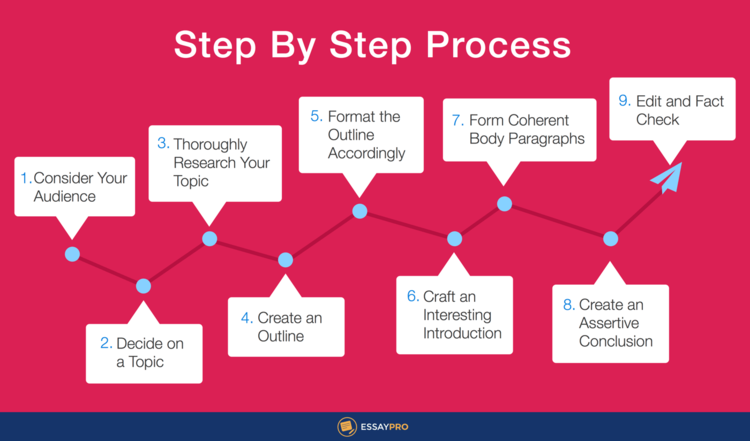
Writing an expository essay shouldn’t be difficult at this point. As with any piece, the first thing to start with is an outline. Organize all your thoughts and information in the correct expository essay format. The format is like the classic 5-paragraph-essay (intro, three body paragraphs, conclusion). The outline is fundamental because you can always refer to it if you get lost in the writing process. Stick to your guns, and you will be fine!
Expository Essay Outline
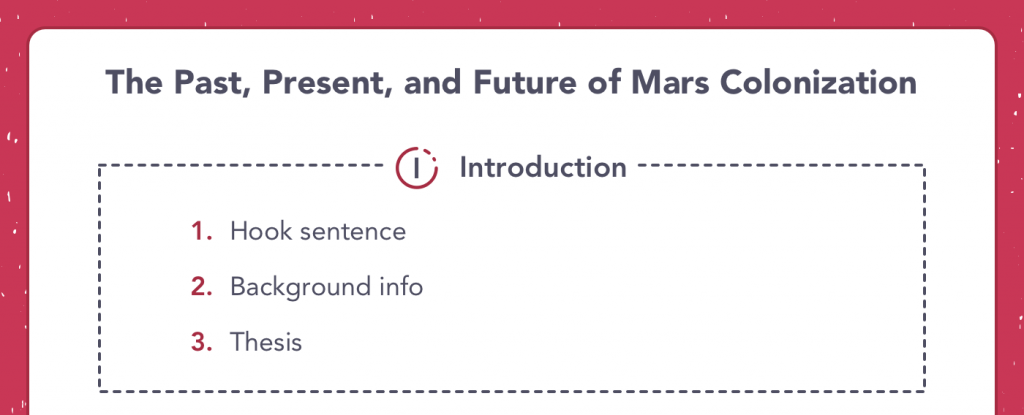
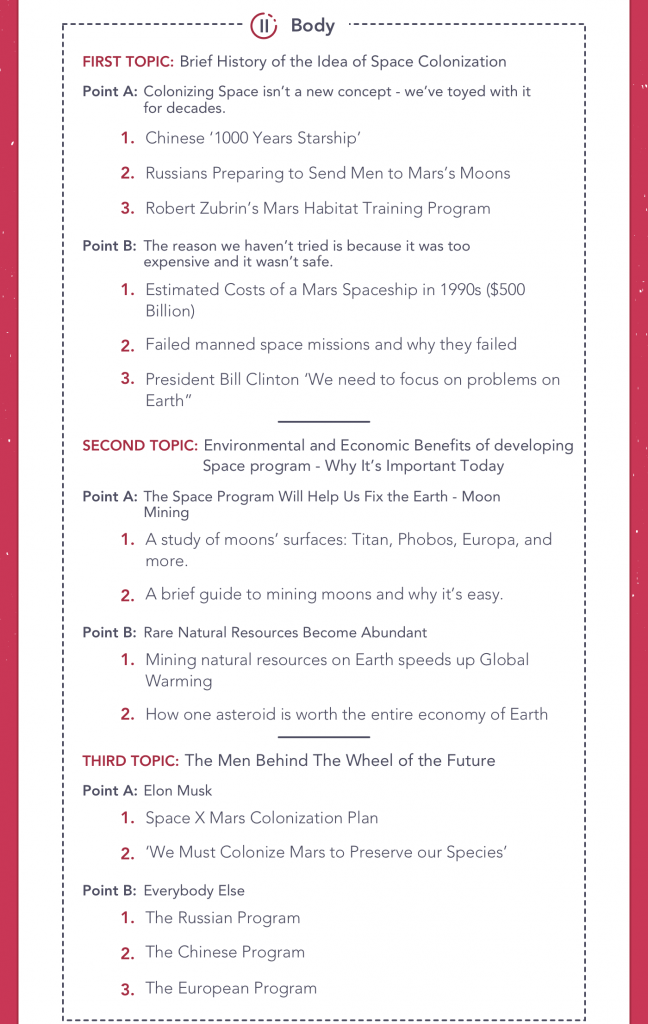
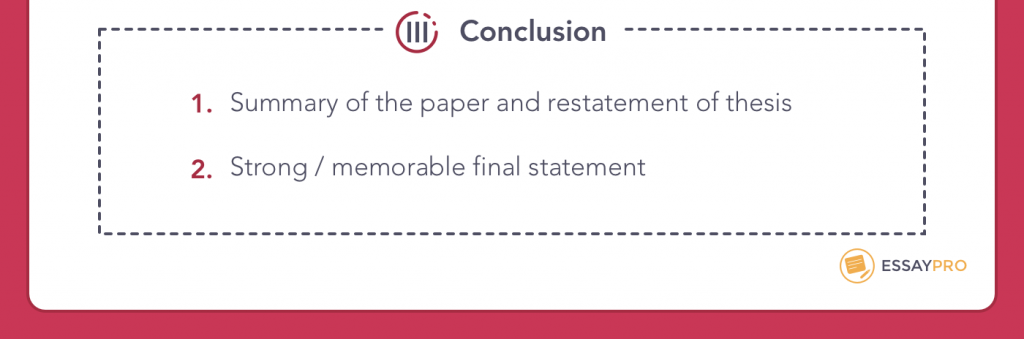
We have created an outline for a sample topic. Use it as a handy reference point on how to create your outline.
Learn more about how to create an essay outline.
Intro – ‘Say What You’re Going To Say’
When searching for how to start an expository essay, you’ll find that most recommend starting with a hook. The expository essay introduction is just like any essay introduction. Its purpose is to capture the reader’s attention and give them an overview of the topic. In other words – say what you’re going to say. The thesis sentence usually goes at the end of the introduction.
Learn more about how to write an excellent introduction.
Body – ‘Say It’
The body paragraphs are where the writer unloads their information. Explain the topic or concept thoroughly. Make sure to use reliable references to solidify your point. Expository essays are often assigned in-class or on exams. Therefore, professors expect students to write fast and pick references from their head. If it’s a homework assignment, stick to traditional sources and the MLA format.
Study hard for exam questions! Professors will know if you’ve studied the source material or not. Having studied well, you should have no problem picking references. Simply go through the class material you’ve learned.
Conclusion – ‘Say What You Said’
Last but not least, your expository essay conclusion must hit all the main points and wrap everything up. Basically – say what you said. The conclusion is your last chance to make an impact on the reader. Leave them with a good impression of your work, and give them some thoughts to ponder upon.
Now you know the expository essay structure. Learn it, use it, and make it yours.
Proofreading Your Work With an Expository Essay Rubric
Writing an expository essay is only the first step. Then you must proofread it to make sure you’ve nailed every point. Remember that professors deduce points for watery text and lack of transitions between paragraphs.
Proofread your essay carefully to see if you’ve ticked off all the points on this general rubric.
The Thesis Statement appears near the end of the introduction. It states the topic and the writer’s motives for writing this paper.
The writer Explains the Evidence clearly, showing how it supports the thesis. Every body paragraph features a topic sentence and evidence to support it.
All Evidence presented comes from a reliable source. All evidence is relevant to the conversation.
There are no Grammar, Punctuation or Spelling mistakes that distract the reader from the essay’s content.
Every part of the paper is appropriately formatted using the MLA Format.
Example of an Expository Essay
We’ve uploaded some expository essay examples to give you a better idea of the end result. Some of our top writers wrote these examples. Feel free to browse through them and get ideas.
An extended essay is a thesis written under the supervision of an advisor. It is a mandatory component of the IB Diploma, and writing it could be challenging.
In this article, we explain the basics of what is an extended essay. We also take a look at the structural elements (outline, format, etc.) and offer some exciting topics and writing tips.
Follow this detailed writing guide compiled by our team of experts to ace your extended essay. Also, stick around until the end for some excellent extended essay examples.
TABLE OF CONTENTS
What is an Extended Essay?
Choosing an Extended Essay Topic
Where to Get Ideas
Step-by-Step Guide to the Research Process
How To Write The Research Question
How Do I Start My Extended Essay
Introduction
Body Paragraphs
Conclusion
How to Present Your Extended Essay
Extended Essay Examples
What is an Extended Essay?
An extended essay is a research project which provides students with an opportunity to investigate a specific question in-depth. Writing an extended essay is a part of the International Baccalaureate program (IB).
“What is an extended essay in terms of grading?” This essay (along with the TOK presentation) gives you up to 3 additional points toward your overall Diploma score. You need it to obtain a degree in your target field of study.
The extended essay word count is around 4,000 words. Remember that it’s all about quality rather than quantity!
Choosing an Extended Essay Topic
In most cases, you will not get a specific topic assigned for an extended essay. This paper is more about your interests and ideas.
Stick to these tips when picking the topic:
Don’t choose a topic your professor will like. Selecting some topic which may leave an impression is an easy way to guarantee yourself zero motivation.
Don’t pick an overly complicated topic. For obvious reasons.
Keep a positive attitude by picking a topic you love. If you enjoy biking or video games – write about that!
Narrow down the topic. The portrayal of Women in Mass Media (Film, Social
Networks, TV, News, etc.) is a course for a whole semester. The representation of Women in Video Games is narrow enough for a good topic!
Where to Get Ideas
We have summarised the main points of selecting a topic. But, what about some of the possible sources where you can find ideas?
Brainstorming. Sit down and write all of your topic ideas on paper. Brainstorming is about feeling free and writing whatever comes to your mind.
Social media. There’s more than enough content on Facebook, Instagram, & Twitter for extended essay ideas.
The Library. Head to your school library and shop around for interesting books, encyclopedias, categories, etc. It is probably the easiest way of picking a topic.
Databases. Skim online databases, like ProQuest or Questia to discover the latest trends in research. See what others are writing about. Maybe you could offer a new insight regarding a heavily discussed research subject.
Step-by-Step Guide to the Research Process
Research is an integral part of an extended essay. To speed up the process and maximise its effectiveness, we suggest that you stick to these steps:
Think about a subject area you are familiar with. It’s often better to pick subjects you’ve previously covered in your IB program.
Look through the guidelines concerning your selected topics. The grading rubric is what matters the most.
Conduct preliminary research. Dig deeper into your topic by reviewing relevant materials and highlighting important points.
Develop an outline. It will be a plan of action which you can always refer to when writing an extended essay.
Finish your Feasibility Study. A feasibility study checks to see if your ideas are feasible enough to continue pursuing the project.
How To Write The Research Question According to IB Standards
A proper research question is half the battle. Out of the entire prompt offered by the instructor, a student has to highlight the main point and make a research question to answer throughout the paper. Make sure that you have strong evidence to support your answer.
“Your goal is to propose a relevant research question related to the main subject of your writing that will motivate people to study more about it. Specify how the community will benefit from your research.”
Many students ignore the difference between a topic & research question. A topic is something more general.
You cannot come up with the research question unless you decide on the topic to cover. The research question is the heart of your project:
It identifies the proposal;
Motivates the audience (catches the reader’s eye)
And guides your claims and inquiries.
There are several types of questions to choose from. The 1st group is called “convenient.” It’s excellent if you have to state a question on a form; the 2nd group is “fads,” (those could be an extended essay on books such as “The Great Gatsby” or “Lord of the Rings”).
Once you’re ready with the question, back it up with some intellectual debate.
Use the step-by-step instructions below to offer the best research question ever.
Analyse the statement of purpose;
Observe the collected data, including your notes & reference materials;
Decide whether you have enough evidence;
Come up with a solid argument.
Suggest the ideas how something has changed to find innovative solutions to the issue that you investigated.
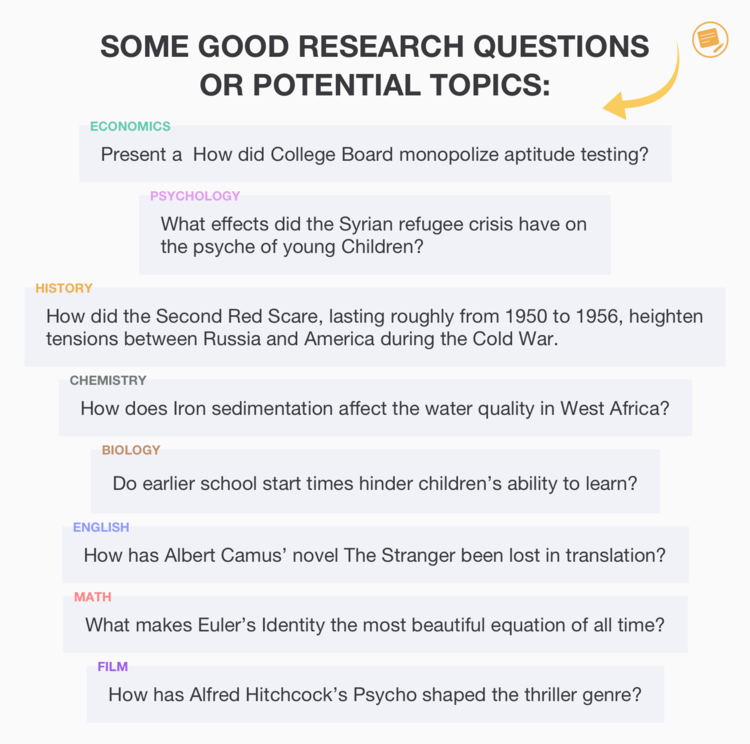
Here is an example of some good research questions and potential topics:
How Do I Start My Extended Essay?
Pick an Advisor that knows a lot about your topic. A biology teacher would not be great for your History EE.
How to Write an Extended Essay Outline?
The best way to start an essay with a free-ended topic is to find an area of interest: what would you like to write about? Follow these steps:
Build an extended essay outline around the research question. The introduction should contain your research query and your main argument, otherwise known as the thesis statement.
The body is easiest to divide into three parts.
The concluding paragraph should restate your main argument, thesis statement, and summarise your findings.
An outline should be the notes of what you plan to state. Do not fiddle with the Roman numerals; keep it clean with bullet points and short sentences.
How to Write an Extended Essay Introduction: Smart Tips
The best way to start an essay with a free-ended topic is to find an area of interest. In other words: what would you like to write about? Follow these steps:
Brainstorm: Jam-write for 10 minutes straight or make a mind map of what you’re interested in;
Develop a powerful hook sentence to grab the reader’s attention;
Provide some background info explaining the research topic;
Explain the significance of the chosen problem;
Finish the introduction with a sound thesis statement.
Your extended essay introduction should state your thesis & research question.
“In a perfect EE introduction, the context of the research question is demonstrated. The introduction clearly explains the significance of the topic and why it is worthy of investigation.”
This last sentence is important. Don’t forget to state why your topic is essential to study. It’s a good tip for any essay; if something isn’t important, why would it be worth reading?
Writing Extended Essay Body Paragraphs
Body paragraphs don’t need hooks as much as the introduction does. However, they should still be interesting to keep the reader’s attention on the page. Body paragraphs serve to prove the author’s main argument.
Every body paragraph must include these parts:
Summary of the main point into a single line that identifies the idea/subtopic behind the paragraph;
Two additional bullet points to expand every paragraph (evidence, data, quote + explanation of how the offered example relates to the conveyed idea);
Extra ideas that are directly relevant to the general idea behind it.
Making an Extended Essay Conclusion Impressive!
What should an extended essay conclusion contain? Check whether the conclusion has the following:
Restated/Rewritten thesis statement
Summary of the paragraphs (paraphrased topic sentences)
Implementation of the ideas
Predictions for the future
Verdict & a hook (usually, a rhetorical question)
How to Present Your Extended Essay
The structure of your paper is the way you present it. A paper of this type consists of more sections than most of the essays. Here is what you should include:
Title Page Your title is a clear, concise definition of the paper’s focus; it should not necessarily repeat the topic or research question.
Enter the full title of your paper roughly 1/3 down of the 1st page and place it in the center. Never italicise, underline, make it bold, or add quotation marks around the essay’s title. The exception is the title that has the name of a book, story, poem, company, music composition, or film.
Example: The Influence of The Beatles on the development of pop rock music in the United Kingdom.
Enter your name and last name. Make sure it’s triple-space and centered.
Make it double-spaced, center, and enter the name of your educational institution along with your personal IB Candidate number in the last 3 spaces.
The last element of the title page is TOTAL WORD COUNT, and it has to be double-spaced, center, typed in capital letters.
Abstract An extended essay abstract is a summary of the main points. There are three basic elements to include in this part of your project: the research question, the scope of the study, & the conclusions.
Take the following steps to come up with a good abstract:
Highlight the sentences in your essay with the issue details;
Underline the research question/thesis;
Define keywords or phrases that display the scope & sequence of the study (a list without explaining in details);
Condense the conclusion into several concise sentences. That would be your abstract.
Acknowledgements A statement declaring something to be factual/true. In the case of an academic or scientific paper, you should think about the people you would like to thank.
Make a list of those who supported your work or contributed something to your studies. Unlike the bibliography, these people should not necessarily be authors of the sources where you gather information.
Table of Contents Create a full table of contents for your paper. Just like a table of contents in a book or online article.
Make sure that each basic paragraph has subheadings. List them in the order of their appearance in your table of contents, specifying the pages where each section starts/ends.
Visuals Those are the necessary visual elements to illustrate & support your writing (graphs, charts images, tables, etc.) You can either insert images found on the web (do not forget to provide proper references in such case) or come up with your own visual elements (e.g., prepare a graph in Excel and add it as an image using the Screen Saver option).
Calculations If your project requires some numerical data and its interpretation, involve this section. Put down and explain the necessary formulas & equations (the author should interpret them and explain the outcomes of each calculation).
Footnotes & Endnotes In the case of in-text references, it depends on the format whether to include them or not. In some situations, a writer may decide to add an explanation of something where they don’t want to interfere with the flow of the content.
Footnotes usually serve the purpose of automatic page numbering.
Appendix It is the list of all visual elements used to support your writing as well as references to these inserted images, tables, graphs, etc. Simply copy-paste the pictures into this page, explaining where each comes from (source URL) and its usefulness.
Citations & References While you can ignore some of the sections based on the selected writing style (format), each essay should contain in-text citations & references. The purpose is to reflect intellectual honesty in research practices. The usage of in-text quotations also helps to prove the central arguments of the author (serves as supporting evidence).
The basic information about the sources should contain the following:
Author’s name and last name
Title of work
Place of publication
Publication date
Smaller details available (number, volume, issue, URL, number of pages cited, etc.)
Bibliography Include a list of references to all sources that contributed to your work. A student should distinguish each author whose work contributed to their paper.
If you have to write an annotated bibliography, add little summaries of the sources that contributed to your study.
Are you one of the students who has discovered their passion for reading, writing, leadership, and the urge to overcome new challenges? Various organizations are ready to support your enthusiasm. To join them, ambitious students have to submit powerful application papers. The National Honor Society essay is a tool that allows becoming a member of one of the most prestigious organizations in the United States. This guide explains how to write the National Honor Society essays with a couple of examples.
TABLE OF CONTENTS
What is the National Honor Society Essay?
What Are the National Honor Society Essay Requirements?
Steps to Writing the National Honor Society Essay
How to Start a National Honor Society Essay?
How to Finish the National Honor Society Essay?
What Happens Once You Are Accepted?
The National Honor Society Essay Samples
What is the National Honor Society Essay?
The primary thing to discuss is what makes the National Junior Honor Society (NHS) essay different from other types of academic papers. It has a lot in common with a scholarship & admission essays. The organization itself is a friendly student community that allows excelling in such fields as:
Scholarship
Social services
Volunteering
Internship
A student has to show their best side to be accepted to the organization. The NHS has its rules of formatting & structuring papers. To prove you are the right candidate to fit local requirements, you should stress the basic reasons why the NHS and the entire community will benefit from obtaining your services.
An applicant must illustrate personal leadership with some examples. Think about the achievements you wish to accomplish and explain why and how your skills may add up to the field of social services.
What Are the National Junior Honor Society Essay Requirements?
The paper is sometimes called the National Junior Honor Society essay as even the youngest students can join. There are several conditions the applicant should meet:
Current candidate’s educational institution should have an NJHS chapter;
The candidate must study in grades 6-9;
Ninth-grade students should have passed a middle school
The applicant must possess an accumulated GPA go minimum 85 (it equals to 3.0 on a 4.0 standard GPA scale);
An applicant should be a good leader and show citizenship and commitment to the particular society;
A student should take part in various volunteer programs or internships;
Finally, the interested student should possess high morals and ethics. Those are the National Junior Honor Society essay requirements each applicant should correspond to.
How to Write the National Honor Society Essay?
It is time to have a look at how to write a national honor society essay. Use these basic writing tips:
Conduct in-depth research on a preferable topic even though it should describe the writer’s experience;
Begin to analyze the selected topic – the thematic should be unique and catchy;
Brainstorm on the relevant ideas;
Prepare an outline the way you wish to put down your thoughts;
Write the paper;
Proofread & edit the final draft. The NHS is strict with any sorts of mistakes. The smallest errors may result in disqualification!
Once you are ready to start writing, find out how to start the National Honor Society essay. We tried to collect the best tips for you.
How to Start a National Honor Society Essay?
The introduction is the most important part of the National Honor Society scholarship essay as it must encourage the target audience, which predetermines applicant’s further fate, to read the paper. Come up with a relevant and attention-grabbing introduction. The approaches to doing it include:
Explaining the main reason to join the NHS
Specifying the things a student knows about the organization proving his or her pure interest
Highlighting the strengths of the applicant (unique skills, in-depth knowledge of specific topics, other achievements)
Start with one or few engaging hook sentences to make the admission officer want to read the paper
Writing the Body Paragraphs of the NHS Essay
There is nothing special to say about the body paragraphs of this paper. Every paragraph should comprise of the topic sentence and evidence. Unlike in college essays on specific topics, the student should start with the main reason to pick him/her and prove the claim with the evidence collected in different sources or examples from personal experience. Do not include more than 3 body paragraphs in your writing.
NHS Essay Conclusion
A conclusion must be powerful as an introduction. The goal is to help the admission board with making the final decision in favor of your candidacy. The conclusion should effectively meet the goal, which is to prove the specific applicant is eligible to join the NHS community. Sum up the reasons to choose you from the pool of other candidates by mentioning several factors.
Mention your grade point average
List personal qualities
Name professional skills
Identify the main purpose of your application paper
Conclude the leadership experience
Make a summary of these points
Add a hook or call-to-action (CTA) in the end. The CTA should finalize why the organization would benefit from choosing you.
What Happens Once I Am Accepted?
We would like to share more reasons to join the NHS. If the National Honor Society personal essay you submit succeeds, they will invite you to an induction ceremony with other accepted candidates of the local organization’s chapter. Those are public events, so get ready. The organization allows bringing whoever you want with you to support this event: from parents to close friends. The HNS propose different ideas & sample programs to observe before the ceremony. The event includes several stages.
A special entrance by inductees
Warm welcome from the adviser, principal, or president
National Anthem/Pledge of Allegiance
Guest Speaker
Review of entrance criteria
Honor Society Pledge
Final remarks
Candle lighting/Symbolic presentation
The National Honor Society Essay Examples
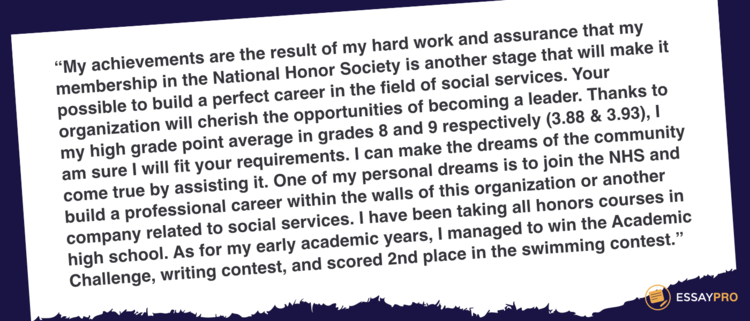
To let you understand the way a successful paper should look, we have prepared a couple of the National Honor Society essay samples. These are the brilliant examples of extracts!
Whether you are a student in high school or college, there is a 100% chance that you will have to write some informative essay during your educational years. Your teacher may either assign you a topic or allow you to choose one for yourself. Depending on the length and requirements for the paper, your topic options will narrow down. A lot of the times, students will end up receiving a subject that they are utterly clueless about and thus have no starting point to build off. Do not worry: We are here to teach our students everything they need to know about crafting an informative essay!
TABLE OF CONTENTS
What Is An Informative Essay
Informative Essay Topics
How to Write an Informative Essay
Informative Essay Outline
Introduction
Thesis Statement
Body Paragraphs
Conclusion
Post-Writing To Do List
Examples
What Is An Informative Essay?
The informative essay definition is to educate your audience on a particular topic, to ellobrate on a term, or analyze data. Not to be confused with other forms of assignments. They are intended to teach your readers new information. Presenting opinions is not the purpose of this style of assignment. Generally speaking, this type of essay will compare controversial viewpoints about a particular topic.
An example of this would be a paper regarding the amount of pollution produced by humans every year – and its impact on the ice caps.
Bottom line: No matter the field chosen as a topic or the level of knowledge required, an informative essay should present in-depth knowledge and basic facts regarding the chosen topic at hand.
This Type of Essay is similar to an Expository Essay
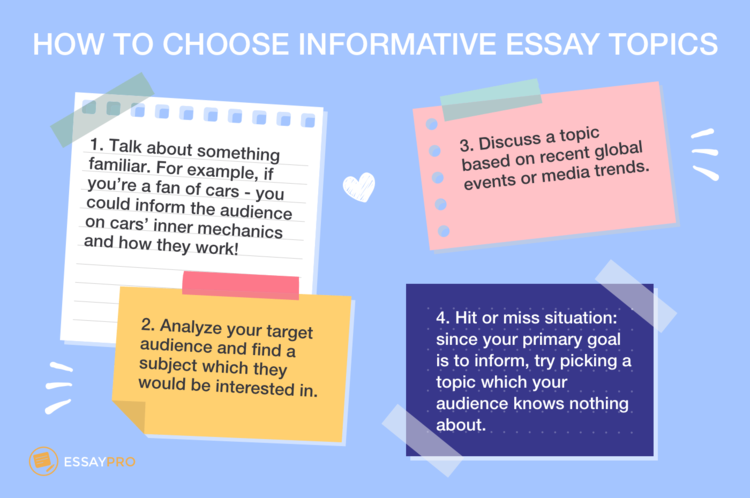
If the topic is not assigned, you will need to choose your informative essay topic. You might probably be stuck in this step if you have a wide range to choose from. Take your time and keep these pieces of advice in mind to select the most appropriate topic.
Make sure that your topic is not too broad and not too narrow. You need to have enough information about your subject to write about, but not so much to make your essay a novel.
The topic should be attractive and exciting to your audience. Think ahead about who might be reading your paper. Of course, if it was assigned to your class, the teacher will be your primary audience.
The best option is to choose the topic that interests you. It will make the writing process much more pleasant and will let you express your enthusiasm fully.
Sometimes, teachers and professors will require presentations or speeches to come along with the written essay. This is why it is smart to pick a topic that is interesting enough to a wide audience (something people can relate to) and can be explained clearly through speech. Here are some examples!
The origin of language
The origin of the universe
How to maximize financial efficiency
Why do people procrastinate
What causes addiction
Evolution of human rights
Legalization of Marijuana
Nanotechnology
Why do we dream?
How do 3D-glasses work?
How to Write an Informative Essay
Before you sit down in front of your computer screen and start typing away, there are some necessary steps to make and items to prepare beforehand. Having a set plan allows you to organize information effectively, and this greatly speeds up the entire essay writing process.
Brainstorm Ideas: Before writing an informative essay, choose a topic accordingly. Selecting a field of study, you feel strongly about is a good idea. Regardless of the chosen topic, brainstorming is the way forward for the top result when learning how to start an informative essay successfully. As it will allow you to create a general outline of your informative essay, and help organize your thoughts accordingly.
Choosing a Topic: After narrowing down your options, it has finally come time to choose the most appropriate topic. Remember, the selected subject at hand should not be TOO BROAD nor TOO NARROW.
Crank Out Some Informative Research: Gather information and use various sources including primary and secondary ones! Primary sources are physical pieces of evidence relating to the topic at hand. Secondary sources are articles and papers written based on that topic.
Primary sources: If you are talking about the Evolution Of Human Rights, a primary source could be a speech written by Martin Luther King Jr!
Secondary sources: If the topic is about addiction, a secondary source would be Bruce K. Alexander’s Rat Park Study!
Use a variety of sources, and validate their reliability: Using sites like Wikipedia is generally frowned upon, however checking out the links used at the bottom of every wiki page is an effective way to get sources quickly! Do not only use one type of source (example: Website Articles). Provide different types of sources to make your informative essay well-rounded!
Informative Essay Outline
As a writer, you may be wondering: “If I hire someone to write my essay for me, will they know how to structure my informative essay?” This is an excellent question to ask and an idea to consider if you have decided upon this path. If the writer presents you with something similar to what is shown here, then you are in good hands!
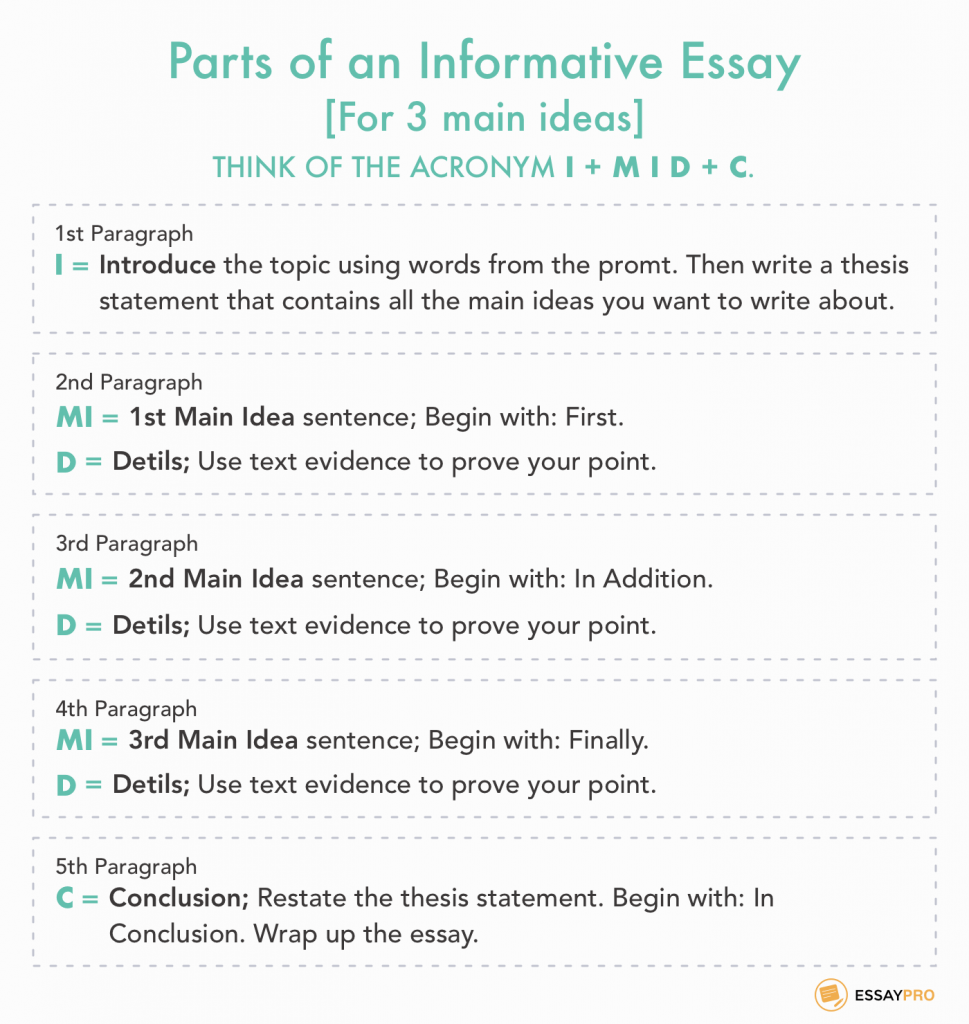
The informative essay outline is written in the standard essay style. Usually speaking, it will consist of:
An introduction + thesis statement It serves to present the main argument in an exciting and interesting manner
3 Body Paragraphs Body paragraphs will be mainly used to support the thesis created in the intro.
The Conclusion It will wrap up the information and present its significance in the real world!
Introduction
The intro should start with an attention getter that grabs the reader’s attention.
Examples: rhetorical question, joke, anecdote, own story, give the audience compliment, shocking statistics.
Afterward, your informative essay introduction should reveal any background context that will be necessary for the reader to understand while reading through the essay. This is an essential part of your informative essay outline. These sentences should pay the way for an excellent thesis statement.
Thesis Statement
The last sentence of the introduction should be a well-formed and coherent thesis statement. An informative essay thesis statement summarizes the main points to your readers:
By elaborating the purpose of the paper, without expressing any opinions or views on the subject;
The argument should be easily readable, precise, and accessible to your audience;
As well as appealing to make your readers want to learn more about the subject by reading on.
It is always worth referring to informative essay examples to see exactly how a thesis statement for this style of writing should be written.
Body Paragraphs
The purpose of this section in the informative paper outline is to defend the thesis statement, so the content in these paragraphs must be tip-top.
First of all, each body paragraph must start with a topic sentence. Create a smooth transition from your intro by creating a topic sentence that links the thesis to your first main point. (A smooth transition should also be created for the second and third body paragraph!)
With each body paragraph, there must be a target point and a supporting detail. A target point is the part of the thesis that you are aiming to prove. The supporting detail is the outside validation that enriches your statement.
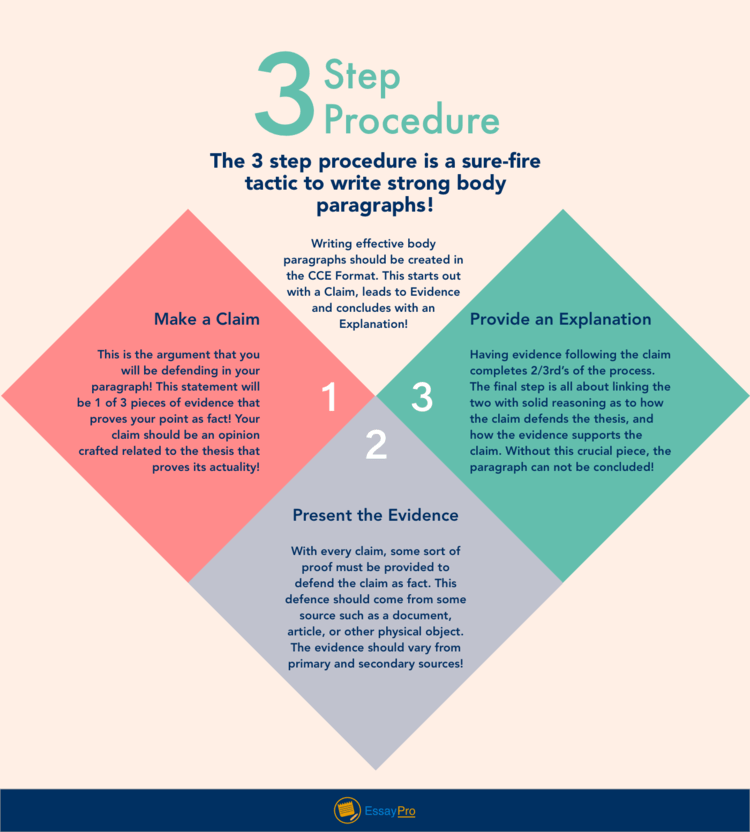
After introducing your topic sentence, it is time to follow the CCE format to craft an essential part of the essay.
First, you need to make a claim. This is your main argument of the body paragraph. Since the quality of the essay is dependent on how well the thesis is defended, make sure that your 3 claims are reliable.
After defining your claim, you must introduce the evidence. This is your physical proof that validates your claim.
Usually, in informative writing, this will be a quote from some document such as journals, articles, bibliographies, etc. Without this, your informative essay will hold no value. It would be the same as accepting opinion as fact.
To conclude the CCE process, the writer must present an explanation of his claim. In other words, they need to display how this claim proves their thesis statement as fact.
This is necessary and should be explained coherently. If eager to gain extra validation points, the writer can go into more depth about how the evidence backs up the claim. However, if this can be inferred without the need of extra information, then that would be ideal.
To conclude a body paragraph, a sentence should be created that gives a general synopsis of the argument presented. The primary purpose of this sentence is to display assertiveness; in other words, display that your opinion is the right one.This gives your entire essay more strength and makes your argument/thesis look sharp!
Conclusion
After portraying your three main arguments, it is time to wrap up your essay by learning how to conclude an informative essay efficiently.
The informative essay conclusion restates the thesis statement and offers final thoughts and insights on the topic. Explain it in different words and provide room for a smooth transition.
This “room” is necessary because you will now need to restate the impact of each one of your arguments briefly. If done correctly, the restatement and then the brief argument relay should mix well with each other!
To effectively finish the essay, one must come up with an overall concluding statement. This statement should serve as an explanation for the significance of your argument. In other words, explain why the informative writing you just crafted has value and where this information can be applied. This gives the work “real-world” value!
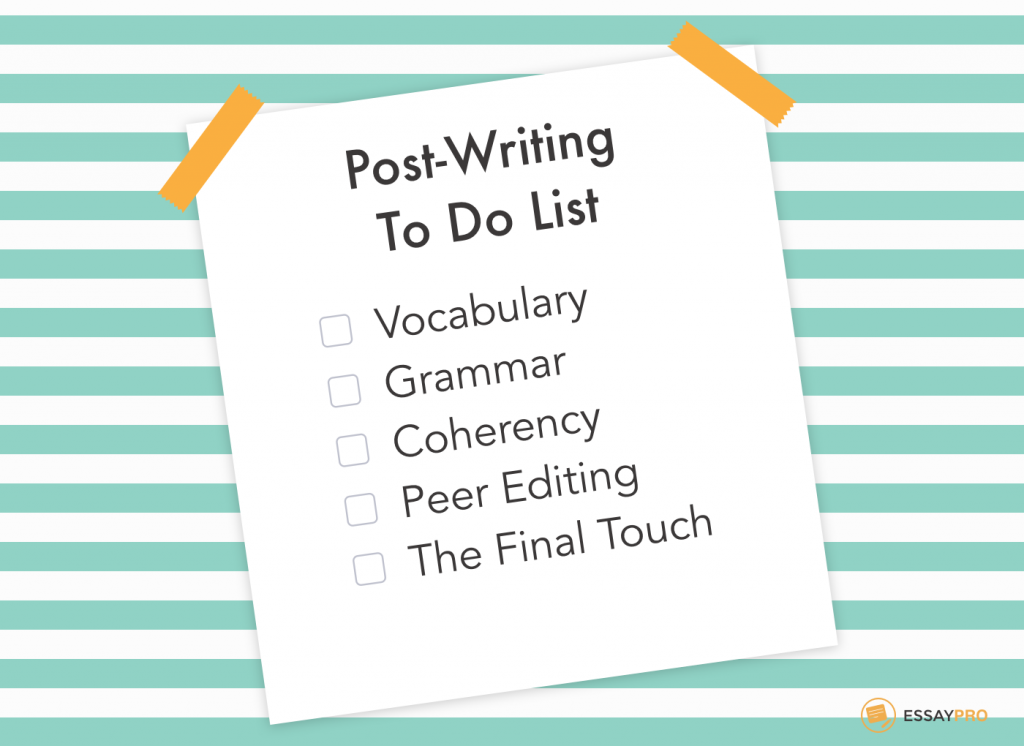
Post-Writing To Do List
Vocabulary: After rereading the draft, make sure that you are satisfied with the language you have used. If the words were not crafty enough or phrases could have been stated more smoothly, then edit accordingly.
Grammar: Nothing aggravates teachers more than having to pause their reading to fix grammar mistakes. It shows carelessness and a lack of proper editing. Use websites like Grammar Check to make sure that there are no issues with punctuation, spelling, etc.
Coherency: From a writer’s perspective, this is the most critical textbox to have checked. They are using language that can be easily understood as well as proper transitional skills is an excellent way to keep your paper moving smoothly.
Peer Editing: Having a second pair of eyes to read through your paper is a surefire way of validating your work. If the essay sounds fluent and makes sense to another brain, then you are increasing the odds of it looking great to the teacher.
The final touch: As you have edited your final draft, your next step will be transforming it into a full-fledged essay. Give your final draft one more read-through. Read it aloud and fix small mistakes your eye might not catch.
Informative Essay Examples
Now you can find our best informative essay examples by referring to the attachments below.
Have you ever seen an episode of How It’s Made? That’s an informative essay in video format.
Informative writing is a basic communication skill. Students practice it since middle school to clearly explain concepts, ideas, how things work, histories, and more. As you’ll learn from our list of 150 good informative essay topics, this type of essay can be about anything.
Informative essays are academic papers which inform, explain, or teach the reader any information. They could be:
Research Papers
Compare and Contrast Essays
Descriptive Essays
Expository Essays
Narrative Essays
In this article, we provide 150 informative essay topics which you may use for reference. Feel free to grab any of these topics for yourself!
TABLE OF CONTENTS
Informative Essay Structure
How To Choose a Topic
List of The Topics
Interesting Informative Essay Topics
Topics for College Students
Topics on History & Political Science
Science & Medicine Informative Ideas
Informative Process Analysis Essay Topics
Easy Informative Essay Topics
How to Structure Informative Essay: Piece of Advice
Always create an outline first, as it will guide you in your writing. Every essay has an introduction, body, and a conclusion. Your informative essay should be structured in a way that best supports your flow of information.
Introduction
When a reader picks up your essay, you have about fifteen seconds to grab their attention and tell them exactly what they’re about to read. A good introduction with a solid hook and thesis will keep the reader engaged throughout your essay.
Body
After greeting your reader and inviting them to participate in your informative essay, it’s time to serve them with facts.
There are usually three body paragraphs within an academic essay, each with a single argument or focus. The argument (or focus) is clarified to the reader through a topic sentence, which appears at the start of each paragraph.
Since readers hardly believe in facts without evidence (and rightly so), the essay writer must present trustworthy sources to clarify where they’ve gotten their information.
Conclusion
To wrap it all up, we have the essay conclusion. After reading a lengthy informative essay, the reader needs to refresh all the information they’ve just learned. That’s why you’ll find that most conclusions briefly repeat the thesis statement and every topic sentence of the essay.
How to Choose Excellent Informative Essay Topics
Informative essays are mostly how to’s and how it works. Your professor will expect you to delve into the intricacies of your subject; explore it to the fullest. That’s why you should go with a topic you find interesting.
Finding topics might be tough. But thankfully, the internet can present a variety of ideas for inspiration.
Below are a few safe bets of how to choose an informative essay topic without it being boring:
Still out of inspiration to come up with your topic? We’ve got you covered. Here’s a list of informative topics to write about.
Good Informative Essay Topics
The reader always seeks to learn something new from an informative essay. That’s why the “How X Works” formula is a safe bet for good informative essay topics. It’s a simple way to explore a concept in depth.
How cars (or to be more modern: electric cars) work
How does vinyl work
How computers work
How democracy works
How communism was supposed to work according to Marx
How a company like Facebook operates
Several ways of how media (videos, photos, memes, songs) go viral
How the voting system in America works
How caffeine, alcohol, or sugar works on the human body
Anything with “How X Works” will be a great informative essay topic!
Interesting Informative Essay Topics
From social problems to innovations – there are many exciting things to discuss in your academic papers. You want to grab the reader and keep them engaged.Here are a few engaging and, informative essay topics:
Inform the reader on how war directly affects civilian life
Inform on the circumstances which lead to drug & substance abuse among teenagers
Explain which significant factors led to the civil rights movement of the 60s
Illustrate how internet traffic generates profit for major corporations
Explain how meditation works on the human brain
Pick a religion. Distinguish its casual followers from extremists
Explain why it is crucial to support cultural developments in your hometown
Explain to the reader how to use the Bible to interpret classical art
The history of tourism
The history of cinematography in the US
Informative Essay Topics for Middle School
Middle school is the bridge between elementary & high school. It’s an exciting period of life. Young students should consider covering simple topics in their middle school essays:
Proof that grounding kids are wrong
How computer-animated characters are made
A narrative-informative essay about a lesson learned during summer
Pre-psychology. Understanding pet peeves and how they work
The impact of celebrities or role models on youth
The science behind the ollie: how skateboarding works
The history of waking up to school at 7 am
How Martin Luther King Jr changed America
Why Bob Dylan is the greatest living poet
How fashion trends changed in the last few decades
Informative Essay Topics for High School Students
High school is an exciting time full of new experiences and growing up. High schoolers are faced with more pressing issues as they prepare for college life.Here are some informative essay topics for high school students:
The false promises of college: how most colleges only care for your money
How great leaders are those who challenge the status quo
Ways to prevent mass murders in the US schools
High school bullying unmasked and how to stop it
The history of the school system and a brief glimpse into the future
A summary of Howard Zinn’s A People’s History of the United States and why it should be taught in school
What makes students outcasts?
What makes a political system corrupt?
The dangers of Googled advice – how bots write articles with false information
How to colonize Mars
Informative Essay Topics for College Students
College may the time of your life. But it doesn’t come without challenges. It’s when coursework gets harder, social life becomes less important, and the library becomes your best friend. Here are some informative essay topics for college:
The importance of public speaking 101 explained
How pubs and nightclubs target and exploit college students
The pros and cons of studying abroad
The statistics of whether college education guarantees financial success
Social media and the decline of critical thinking
How to analyze abstract expressionism art
How much does college cost? The cost of college examined
The benefits of a Liberal Arts Major
Compare and contrast: living on campus and renting a room
History of Ivy League colleges
Informative Essay Ideas on Sports & Health
More people support healthy lifestyles with every year. Sports & Health are an ever-expanding category for informative essay ideas:
Why the super bowl is such a big event in America
Explain why cybersports should also be considered sports
Sports betting and how it works. Should it be legal?
The history of football
Illustrate how running every day improves overall health
The experienced referee explained: the unnamed hero of sports
How protein shakes and vitamin supplements work
A history of doping in sports
Explain chess in regards to why it is a sport
Explain how the ‘Organic Foods’ trend originated
Informative Paper Topics on History & Political Science
History presents some of the best informative essay topics because it is a very informative subject. Keep in mind that exploring the history and political science can be complicated as there are many sources with different opinions:
The causes and effects of Spanish colonization
How the scars of World War I led to World War II
The impact of racism on the criminal situation in America
What are socialism and the centralized system
How does the US government function?
What is the role of the UK Prime Minister?
What are some of the most thinkers in the world of politics?
Pick a totalitarian ruler and explore their mentality and how they make their decisions
Responsibilities of the Secretary of State in the US
The history of women’s rights in Europe
Informative Essay Topic Ideas on Religion
You should be very careful when selecting a religious issue to discuss in your paper as it is a sensitive subject. In your writing, you should show respect for all the world’s religions. Anyway, here are some of the topics that you may enjoy:
The Roman Catholic clerical organization: origins & history
Jewish Kabbalah and esoteric mystical customs & traditions
Crusades in the middle ages and the impact it had on peoples interpretation of religion
Fanatic religious movements that are dangerous for humanity
The gap between Christianity and Satanism
Religion as the most powerful tool to control masses
Special clothing to be baptized in: necessary or not?
The world’s newest major religion: Agnosticism
Earth divinity dogmas and their roots
A modern explanation of the 10 Commandments
Informative Paper Topics for Business Classes
Business administration is becoming a more and more demanded degree around the world. It covers management, marketing, economics, and much more. If you need to prepare a project for any of those courses, think about using one of the following ideas:
Why Thomas Edison was a successful entrepreneur and not an inventor
Starting a career on Wall Street: 70s vs. now
Jeff Bezos: how to be a successful company CEO
How Henry Ford changed how factories worked
The psychology of social media marketing: how targeting works
Hotel management: how the world’s best hotels get their clients
How to earn money with the help of services like eBay
Launching an e-commerce project
How the economic crisis unfolded
Cybersecurity in modern entertainment corporations: how Disney controls its leaks
Science & Medicine Informative Ideas
Science and healthcare are interrelated fields. Whenever there’s a significant development in one, the other is affected as well. When getting ready for your upcoming science or medicine lesson, consider these possible research questions:
Treatment of diseases using nanobots
Adverse consequences of plastic surgery
Why Vitamin C is so important
How improper eyesight can alter the brain
How viruses infect humans
History of diseases: previously deadly, now common diseases
How nanotechnology is evolving in the field of medicine
Importance of minerals in the human organism
Comparing & contrasting bulimia and anorexia
Appropriate morning exercises to stay in a good shape
Environmental Essay Topics
Discussing the environment is always relevant in academic writing. Our apathy towards the situation has led to global warming, forest fires, extinction of species and more. Here is a list of environmental essay ideas:
How forest fires start and spread
How to prevent soil erosion
The impact of poaching on wildlife
How a single person can work against global warming
How the air can be cleansed from pollution
How whales help clean ocean pollution
The connection between global warming and natural disasters
Various types of tropical birds
Australian animals under the threat of extinction
If the ice melts: Earth post-global warming predictions
Informative Essay Topics for Communications, Media Studies and Arts
The communications major is broad and includes journalism, music, cinema, and media studies. There are many popular essay titles to choose from:
How outcasts become rock stars
How Facebook has changed the way we communicate
Blade Runner: why this film is remarkable in environmental education
The British Invasion: history and impact
The origins of hip-hop culture
Exploring Neoclassicism cinema in Italy
Journalism in the era of fake news
How to look at a cubist painting
Marshall McLuhan’s relevance in today’s media ecosystem
European Union Article 13: The Meme Ban and its impact on the internet explained
Informative Process Analysis Essay Topics
An informative paper on process analysis can be educational and captivating. It’s like a how-to guide on various subjects. Here are some informative process analysis essay topics:
How to launch a business campaign on Facebook
Cacio Pepe: The most feared pasta of Italian cooks and how to make the perfect one
Raising a dog: facts and myths
For future detectives: How killers get away with murder
How a smartphone works
How Bitcoin works
The captivating creative writing formulas used in the Harry Potter franchise
How Elon Musk’s ‘gigafactories’ are meant to function
A brief guide to how corporations sell products
How and when to use the Heimlich maneuver
Easy Informative Essay Topics
Sometimes a simple topic is all it takes! These are easy, informative essay topics because there is an endless amount of information available on them online:
A guide to proper diets
A topic on the gun control debate in the United States
A topic on abortion laws in the United States
The pros and cons of legalizing Marijuana in a specific state or country
Several ways to quit smoking
Exploring how teens engage in addictive behavior
A history of the counterculture movement of the 1960s
A brief look at Native American culture and traditions
The pros & cons of remote education
What started World War II
Funny Informative Essay Topics
Academic life can be hard. But there’s always room to lighten up the mood with funny essay topics:
How to cheat on an exam
How to fail a good deal
How humans are little different from monkeys
Why smoking marijuana can help you study
What does a school principal do
Funny and ridiculous types of sports in the world
The statistically best excuses for missing class
How to make a quality meme
Why music is a useless subject in school
How to make a viral video
We hope that you found this list of informative essay topics useful.
Students and professionals alike are required to perform laboratory reports for various reasons. Usually, the results are used to highlight changes or establish a pattern with one’s management or lecturers. Lab reports are also written for archival purposes so that the work doesn’t have to be done again in the future. In the section below we will review a basic structure used to organize lab reports.
TABLE OF CONTENTS
Abstract
Introduction
Procedures
Results & Discussions
Conclusion and Appendices
It is important to note that this particular structure is designed to give you a general idea since one organizational format does not work for all types of experiments. Therefore, while performing any laboratory reports, it is essential to keep in mind the requirements given out by the instructor or supervisor if that is the case.
Lab Report Abstract
Without a shred of doubt, the abstract aims to summarize four essential elementspresent in any laboratory report. First off it is vital to identify its purpose in order to establish relevance to our initial hypothesis or assumptions. Secondly, examine any key findings to use as a point of comparison which aims at either proving or disproving the initial premise. The next step now revolves around establishing its significance to us and the general public. That is important because without understanding why we conduct a specific experiment then it could all be for nothing. Lastly, it should sum up all of the facts and reach a conclusion. While doing so, it is crucial to have a realistic approach towards the initial hypothesis, results obtained, experiment expectations and methods used to get their results.
Quite often the individuals piecing together laboratory reports include a clear indication of the methodologies or theoretical work that has been put into practice. Keep in mind that no abstract, regardless of topic, should ever exceed 200 words. The sample provided here adds up to a total of 191 words.
As previously mentioned when learning how to write a lab report introduction one should remember to highlight the following key points:
Clearly establish what kind of experiment will be discussed or will be taking place. Give a brief understanding of its background.
The initial hypothesis behind undertaking the experiment, such as what we aim to achieve through it.
The importance or value the experiment to us as those performing it as well as what meaning it bears within the real world.
Establish what methodologies will be used to extract, record, & analyze the data. This should be done in comparison to the initial expectations or hypothesis.
These elements combined give our laboratory report introduction a clear sense of purpose as well as establishing the means through which we will come to a conclusion. Thus, making use of these elements in an appropriate manner will allow the readers to follow along without any confusion occurring.
Procedures
The methods used to collect, store and analyze data are often referred to as “Procedures”. By documenting each of these steps in a clear and concise manner, it allows one to follow along while also being able to repeat the experiment if necessary. Keep in mind that historically laboratory reports and their procedures have been recorded as first-person narrative accounts, despite the fact that most instruction manuals prefer to make use of a second-person approach.
Due to the audience’s expectations of receiving a 1st-person narrative, it becomes tricky at times to produce an in-depth lab report. Since the “Procedures” represent the bulk of the work and should be easy to replicate, include any unexpected events that could have impacted the outcome.
Results & Discussions
In this section, one should present their data and discuss its meaning. Keep in mind that for some laboratory reports this section will be split into two distinct pieces, namely Results and Discussion. Nonetheless, the reason this example lists them together is due to the strong case put forth by P.B. Medawar in 1979. His reasoning indicates that when trying to present vast amounts of information, it is best to combine the two in order to avoid dumping too much data at the same time on the audience without much context.
The best option is adhering to the instructor’s requirements as well as applying your own judgment where appropriate. For example, in some scenarios, it might be best to combine them since this will make the meaning of the data clear to the audience. But in some cases, it is best to keep them separate and only enter the Discussion phase after a conclusion has been reached on the results of the laboratory report.
If the two sections must be split, keep in mind that ==the Discussion section should not only review the results but explore the implications of them to both scientists and the general public. Feel free to make use of any visual representations to help take the point across. Don’t forget to mention any events that could have altered the final results, if relevant.
Conclusion
Most laboratory reports will choose to make use of a conclusion to help wrap things up. In contrast to the Results and Discussion section, the conclusion aims to sum up the results as a whole instead of just examining them individually. This applies to their implication as well meaning that now it has to be compared to the assumptions presented in the introduction of the laboratory report.
Highlight how the results obtained compare to the initial hypothesis and explain why they match these expectations or why they failed to meet them. Remember that in most laboratory reports where the Discussion and Results sections are displayed separately one does not often encounter a conclusion.
It is not a must to make use of appendices. However, most detailed laboratory reports will have a few included as part of their content. Their purpose is to summarize information that is far too detailed to be included in the report itself. An example of such a scenario can be a table giving voltage-current measurements to an RLC circuit. Thus, one would summarize the information in a visually pleasing manner by using a graph and place the long table at the end as an appendix. Other examples usually revolve around annexing unrelated information that may not concern the laboratory reports goals directly.
There are two types of appendices: formal and informal.
A formal appendix should contain a definite beginning, middle and end segment for the data being displayed. Even when presenting tabular information it is crucial to add all the necessary explanations so that it becomes easy to understand one’s train of thought without confusing the audience. Due to various time constraints, supervisors or tutors may ask for an informalappendix. They may include multiple calculations or any additional information that is needed to understand the task at hand. In contrast to the formal version, they do not need an explicit structure but should still be titled, captioned, and include comments where relevant.
Narrative essays are a popular type of academic writing. Both high school and college students write loads of them. These essays show your creativity, character, and ability to tell a compelling story. Telling a great story could be a challenging task. That’s why our team have compiled a list of things you need to know before writing a personal narrative essay.
TABLE OF CONTENTS
Definition
Good Narrative Essay Topics
Outline
Introduction
Body
Conclusion
Narrative Essay Example For College
Narrative Essay Example for High School
General Advice
Fear not, for we are all authors! Every person’s life is a story. Who else could be the author besides the person experiencing it? Writing a short story is different than writing an essay about your entire life. They key here is to cut out a memory or experience that stands out for you and turn it into a great story.
What Is A Narrative Essay?
A simple narrative essay definition is a piece of academic writing that tells a story. As the author, your purpose is to create a lifelike experience for the reader. You must place them in the middle of the action and keep them engaged. You would typically tell this story from your point of view.
Use vivid and evocative detail to create an atmosphere for the reader. You need to be specific with the information you use. Pick the type of vocabulary that sounds most realistic to your scenario. This will support the atmosphere you want to create.
There are several types of narrative essays to discuss.
Autobiographical Narrative Essay
This assignment prompts you to describe a memorable event that happened in your life. It’s not an autobiography, contrary to what the title suggests. You must think of a specific game that matters to you and explores it. Focus on the story and its purpose, instead of details.
Descriptive Narrative Essay
The autobiographical essay would have you focus on the story without exaggerating details. In a descriptive narrative essay, you have more creative freedom. You must describe a situation, memory, or experience in vivid detail. Your goal is to paint a picture for the reader and tell a beautiful story.
A well-written descriptive narrative paper is usually straightforward. It takes a complicated story and narrows it down, allowing the reader to infer the rest. Great writers avoid over-exaggeration and stick to their purpose. There are always some limits to the amount of content you can provide to your readers. Keep this in mind when choosing what to describe in your work.
The tricky thing about the narrative essay is that there are always some limits to the amount of content you can provide your readers with. Ideally, a well-written narrative paper is one that takes a == complex story and crunches it down into a limited number of words== while always remaining relevant to the purpose. At the same time, keeping the attention of the audience is crucially important.
Good Narrative Essay Topics
When it comes to topics, there are several things you need to take into account.
Start by carefully reading the directions of your assignment. Teachers will often tell you what they are looking for in your narrative piece. Most narrative essays share a few common characteristics:
A Conflict/Challenge: An inciting incident that creates the tone and sets the story in motion.
A Protagonist: A relatable character that faces the conflict or challenge to overwhelming odds.
A Change or Growth: Overcoming the conflict or challenge sparks some change in the protagonist. A realization may have sparked this change. It could also be an after-effect of the characters development throughout the story.
These variables are the essentials of storytelling. You need to spend time brainstorming to connect all the dots and create great story ideas. Search your memories and experiences, and you’ll find something worth writing about!
Here are some narrative essay ideas to help you brainstorm:
Overcoming Fear
Facing a Challenge
A New Experience or Discovery
A Moment of Excitement
Learning a Tough Lesson
A Thrilling Moment of Adrenaline
The Moment You Stood Up For Yourself
Relationship Experience
A Discovery That Changed Your Life
A Rebellious Act
These are a few typical examples that students tend to explore. Consider making a story based on your personal life experiences. The most vivid memories are usually the ones that tell a great story!
Narrative Essay Outline
Narratives have a standard format. This includes the Introduction, the Body, and the Conclusion. Some follow the 5 paragraph narrative essay outline. Composed of 3 body paragraphs, each contains a new idea.
The Introduction must lay out the setting and ignite the movement of the story.
The Body Paragraphs travel through the story. Describing it in vivid detail, they slowly untangle the puzzle that is the purpose.
The Conclusion unravels the purpose for the reader. You must ensure that the reader understands the essence of your story.
Now let’s break down some critical parts of each section of the paper!
Introduction
The Introduction must accomplish three main goals:
Each Narrative Essay should start with a strong hook. It carries the reader through the introduction and gets them engaged in the story. To create a strong hook you can:
Bring up a future scenario as an initial starting point.
Offering a quote that will be relevant later in the essay.
Place your reader in the middle of the action.
Set the scene for the reader:
As authors, we want to throw the reader’s boat into a chaotic storm and get them engaged.
However, it doesn’t hurt to give them a life jacket, in case they start sinking in confusion.
Allow the reader to get an idea of what’s going on. Don’t give it all away, and keep them thinking!
Defining the purpose:
Without giving away too much information, provide insight into what the essay is all about.
Don’t give away the lesson you’ve learned just yet. Give your reader merely a sneak peek of what’s about to come.
Body Paragraphs
The Body Paragraphs Must Accomplish 4 Main Goals!
The body paragraphs will vary depending on the length of the essay. The range of the story should match its impact.
If it’s a quick life lesson that many others have experienced, don’t stretch out the plot. Perhaps you need to put the reader in your shoes for the story to work. In this case, you have a fair reason to make it more prolonged and intense.
Vivid and relevant detail: The narrative essay is all about creating a scene as well as a mood to follow. Even best essay writers spend hours and are meticulous when it comes to details. Don’t spam your sentences with literary symbols. As long as each sentence serves a purpose, then you are good to go.
Dialogue: Throwing the reader into a spoken scene is an effective way to refresh their attention. Dialogue is a great way to give a story life and support the atmosphere. Still, you must use it constructively. For example, if you have two New Yorkers talking to each other, using London slang won’t be a great choice.
Write chronologically: It’s hard for the reader to understand the timeline unless the author is blunt. Keeping things sequential is the best way to keep your paper organized.
Avoid narration deviation: If you are talking about personal experience, the first-person voice will work best. If this a story you heard from a friend – using the third person would make more sense.
Conclusion
Narrative essay conclusion has the task of stating your purpose and offering a final comment. As the story wraps up, the reader must have lived through your experience. In the end, it would be good to leave them with something to think about.
Narrative Essay Examples
The content of narratives essays can vary when it comes to different institutions. We have decided to provide you with examples in case you face a problem.
Example for College
College professors search for the following qualities in their students: the ability to adapt to different situations, the ability to solve problems creatively, and the ability to learn from mistakes. Your work must demonstrate these qualities, regardless of whether your narrative paper is a college application essay or a class assignment.
You want to demonstrate your character and creativity. Describe a situation where you have encountered a problem. Tell the story of how you came up with a unique approach to solving it. Connect it to your field of interest. The narrative can be exciting and informative if you present it in such a fashion.
High school is all about showing that you can make mature choices. You accept the consequences of your actions and retrieve valuable life lessons. Think of an event where you believe you have acted exemplary and made an adult choice. A personal narrative essay example as such will showcase the best of your abilities.
Finally, use outside sources to help you get the best result possible. Try searching for a sample narrative essay to see how others approached it.
Writing a narrative essay should be a positive experience. It doesn’t restrict you to a linear format that doesn’t allow for variation. This is one of the most free-spirited and original essays to write. That doesn’t mean that rebelling against all rules and writing something absurd is fair play.
If you are still struggling in deciding what to write about – think of your story as a coming of age tale. An event that transformed you into the person you are today.
Your primary goal is to take the reader on a journey. Have them share your experience and take something away from it. The best stories are always the ones that teleport the reader out of their comfort zone.
Imagine being put in a time capsule with an artificial intelligence chauffeur who asks “Which one of your memories would you like to access?”
In a narrative essay, this scenario is not far from the truth. What makes a narrative essay unique is your story, voice, and writing style.
TABLE OF CONTENTS
Narrative Essay Definition and Types of Essay
How to Choose Narrative Essay Topics?
Narrative Essay Topic Ideas
Narrative Essay Examples
How to Get a Qualified Writing Help
Narrative Essay Definition and Types of Essay
A few words about a narrative definition before we move on: a narrative paper is a type of academic assignment that tells a story about the writer’s personal experience with making some point. The goal is not just to share an entertaining story.
Narrative essays rely on settings, character growth, dialogue, conflicts & resolutions, and turning points.
Another purpose of such writing is to stress the reasons for sharing the episode and the significance of the provided experience. Unlike the heavily-structured persuasive essay, the narrative essay is more free-form. Every narrative has a beginning, middle, and end.
Mind that 4 types of such paper exist, and you should make a difference:
Exposition
Description
Narrative
Argument
How to Choose Narrative Essay Topics?
Always keep in mind that narratives tell stories
The theme you choose should make it possible for the audience to connect to your personal experience and skills and learned a valuable life lesson.
Pick useful ideas to discuss
If you have a passion for something, select issues that you struggled with, it is a unique chance to avoid writing about things that make you yawn.
Be ready – do not miss the stage of planning!
Your paper has to prove a particular point, so be sure to check how much information you need to collect on different topics.
Keep on experimenting through
Experiment by, for instance, mixing various episodes from your life/different topics. Think about the subject that will guarantee the best emotional experience to your readers.
Recall the essay structure
An academic paper always requires a golden formula structure. Think about the list of ideas you choose from whether it is possible to develop the relevant, logical sections according to the intro-body-conclusion organization. As a body requires at least three paragraphs, decide whether you will be able to come up with three claims (topic sentences) to support the thesis statement.
Our essay writing service has compiled a whole list of narrative essay topics with descriptions to light your path. Scroll down and find some excellent narrative essay topics for college students.
Narrative Essay Topic Ideas
Experience Is a Teacher
Grab a pen and paper and jot down the experiences that spring to mind.Your experience could be something negative eventually turning positive or vice-versa. The most intriguing part of a negative experience is how you handled it and came out on top. Give your reader a setting, making them part of the story, and have them experience this moment of change with you.
Fear is a sincere and relatable emotion. Describe the moment you overcame your biggest concern.
Heroism takes bravery… or stupidity in separate situations. Write about your experience of courage.
Nobody is perfect, and everybody makes mistakes. Talk about a mistake you’ve made and the lessons you’ve learned.
When life gets too monotone, it’s always good to get out of your comfort zone. Share memories of the time you’ve experienced something new.
First work experiences teach responsibility and give students a glimpse into adulthood. Write about your first work experience.
Childhood Memories
Take the memory trip to your ** open and sincere years*, and find a crazy story to share. If you have a setting, an idea, but no story – you can always make one up. Make it convincing, and people will think you’re a wunderkind!*
Write about a childhood experience that showed the importance of teamwork.
Remember when parties didn’t need alcohol to be fun? Recall the craziest party of your childhood.
Write about your first experience of physical or emotional pain. How did you overcome it?
Kids often have role models who are like superheroes in their eyes (from Hollywood actors to rock band players). Who was your role model and why?
Write about a dream you remember from your childhood.
Growing Up in High School
Everyone is nostalgic for their school years in one way or another. It is a time of knowledge, development, and growth or skipping college classes and looking for trouble. Find something exciting from your high school experience and turn it into a narrative essay.
The school was mostly dull, but some classes didn’t feel that way. Focus on a school subject that you cared about.
Depict an experience of humiliation, whether it was you or someone else. How did people react and what did you learn?
Hobbies (football, guitar, gaming, traveling) are what you looked forward to when rushing to complete homework. What was your after-school hobby?
Describe your best friend from high school and how you’ve both changed growing up.
Write about your greatest school achievement.
Personal Narrative Essay Topics
Relationships start with family. As a person grows, they extend to friendships, romantic interests, business relationships, and far beyond. Explore the vices and virtues of the people you’ve met.
People change. Some stay together, and some fall apart. Write about an old friend who you’ve lost and why it happened.
A few words can change a person’s perception of things. Write about a conversation you’ve had that changed your life.
Discuss a productive business relationship where you’ve made a great achievement from working with your partner.
Dads can be the voice of reason and moral discipline. Talk about the way your Dad has influenced you.
As people grow and move around, they change their circles of friends. Have you had this experience? Talk about what it feels like meeting an entirely new group of people, sharing experiences, making friends, and building relationships.
Moral & Ethical Dilemmas
Laws keep the world in order. Or do they? Students from all over the world discuss many challenging moral questions. Times come when a person has to choose – do the legal thing or do the right thing according to their set of ethical standards. These points make morality an infinite pool of inspiration.
Talk about the time you’ve done something illegal, but it was the right thing to do.
Talk about your observation of a cowardly act. Explain why you think it was cowardly. Share what you would have done instead.
Teachers, parents, police, government – the morals they preach can be wrong sometimes. Provide the details of your act of rebellion against ‘the man in charge.’
Talk about the time you had to do something that undermined your morality.
From a moral perspective, how do you think your government should deal with homeless people?
Hobbies & Interests
Hobbies are things that people enjoy doing most of all that spark lifetime interests in the community. Some people end up happy when their hobby becomes their job. Besides, people attract each other based on the things they do, and the places they go. Ask yourself“What do I enjoy doing?” Or “Why do I like this particular type of music?”
Discuss the time you’ve dumped your responsibilities to do something in favor of your hobby and came out on top proving everyone what you are worthy of.
Write about your talent and how you develop it.
Would you turn your hobby into a class taught in schools?
Tell us how your hobby or obsession managed to get you a job.
Hobbies are often looked over by parents. They want their kids to do well in school. How do you think parents should act towards kids who care more about their hobby than getting good grades?
Moments of Inspiration
Ever had that moment that inspired you to do great things? As students, we often get inspired by the most straightforward observations. A field trip, or a beautiful view, a film with a moving story, or a classic book like ‘Catcher in the Rye’ – whatever your source of inspiration, you can always turn it into a fascinating piece of writing.
Have you ever seen a movie that inspired you to go out and do great things?
Have you ever been inspired by a book character to behave a certain way and how do you empathize with this character?
The most successful people have failed millions of times to reach success. Tell us about a successful person that inspires you to keep trying.
Write about the time when something seemingly insignificant greatly inspired you (examples: a close person, heroic deed, event, etc.)
Have you ever felt like you could do better? Remember the time you saw someone do something, and it inspired you to do it better than them.
College Student Life
Entering college means getting catapulted into a new world enriched with new impressions. New circles of people, a new system of education, student living conditions, and much more. All the craziest stories happen in college; whether you’re there to party or use textbooks for pillows, there’s plenty of narrative essay topics for college and about college that you can write about.
Tell us about the most unlikely exam that you’ve passed and how you prepared for it.
College professors are open to discussions and reinterpretations. Describe the time you’ve won an argument against your professor.
Describe a lecture that has inspired you to get out there and do great things.
After the harsh transition from high school, there’s always a moment when you snap and suddenly realize that you’re in college now. Tell us about the moment that kick-started your college life.
College can refer to partying, studying, or fulfilling your dream – which one will you choose?
‘Imagine If’ Scenarios
Narrative essays usually require the student to write about their life. What are the exceptions? Frequently narratives get dramatized in favor of telling a great story over blatantly stating facts. ‘Imagine If…” scenarios are massively amplified versions of reality, making it one of the most popular sub-genres in essay writing. Enter the realm of free-flowing imagination and see where it takes you:
If you had your reality show – what would it be like?
If you could travel back in time – where would you go and why? Would you change the past?
If you had a superpower, which one would you choose, why, and would you use it for personal goals or help people to be happy?
What if you were a movie director with an unlimited budget? Tell us about the movie you’d make!
If you were a best-selling musician and you’ve just come off your most successful album ever – what would you do next?
Places You Have Attended
You should not necessarily discuss only places from your memories; it is also possible to describe locations that you would like to attend and provide reasons for doing so. Some ideas may include:
Tales from history: the impression of a visit to the National Museum of the U.S. History
Having a trip abroad for the first time in your life. Describing your ideas from that flight
The very first time you traveled to Paris compared to your last visit to the ‘City of Lovers’
Tasting that favorite dish in a cozy restaurant by the Red Sea
Going to see a gig of a favorite rock band at the best venue in New York
Top-preferred Activities
This one is similar to your “hobbies” yet slightly different. It is better to focus on what you do well and share some useful recommendations instead of fake memories. Describing something, you have a passion for always adds a dynamic perspective!
If you were a scriptwriter for “Game of Thrones,” what would you change about the plot of season three?
If there is a book that changed your opinion on a specific topic, would you recommend it to others and why?
Do you find any resemblance with your favorite Marvel or DC hero?
If you were the head of a mobile app development company, which sort of game would you release first?
Is there a music composition that always cheers you up in any situation?
Author’s Strong Sides and Expertise
If you believe you are an expert in a particular field, offer the reader some tips and tricks on how to succeed in the same area. I recall the personal experience and factors that helped you. It may look like recommendations, but do not forget that you are not writing a how-to guide – involve more creativity and descriptions.
Reasons why people can always cry on my shoulder and get cheered up immediately
Several things that make me the top specialists when it comes to social media marketing
The art of telling lies: how my creativity once saved the day
Features that make me the best football players in my team
A paper for those who seek advice in cooking Japanese dishes
Good Narrative Essay Topics Without a Category
All of the previous narrative essay topics are tied to a particular genre or theme. Still, there are plenty good narrative essay topics you can pick from that is quite random, yet fun to write about. Check out some more topics for narrative essay assignments that we thought of.
The first car you ever got
Something that really ‘grinds your gears’
The worst day ever
Your guide to dancing at parties
The moment you realized that Google saves all your data
Your guide to relieving stress
Your guide to reading books, listening to music, watching movies
Things to do while waiting in line
If you had a billion dollars for a day
A dream that came true – by accident or through hard work
Fun Narrative Essay Topics for High School Students
This section is a pleasant bonus for our young readers! A good sense of humor is an excellent ace of the base in writing. You may turn a severe situation into something fun and relaxing by involving a relevant joke or anecdote. The rest of an essay will then be more alive and exciting. These ideas will help you to inspire:
A bad experience with girls
The time you almost died doing something stupid
The time when your fun and naive high school persona got trapped in a harsh real world situation
The most significant experience in your digital life
The moment when math saved your life
If you starred in ‘My Sweet Sixteen.’
If you starred in ‘Sixteen and Pregnant.’
The most random way you’ve made a friend
The moment you realized that partying is destructive and decided to stop
Your first experience with alcohol, cigarettes, or drugs. What would you tell a person who has never tried either?
Narrative Paper Topics about Personality
Each of us has its personality. It is possible to express yourself in any light by choosing to write a narrative paper about your strengths, weaknesses, characteristics, mood, etc. We have analyzed some of the best topics for you.
How patient can you be if you have to wait for something that matters to you?
How much self-control can you boast?
Have you been a leader at least once in your life?
How would your life be different if you had lost your parents early in life?
Do you have a competitive spirit when it comes to playing various sports games?
Do you take higher risks when your best friends surround you?
List and discuss personal superstitions
Pranks, jokes, anecdotes, and hoaxes you have ever fallen for
Assumptions that people usually make about you
How much of a daredevil are you?
Gender & Sexuality
Any topic related to gender is a sensitive one. A writer should be careful not to tread on corns. A paper on one of the ideas about sex should be objective and written in neutral tone, and here we go with some issues that you may find interesting to discuss:
Are there any boys in your company that regard women as “prey”?
Is there too much pressure on women to have ideal bodies?
The difference between male and female roles based on your family/parents
Effective preventive measures to deal with online adult content
The best way to learn about sex in school
The basic principles and purposes of the feminist movement
Is it acceptable to have gender and sexual education at school?
Why so many parents possess different hopes for their sons than for their daughters?
The way sexuality is presented in the “Game of Thrones” book series
Did you have any negative experiences with gender bias in school?
After finding a topic that suits your mood, do some brainstorming. Write all possible scenarios on a piece of paper and organize it into a unique narrative essay outline. Follow the instructors of your professor. Most of your questions have probably been answered there.
Narrative Essay Examples
One of the narrative essay examples to offer is The Climb (it is an extract – not a complete essay).
“ I suffer from this fear. I am climbing great causes my legs to shake, breaking me out in a cold sweat. Each time I achieve a certain height, thoughts of sudden death run through my mind, and terra firma shows up as a treasured place. I imagine my funeral. I feel sick to my stomach, and my palms become clammy, all because I have been scared of heights since before I can remember. It is not a fear of a particular place, it is the view of the long way to fall, of mountains surrounding me, taking into account no solid wall exists between me and the edge. My sense of safety has vanished at that moment.”
Another sample chosen from the list of grand narrative essay examples is a Playground Episode. Some people say that childhood memories are the strongest.
“It is difficult to select the specific event or memory from my childhood. Many of the situations I used to go through made it hard to decide what left me with the fabled and fuzzy feelings. I used to travel by plane a lot. My father was an Air Force Major, so my family and I used to get flight tickets cheap no matter where we were heading. The large trees of Sequoia National Forest on the edge of The Grand Canyon impressed me more than anything else. Those are details that make my childhood experiences unique. Once, I stood in the playground of my elementary school. The power of the wind was gusting a storm that day, Standing in the stadium pulling my hoodie over my ears I feared the rain would drench me. Miniature tornados surrounded me. It scared me to death!