
- 1000 Word Essay
- 5 Paragraph Essay
- 5 Paragraph Essay Outline
- Bullying Essay
- 500 Word Essay
- AP English Essay
- Argumentative Essay
- Argumentative Essay Topics
- Cause and Effect Essay
- Classification Essay
- Compare and Contrast Essay
- Compare and Contrast Essay Topics
- Creative Essay
- Critical Essay
- Definition Essay
- Descriptive Essay
- Essay About Yourself
- Explanatory Essay
- Expository Essay
- Extended Essay
- NHS Essay
- Informative Essay
- Informative Essay Topics
- Lab Report
- Narrative Essay
- Narrative Essay Topics
- Nature vs Nurture Essay
- Personal Essay
- Persuasive Essay
- Persuasive Essay Topics
- Process Essay
- Problem Solution Essay
- Reflective Essay
- Reflection Paper
- Scholarship Essay
- Synthesis Essay
- Thematic Essay
Category: Types of Essays
Types of Essays
4 MAIN TYPES OF ESSAYS THAT YOU SHOULD KNOW
While studying at school or university, you will probably face a lot of essay writing assignments. For this reason, effective paper writing services are becoming more and more popular nowadays.
It is challenging to be good at all types of writing, but that fact should not sway your confidence. Essay will help you become fully versed in the four main types of academic writing, giving you the complete skill set to write any essay!
TABLE OF CONTENTS
- 4 General Types Of Essay Writing Styles
- Expository Essay
- Persuasive Essay
- Descriptive Essay
- Narrative Essay
- Linkin Parts Of Essays
The 4 General Types of Essay Writing Styles
Though there is a lot of room for creativity and customization, most written texts follow 1 of 4 pathways. Generally, any other text written in an essay style is some sort of creative writing that has no instructional guidelines. In other words, not all types of essay writing are included in this text. Since we are focusing on academic writing, anything excluded from this group shall not be mentioned. So, maybe you wondering “what are the different types of essay writing?” Well, the 4 types of essay writing are expository, persuasive, descriptive and narrative.
Difference between types of essays is just a matter of understanding what is the author’s goal. It can be telling a story about a personal experience, explaining an issue, portraying something, or trying to persuade or convince the reader to accept a certain point of view. The four essay types are:
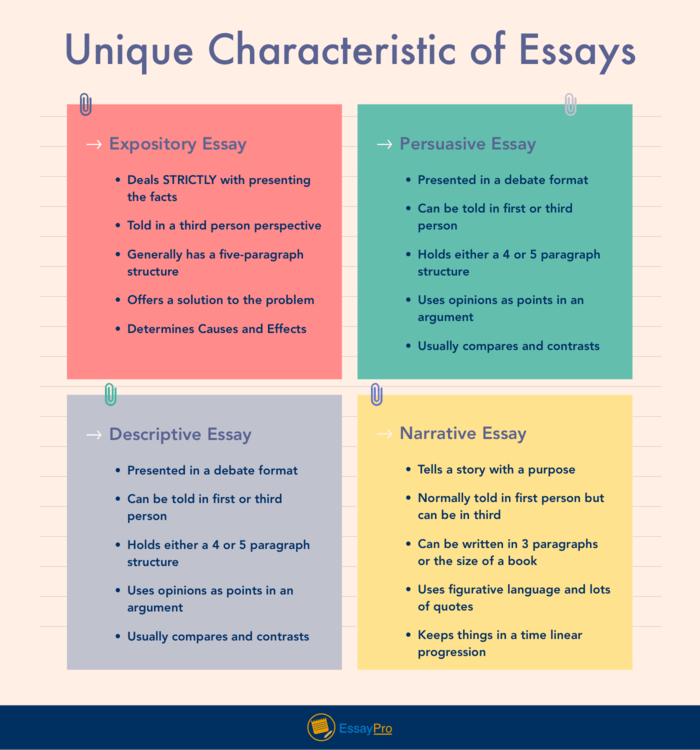
1. Expository Essays: It’s All About Facts
An expository essay is a type of academic writing in which you need to investigate a topic using facts, statistics, and examples. You can accomplish this in several ways: defining a term, comparing and contrasting, analyzing a cause and effect, etc. The purpose is to explain the subject in a logical manner. Provide a fair, balanced analysis without showing personal emotions and relation to the topic.
Tips About Writing an Expository Essay:
- Deals STRICTLY with presenting the facts
- Told in a third person perspective
- Generally has a five-paragraph structure
- Offers a solution to the problem
- Make sure to include your thesis statement in your introductory paragraph. It should be one concise sentence that describe the main idea of the story.
- Every paragraph must cover a point that relates to the thesis

2. Persuasive Essays: Convince Me If You Can
Persuasive Essays do like the name shows; they attempt to persuade an audience into believing that their side of an argument/debate is correct or better. This will require several methods of rhetoric including the use of ethos, pathos, and logos. A student that believes the death penalty should be abolished worldwide would create an argumentative essay in which they state facts and opinions for their reasoning. Persuasive essay writers must understand how to present themselves as credible sources of information, appeal to emotion, and logically reason with their audience.
Unique Characteristic of the Persuasive Essay:
- Presented in a debate format
- Can be told in first or third person
- Holds either a 4 or 5 paragraph structure.
- Uses opinions as points in an argument.
- Usually compares and contrasts
- Find relevant sources to defend their argument
- Find the most credible evidence for the opposing view


3. Descriptive Essays: Make A Picture
Descriptive Essays train a writer to describe some kind of imagery. By using the 5 senses of taste, sound, sight, touch, and smell, the writer needs to paint the clearest picture possible. Doing this helps the reader get the most realistic visualization. A common example of a descriptive essay is actually used in types of college essay writing. When submitting in a college admission application, there is a question that requires the writer to describe himself. Learning to sell something (even yourself) using vivid language and intriguing points will help you master the descriptive essay.
Unique Characteristic of the Descriptive Essay:
- Requires creative writing and descriptive skills.
- Can be told in first, second, or third person.
- Usually written in 3-5 paragraphs
- Provides details using the 5 senses
- Aims to creatively define some object or idea

4. Narrative Essays: Tell a Story
Narrative Essays are used to tell a story. This type of writing takes a different road from the usual “research and analysis” style. This type of writing essay allows one to become creative. They can come up with their own plot, setting, characters, ideas, etc. The purpose of a narrative essay is to teach a lesson through the progression of the story. As a reader, one would want to feel a sense of purpose in reading the text, and that is the ultimate goal of the writer. Most books and tales are examples of narrative writing.
Unique Characteristic of the Narrative Essay:
- Tells a story with a purpose
- Normally told in the first person but can be in third
- Can be written in 3 paragraphs or the size of a book
- Uses figurative language and lots of quotes
- Keeps things in a time linear progression
- Add dialogue between characters to add life to the essay


Though all essay types follow the same core principles, there are aspects that make them stand out from each other. After all, expository essays offer factual information, persuasive essays aim to influence, descriptive essays paint a picture, and narrative essays tell a story. These in their own right follow 4 different roads. You can easily learn how to distinguish these types of papers with the help of our essay samples.
Linking Parts of Essays
Though there are different types of essays and examples, all writing styles share some common goals. First of all, the actual parts of an essay stay the same, regardless of the style. Each essay carries with it an introduction, a body, and conclusion, these are the common parts of the outline. Although the content that is placed into those parts varies with the style, their overall purpose is static.
Introduction:
- The introduction is used to open up the topic and briefly introduce key points that will be presented later.
- Any relevant background information is presented here.
- The thesis statement is revealed at the end of the intro and reveals the overall position of the essay.
Body Paragraph(s)
- The body of an essay is the meat grinder; all the action happens here, and any points that need to be proved or explained occur in this section.
- The thesis statement is thoroughly uncovered and explained
- Each paragraph within the overall body serves its own purpose. The main goal of the text is broken down into parts, and each paragraph goes through one of those parts.
Conclusion
- The conclusion recaps main points and restates thesis statements, effectively presenting it as proven.
- The writing is given significance, usually done with a call to action or an overall concluding statement.
When it comes to grading, and overall strength of the text, college professors, and high school teachers focus on a few elements:
- Was the grammar meticulously constructed? How smoothly did the text flow?
- Did the vocabulary offer significant flavor or was it just thrown in there for word appeal. Did the content make sense?
- How well did they answer the question / express the idea?
- Did they stay focused on this specific idea or did their train of thought wander?
When a writer has sufficiently presented points 1,2 and 3, that’s when they can be confident that the writing was strong. Being able to maintain all three parts and provide insightful content that generates reader’s interest is what makes for quality writing.

1000 Word Essay
HOW TO WRITE A 1000 WORD ESSAY
1000-word essays aren’t hard. A student can write one in a day.
All it takes is a solid topic and some planning. Cook up three sources, organize them in a 5-paragraph format, and you’re good to go!
But writing a 1000-word essay that’s interesting and meaningful may take more than that. Formatting requirements (MLA) and punctuation-loving professors can make toughen things up.
In our blog, we will explore how to write a 1000-word essay. After covering a few engaging and relevant topics, we’ll jump right into the essay structure. Make sure to stick around for helpful tips at the end.
TABLE OF CONTENTS
- Choosing Topic for a 1000 Word Essay
- Types of 1000 Word Essay
- How to Structure a 1000 Word Essay
- Introduction
- Body
- Conclusion
- How to Format a 1000 Word Essay
- Tips for Editing and Productivity
What if I can’t come up with 1000 words?
The best tip that will shed light in the dark is writing in a non-stop regime. Just start writing without thinking about any word limit. Of course, it seems much more time-consuming and complicated. Nevertheless, this technique will let you understand and determine any gaps in your writing and then fix them in the shorter version of your draft.
Don’t panic if it ends up more than 2000+ words or more. Once you are done with the writing, read it several times, and highlight parts that you believe are worth attention. Then exclude all parts of the text that you think are unnecessary. Next step will be combining, polishing up and connecting them together. Include transitions between paragraphs to make sure that everything flows smoothly.
Choosing Topic for a 1000 Word Essays
Usually, instructors assign topics for such essays. If not – choosing a topic isn’t hard – make sure it fits the required essay type. Remember that you’ll have to know some background information and form a convincing argument on your topic.

The first thing to do is come up with a list of topics you find intriguing. Don’t settle for a generalized topic like “Gun control”. Instead, be more specific with your topic – “How have gun control laws affected gang activity in the state of California.” After making a list of about ten to fifteen essay topics – narrow it down and choose the best one.
These essays can sometimes be in-class assignments. Which means you’ll have to pick a topic and draft a quick outline on the spot. Here are some good sample topics for a 1000-word essay:
- Video games were more immersive, challenging, and rewarding in the early 2000s compared to now
- Superman is a role model superhero embodying traits people want to see in themselves: compassion, morality, and a sense of purpose
- 2000 years later, Plato’s Republic still provides relevant insights into justice, education, and soul.
- Forrest Gump is the greatest American movie ever made
- Students should write more essays in school as it teaches vital critical thinking and problem-solving skills
- Before going to college, students should take a break from learning for at least a year
- Winona Ryder is one of the most underrated American actresses
- Alcohol and nicotine should be labeled and classified as drugs
- These three artists prove that electric guitars have not gone out of fashion and are still a vital part of American music culture
- Kendrick Lamar is one of the few rappers who does justice to African-American culture, history, and traditions through his music
Types of 1000 Word Essays
When a professor explains how to write a 1000-word essay, they will probably list several types of essay from which you may choose. Your choice of topic will depend on the type of essay. Here are the most common ones:
Persuasive Essay. Persuading a reader will require solid facts, logical reasoning, and reputable sources.
Descriptive Essay. Vivid and illustrative language, describing a person, scene, object or memory, is the quintessence of the descriptive essay.
Narrative Essay. Mostly written during college admissions, narrative essays tell a story rather than feed information.
Expository essay. Digging deep into the roots of the topic, exposing every side of the argument, and deep critical analysis are what expository essays are notorious for.
How Long Is a 1000 Word Essay should be?
Actually, the number of pages that a thousand words might take depends on the format of those 1000 words. We found out that 1000 words take:

These are some of the common requirements if we are talking about high school and college writing.
How to Structure a 1000 Word Essay
We advise students to avoid the common mistake of ignoring their essay’s structure. Another mistake is writing too many words about unnecessary parts. Use the following structure for 1000 word essay outline to avoid such mistakes:
Introduction (100-200 words)
An introduction must capture the reader’s attention and explain what the essay will be about. Introductions vary based on different types of essays. For example, in a narrative essay the story doesn’t start until after the introduction. Read our essay introduction blog for deeper insight.
In short, ever introduction has these three parts:
- Hook or attention grabber;
- Background information;
- Thesis statement.
Body (800 words)
There are three body paragraphs in a 1000-word essay. Each one of them is focused on a specific point of discussion in the essay. The three body paragraphs work together to provide evidence and reasoning to support the thesis statement.
Each body paragraph has these four parts:

- Paragraph 1 (200-300 words)
- Topic sentence
- Argument
- Evidence
- Concluding statement
- Paragraph 2 (200-300 words)
- Topic sentence
- Argument
- Evidence
- Concluding statement
- Paragraph 3 (200-300 words)
- Topic sentence
- Argument
- Evidence
- Concluding statement
Conclusion (100-200 words)
The conclusion of your paper should summarize all the main arguments and tie them together. As mentioned previously, everybody paragraph works to support the thesis statement. In your conclusion, you must explain how all of this relates together and proves your point.
Here are the three parts of a conclusion:
- Summary of main points;
- Restating the thesis;
- Concluding statement.
For more info on essay structure, check out our extended essay outline guide!
How to Format a 1000 Word Essay
Another thing that significantly impacts the grade is adhering to the correct paper format. In most cases, your professor will specify which font, margins, alignment and citation style to use. The title page is also formatted differently, depending on the essay.
In addition to the format, a significant technical part of your essay its citation style. The two most common styles are the APA and the MLA style, with the Chicago and Harvard styles being used less often.
Follow the correct essay format and citation style to avoid lessening your grade.
Useful Tips for Editing and Productivity

The most important parts of writing an essay are organizing and editing. Writing is barely half of the work. We want to share some pro tips to save time writing and make your essay genuinely outstanding.
- Write an Outline first: Most of the time, a 1000-word essay is an in-class assignment. Scribble an outline on a separate sheet of paper to keep you focused when writing. Essay outlines aren’t made for your professor, and they’re made for you. Without an outline, you cannot see the logical structure of your essay and the progression of your arguments.
- Write an Introduction last: Starting an essay can be frustratingly hard, and most writers know this. A general rule of thumb is to write the introduction last. An essay introduction sets the tone and introduces the writer’s main arguments. After writing the whole chunk of your paper, you’ll know all your main points and the tone of your writing. Therefore it is best to leave it for last.
- Proofread Twice before submitting: If your 1000-word essay is an in-class assignment, proofread it. Grammar and logic errors won’t be tolerated by your tutor, besides it will only take a minute. Rewriting the whole paper in class is impossible. Therefore proofreading is the only quality-check you get. If your essay is not an in-class assignment, you have many more opportunities to make it good by proofreading.
- Use Apps for Proofreading: If your 1000-word essay is a homework assignment, proofread it with apps like Hemingway or Grammarly. They will find errors which you may have easily missed. Additionally, if you wish to upgrade your word choice, use sites like Dictionary.com and Thesaurus for synonyms and words with similar meaning.
- Ask a Friend or Essay Pro for Help: Never be shy to ask a friend or us to read your essay and tell you if it makes sense.

5 Paragraph Essay
HOW TO WRITE A 5 PARAGRAPH ESSAY
The 5 paragraph essay is considered to be the standard essay writing assignment. It is used in most exams such as TOEFL, IELTS, and the SAT. Since most of these exams limit the student time-wise in the “Writing” section, students are trained to memorize this format. This allows the student to answer the exam prompt quickly and efficiently. The format’s plasticity allows students to experiment with various essay styles. Persuasive, Argumentative, Expository, Narrative, and Cause and Effect essays can all be written in this format.
Perfecting the 5 paragraph essay is a practice that can turn a rookie into an experienced essay writer.
TABLE OF CONTENTS
- Types of 5 Paragraph Essay
- Good Example Topics
- Outline
- Introduction
- Body Paragraphs
- Transitions
- Conclusion
- General Grading Rubric
Types of Essays on Standardized Tests and More
A student should be aware of various types of academic papers if they wish to learn how to write an essay on an A+ level. The most challenging assignment is the one written for a standardized test. It is critical to decide on the type of essay at the beginning by either following a prompt or choosing on your own. The type of essay may define the topic and thesis. It means that some essays are better off with narrow and serious topics while the rest of the essays suit better if the student writes a creative story full of jokes. The various types of essays include:
- Definition – add a personal definition of the term or phrase along with the official one paraphrased from the dictionary
- Descriptive – add as many details as possible to illustrate the research problem
- Narrative – tell a story with vivid examples
- Argumentative & persuasive – the difference between these academic projects is the writer has to mention and explain personal position towards the analyzed problem in argumentative essay while it is also important to defend the position and convince the readers of your truth when it comes to persuasive one
- Compare & contrast – show the differences & similarities between several subjects
- Cause & effect – explain the reasons for something to happen and the consequences of these actions
- Literary analysis – pick the specific literary text like a poem or essay and evaluate/criticize it
While sometimes it is enough to answer a question, in other cases, a student has to conduct in-depth research and offer more solutions to the discussed problems. Standardized tests ask for the 5 paragraph essays. It means the writing should not be longer than 500-800 words and contain the opening part, three supporting paragraphs, and a meaningful conclusion.
Train hard at home mastering the art of academic writing. Remember that any essay you have to write for a standardized test is limited by time, so you will have to prepare a 5 paragraph essay outline and write the text itself with the speed of light.
20 Good Example Topics
Look at these 20 ideas from different categories. Choose those you like or offer new approaches to discuss:
- Can one learn a life lesson from an experience that they didn’t have?
- Factors that make higher education important
- Things you would do as the President of the United States
- Wealthy nations should share goods with countries living in poverty
- The role of fashion in modern mass media
- Should marijuana be legalized?
- Should education be free for all students?
- Allowing students to grade their tutors
- The discrimination of female employees at work
- The destruction of the globe’s forests and its consequences
- Should laws on gun-control be more strict?
- Should the death penalty be abolished completely?
- Separate classes for male and female students
- Actors in the United States are overpaid
- The importance of investing money in space exploration
- Living in the world without any rules
- Is animal testing ethical?
- Should same-sex marriage be allowed?
- The role of advanced technologies in education
- Ways to protect endangered species
The paper topics listed above are some of the most common topics students write essays about. Of course, they are not limited to only these. Before choosing a topic and starting the writing process, students should come up with a catchy title. The reason for doing so is centered around grabbing the readers attention right from the get-go. It may influence the final grade.
Academic Paper Outline
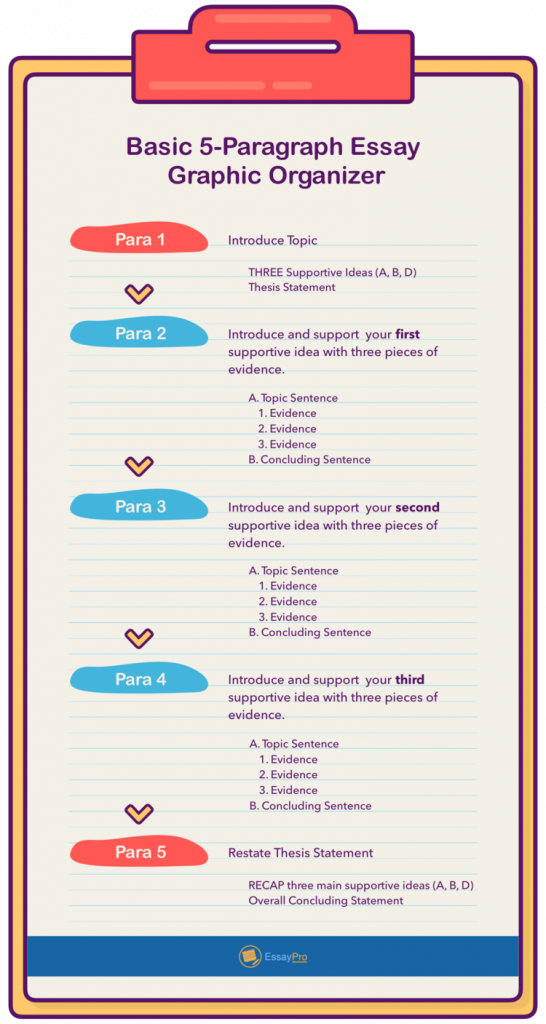
A typical essay format starts with an Introduction, goes to Body Paragraph 1, Body Paragraph 2, Body Paragraph 3, and sums things up with a Conclusion. Each body paragraph serves a specific purpose, and the essay is in the form of a keyhole. This means that it starts very BROAD, gets more NARROW and finishes out BROAD.
Introduction: 3-5 Sentences
An outline format is essential. To start your essay impressively, think about a hook. A hook is a 1-2 sentence bang that makes the reader WANT to keep on readingthe entire text: rhetorical question, literary quote, joke, anecdote, metaphor, simile, a famous person saying, fact, or statistic. It is essential to check the credibility of information twice.
- The introduction sets the structure for the rest of the essay, with the first sentence being the HOOK sentence.
- The Hook Sentence is kind of like the spark to a flame. It grabs the reader’s attention.
- The Hook is usually either a rhetorical question or some life example or a stunning fact
For Example: If your essay is about the preservation of our environment, you could say something like: “Do we want to live on a planet where we are surrounded by desert and wasteland?”
This is a rhetorical question, meaning it does not need an answer because it is obvious.
Brief Introduction of Supporting Arguments (1-3)
Here you are taking your supporting arguments and briefly introducing them to the reader without revealing too much information.
Tip! Think of it as a trailer for a movie, like it should be exciting but can’t give away the “PLOT.”
Example: Preservation of our environment is one of the keys to keeping our planet in a healthy state.

Thesis Statement
- The essential part of your entire essay; this is your argument.
- This statement will be the basis for the rest of your custom essay.
- Since we are talking about nature preservation, an example of a good thesis would be:
- “The preservation of our planet is the most important aspect of keeping Mother Nature in check and avoiding draconian disasters.”
Quick Tip: if you find that your body paragraphs have nothing to do with your thesis, you can go back and change the argument.
Body Paragraphs 1,2,3 (5-7 Sentences)!
Grab this five paragraphs essay graphic organizer! Even though all body paragraphs are equally vital, keep in mind that the opening paragraph should be the strongest one! It may include the most potent argument. A writer should come up with the most vivid example, smartest illustration, and an obvious starting point – topic sentence. Do not forget to add the “reverse hook” sentence. Each argument of the body must relate to the thesis. Here are some other facts about the body:
- This is the “meat” of your 5 paragraph essay, where you explain the side you are defending (Thesis Sentence)
- Structure of the body paragraphs is usually: Intro sentence (1), Supporting Argument
- Explanation (3-5), Concluding Sentence (1)
- Intro sentence should briefly bring out your argument without revealing too much information
- Example: Deforestation and air pollution not only hurt the planet but reduces air quality and increases the likelihood of disease!
- What about Supporting Argument and Explanation? This is taking the topic and going into detail, while still most importantly DEFENDING YOUR THESIS!
- Example: Greed and selfishness are big players that damage our environment with methods that kill our trees and worsen our air. Though short term it may be profitable for the few, long-term it is hazardous for all. In Beijing for example, the air quality is so weak that it is mandatory to wear masks just for its large population to walk around in the streets.
- The Concluding Sentence should be the opposite of the intro. Instead of introducing your argument, you are briefly concluding your argument, transitioning into your next one.
- Example: To conclude, the destruction of our natural resources and our air quality not only worsens the planet’s health, but humanity’s as well.
THE FORMAT FOR ALL 3 BODY PARAGRAPHS IS THE SAME!
KEY TIP:
- The arguments should go in this order:
- The 1st body paragraph should be your second strongest argument
- The 2nd body should be your weakest argument
- The 3rd body should be your most persuasive argument
To give our readers a nice keyhole format visual, we have a picture of a standard Graphic Organizer below.
The Role of Transition Words & Phrases
Between the paragraphs, a student should have transition words from different categories:
- Agreement / Addition / Similarity
- Opposition / Limitation / Contradiction
- Cause / Condition / Purpose
- Examples / Support / Emphasis
- Effect / Consequence / Result
- Conclusion / Summary / Restatement
- Time / Chronology / Sequence
- Space / Location / Place
Why do transition words matter? Could they be the reason for the better grade? Many students fail to include these essential building bridges between different paragraphs, and it makes the paper lose its sense. Inserting a transition is critical. Do it either at the end of the paragraph or the beginning of the upcoming one. Here are the questions you have to consider to choose the appropriate transition word out of the pool of choices:
Decide whether the 1st paragraph reveals a pro and the next one stands for a con;
Think about whether the 2nd paragraph share something of more significant importance;
Is there an earlier historical example to serve as evidence?
Is there another sort of consideration?
Conclusion (3-5 Sentences): This is the “mirror” of your intro
The last paragraph of your paper must contain these elements:
- An allusion to the pattern applied in the opening part,
- A rewritten thesis statement with the help of original language and interpretation – do not merely copy-paste the thesis,
- A summary of the three major points from the paper’s body,
- A closing statement that alarms the reader that the discussion is about to be over.
Look at the detailed descriptions of the recommended steps.
Restate Your Thesis (Sentence 1): You take your main argument (thesis) and restate it conclusively. You are paraphrasing it assertively. Show that you have “proved your point.”
Example: The safety and survival of the Earth are incredibly dependent upon how we as people decide to treat it, and the more carefully we nourish the process, the more beneficial it will be for all.
Conclude your supporting arguments (1-3 Sentences): This is taking your supporting arguments (your body paragraphs) and rephrasing the main points you made in one sentence per paragraph.
What if some of the supporting arguments are similar? Combine them into one sentence to keep the proper structure.
So for example, if one of your supporting arguments was about limiting the use of resources, you could say “Limiting the use of our natural resources and improving their efficiency are key steps in improving the health of our planet.”
Concluding Hook Sentence (Optional)
An excellent way to end an essay is something unexpected, to surprise the reader.
Create a second hook. This time it should be a hook that SUMS things up in a few words, rhetorical questions are right for this.
Example: “The health of our planet is of great importance, and after all, we don’t want to live in a wasteland do we?”
This gives the 5 paragraph essay some spice at the end and makes the reader question your statement.
How about a General Grading Rubric?
Several schools and universities worldwide use several different types of rubrics, but one of the most standard rubric styles is the 5 point style, where it is broken down into five segments: Focus, Organization, Conventions, Style, and Content.
- Focus: Did the writer spends his time proving his thesis? Did he accomplish his goal?
- Organization: Was the essay readable; the transitions between paragraphs smooth; and did the writer follow the proper outline format and not diverge from the set structure?
- Conventions: Did the writer make many grammatical mistakes? Did they have run on sentences?
- Style: Did the writer use high-level vocabulary, were words rarely repeated, how original were his sentence structures?
- Content: Did the writer adequately prove his argument and were his statements logical, reliable, and factual?
Example


5 Paragraph Essay Outline
HOW TO WRITE A 5-PARAGRAPH ESSAY OUTLINE
Writing a 5 paragraph essay outline will help one organize their thoughts and create a rough sketch of their final product before “coloring in” all the details. But before we get to the nitty-gritty, let’s discuss what makes this type of writing so special.
TABLE OF CONTENTS
- About The 5-Paragraph Essay
- Outline Template
- Template Explained
- Example
About This Type Of Essay
The 5 paragraph essay is one of the most common academic writing assignments given to students. Starting from middle school and working all the way up to college level tasks, this particular style is seen in all educational levels. The reason this type of writing is so popular has to do with its main perk: it allows the writer complete freedom when choosing between topics.
As there are many different types of essays that each contain their own sets of rules and writing styles, one will be limited when it comes down to choosing a topic for more specific types. For this reason, the 5 paragraph format is the most versatile among all essay types.
5 Paragraph Essay Outline Template
Most commonly, a student will be asked to write a 5 paragraph essay that defends a side of an argument (persuasive) or develops their own idea from an original question (analytical). Sometimes, they will be asked to tell a story (narrative essay) or write using their imagination (creative writing), but for most academic assignments, one will be asked to write about the former of the two groups.
That being said, the outline is broken down into five main sections (1 per paragraph), and each section will have between 3-5 subpoints. Each subpoint has its own objective, so to build a complete essay outline, one will need to accurately come up with 15-20 guidelines. Down below is an example of an acceptable template:
Introduction
- Hook Statement
- Background Information
- Thesis Statement
Body Paragraph 1
- Topic Sentence
- Claim
- Evidence
- Concluding Statement
Body Paragraph 2
- Topic Sentence 2
- Claim #2
- Evidence
Concluding Statement
Body Paragraph 3
- Topic Sentence 3
- Claim #3
- Evidence
- Concluding statement
Conclusion
- Restatement of Thesis
- Summarization of Main Points
- Overall Concluding Statement

The Outline For A 5 Paragraph Essay (Template Explained)
To start any five-paragraph essay, the author should always implement an exciting hook to grab the reader’s attention from the get-go. This can be something like an interesting fact, rhetorical question or humorous idea; the main goal is to keep your reader interested! Following this step, you want to provide your reader with any necessary background information regarding your topic.
This is especially true if the majority of your information can not be classified as general knowledge. The main goal of this step is to clear up any possible confusion that your audience may have encountered. Lastly, you want to conclude your introduction by presenting a well-thought-out thesis statement that covers the main idea of your entire essay. As this is the central point of your paper, it is important to ensure that the focus of the body revolves around this statement.

After presenting your introduction, the next step is to create a topic sentence that transitions the essay from the previous point to the ongoing one. Using strong transitions words such as firstly, afterwards and moreover will keep your writing flowing smoothly. That being said, the topic sentence should reveal the supporting idea that will defend your thesis. After finishing this step, you must create a claim. In essence, this illustrates the link between your supporting idea and the thesis statement.
So, if we consider the thesis statement to be the focal point of our entire essay, then likewise, we can consider the claim to be the central piece of its respective body paragraph. After presenting a claim, you must then defend it with evidence.Facts, statistics, logic or anything else that can be used to support the claim should be presented. This will usually be between 1-3 sentences. Lastly, to finish a body paragraph, one must present a concluding statement. This sentence presents the significance of the link between the claim and thesis statement, strengthening the validity of the body paragraph accordingly.

It is important to note that each body paragraph follows the same structure; however, each should have their own unique claim as well as separate evidence to help build a well-rounded essay. Lastly, the order of argument strength does indeed matter.
This means that your best argument should come in the first paragraph, the second best in the second, and the weakest argument in the third (although you shouldn’t have weak arguments… but, you know what I mean). The reason for this has to do with reader attention span, and most likely their mind will start wandering off as they get deeper into the writing, so make sure they get the best at first!

To finish off a good 5 paragraph essay, the author has three final objectives. First of all, they must restate their thesis in a different language using conclusive phrases such as: in conclusion, to wrap things, in the end, etc. Afterwards, the next step is to summarize the claims made from each body paragraph and their significance.
Make sure to do this for all three claims. To finish the entire essay, the author should present an overall concluding statement that offers value from a real-world perspective. In other words, how can the information be taken from the writing and applied to a real-world situation? This leaves the reader with a call to action and motivation for further investigation.

5 Paragraph Essay Outline Example
Topic: Why is history and culture important to society?
Introduction
- Humans tend to repeat mistakes, whether it be personal ones or general faults of our species. Thankfully, we finally understood that war never changes, and this acceptance has brought great prosperity. (Hook)
- Introducing the importance of traditions, understanding our roots, and dialoguing the growth of the human race. (Background info)
- Remembering and embracing our past while simultaneously learning and building from it can help the human race achieve great things at an ever increasing rate!
Body Paragraph 1
- Topic sentence introducing traditions and why they hold value.
- Linking the value of our traditions and how we can build from them.
- Evidence of this done in the past (Sounds → Language) (Sticks + Stones → Rifles)
- Concluding statement about the significance of tradition.
Body Paragraph 2
- Topic sentence introducing the importance of embracing our culture.
- Showing our origins and highlighting the value of understanding ourselves
- Provide examples (Civilizations → Empires → Cities)
- Concluding statement about the value of our origins
Body Paragraph 3
- Topic sentence that exclaims the importance of dialoguing our race.
- Using our past to better our future and learning from our mistakes
- Examples (Less War, Technological Growth, Human Rights)
- Significance of the documentation
Conclusion
- By analyzing our cultural and historical past, we can build a future for a better tomorrow! (Thesis Restatement)
- Summary of traditions claim.
- Summary of the cultural claim.
- Summary of value that comes from dialoguing our race.
- If we don’t consider our past as a valuable pool from where to obtain information, then we are showcasing ourselves as an ignorant race. (Overall Concluding Statement)

Bullying Essay
HOW TO WRITE A BULLYING ESSAY?
Why is a bullying essay so popular in the US schools? Numerous statistics and facts provide the answer to this question: The National Center for Education Statistics reports that 1/3 of the school students were bullied in 2007, and some of them on a daily basis. 56% of students witnessed this phenomenon. These dramatic statistics are alarming, and a bully essay is one of the effective ways to make people think about preventing the cruelty in educational institutions.
On our APP writing website, each student can count on cheap help with various academic assignments, including a bullying essay writing.
TABLE OF CONTENTS
- What is a Bullying Essay?
- Bullying Essay Outline
- Topics & Ideas
- Essay Examples
What is a Bullying Essay?
A bullying essay is the type of academic writing assignment that aims to explain the reasons and outcomes of teenage cruelty in the educational institutions. The paper explains why some students wish to miss school. You can choose one of the available essay types to express the feelings towards this problem:
- Definition (define the phenomenon)
- Descriptive (describe the issue with an example)
- Narrative (come up with the related story you personally witnessed)
- Cause & effect (the reasons and outcomes of abuse)
- Compare & contrast (you may compare one phenomenon to a similar one)
- Argumentative (take a certain position on the chosen topic)
- Persuasive (prove why your position is the right one)
- Research paper (conduct in-depth study to learn more about the problem)
It is up to the student to choose an idea unless a tutor assigns the topic. The main goal of a bully essay is to prove this issue matters. It is important to show the adverse consequences and motivate the target audience to start doing something instead of silently witnessing the juvenile crime against each other.
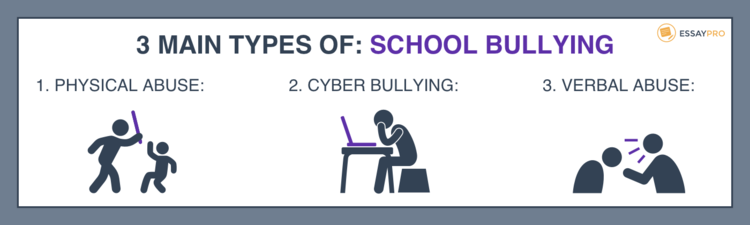
The type of bullying also matters. For example, there is a significant difference between cyber bullying and school bullying, and you should keep in mind the major differences while talking about one of them.
Bullying Essay Topics
It is not that easy to select a specific topic. The teachers do not always assign one. Th basic rules for selecting the research question are:
- Brainstorming. Sit down with your peers or family members to discuss the recent trends related to the school crimes and prepare a list of possible ideas.
- Discussing. You should not ignore the help of your tutor – hurry up to consult them before it is too late (before the deadline passes). They can help you before or during the process, not after!
- Exploring. Learn as many details about the issue as possible to decide whether there is enough information available from the sources you can access for free.
- Excluding. Exclude the topics you do not like or have minimum information about from the list one-by-one, leaving the best idea on the go!
Here are some of the top anti bullying essay topics to consider:
- Being mean to the surrounding people
- Teasing and pleasing in the US high schools
- The difference between teasing and bullying
- An example of teasing you witnessed
- Different types of bullying
- Teenage bullying essay
- The basic factors of cyber bullying
- The role of the internet in high school bullying
- The “best” age for school bullying
- The reasons for bullies to behave the way they do
- The consequences of high school bullying
- The way bullying impacts academic performance of the victim
- The mental issues of the school bullying victims
- The most effective ways to fight school bullying
- The useful prevention measures
- The best punishment for the school bullying
- Physical abuse in high school
- Verbal attacks of the classmates
- Psychological explanation of the concept
- The role of parents in preventing school bullying
- How to identify, prevent and respond to cyberbullying
Those are the top topics to consider. This information may be insufficient to succeed.
Bullying Essay Outline
Bullying essay outline will look the same way as a regular essay on any other topic. You can add more body paragraphs if necessary. The flow of thoughts should be logical – that is why it is critical to come up with an action plan called outline before writing the paper. The template you may use is:
- Introduction: Define the research question, explain why it matters in modern society, and finish with an impressive thesis statement. You may involve a hook sentence like a shaking fact or statistics in the beginning to catch the reader’s eye. The goal is to make them read to the end and care about the issue.
- Body: Each body paragraph should start with a topic sentence (claim), followed by the evidence and examples collected from the primary sourcesand personal author’s experience.
- Conclusion: Start with a paraphrased thesis. Try to provide a sense of why the discussed problem remains relevant or significant for the US society and how to fight it effectively.
- Bibliography: Do not forget to recall the sources cited in the text to earn extra credits, avoid problems with plagiarism, acknowledge the distinguished authors, and offer your reader more information to observe.
Writing a bullying essay introduction is the most important section. We should discuss it next.
Bullying Essay Introduction
Writing a paper on bullying is an important step in the process of fighting and preventing a harsh high school issue. In college, the problem is less relevant, but college students often write about it in their research papers.
In the opening paragraph, a student must grab attention. The best method is to start with a dramatic statistics about the explored issue to make the reader understand how it matters in the modern society. It is not enough just today that it is bad and takes place.
Briefly summarize why some students get at others, providing a background (history) of the research question. You may add the basic types of bullying here. End up with a persuasive thesis statement made of 1-2 sentences. It must summarize the reasons to study the offered research question and offer a particular author’s position.
Once you are done, provide at least 3 arguments to support the thesis statement in the upcoming body paragraphs of the paper.
Bullying Essay Conclusion
Writing a conclusion is not the time to relax! It is about stressing the importance of an issue once again. In the ways to reduce bullying in schools essay, an author may summarize the basic methods of fighting the problem along with the possible implementation and predictions for the future. At the end of a cyber bullying essay, you may offer several solutions to get rid of the issue online along with the forecasts regarding internet crimes. Do not forget to include a restated thesis at the beginning! It is a good idea to finish with a hook to leave the impression on the reader, reminding how important it is to solve the problem.
Free Bullying Essay Examples
How about having a look at the short paper about bullying written by one of the academic writing experts? It will provide you with an overall idea of how to write an argumentative essay on bullying.
If you have difficult times writing any type of academic paper, do not hesitate to contact one of Essay Pro writers and ask for help.
Cyber Bullying Cause and Effect Essay

A Persuasive Essay on Bullying
“No matter what kind of bullying the students face, it is an extremely hazardous issue. Several reasons for this type of rule break exist. The main reasons include insecurities, mental issues, evil nature, family problems, and other things that make the bullies feel uncomfortable about themselves. They put others down to feel better. Bullying has both emotional and physical negative impacts on the victim. As a result, a student suffering from bullies may feel depressed, lonely, shy, weak, and start experiencing the symptoms of different mental diseases. In this essay, I will prove that governments, school boards, and parents have to invest more time, efforts, and money in improving the situation with bullying by preventing it or at least helping the victims.”
How to Prevent Bullying Essay
“The statistics are dismaying: the recent studies showed that 13% of kids in kindergarten and school become the victims of bad treatment from the side of their classmates. 11% of kids admit to being a bully. A lack of support leads to such type of self-protection. This essay proves that the best ways to reduce the problem or even solve it completely include analyzing the warning signs, keeping in touch with children, educating school children on the problems associated with self-protection, teaching a child empathy, reporting any acts of bullying, etc.”

500 Word Essay
500 WORD ESSAY: COMPLETE WRITING GUIDE
The 500-word essay is an excellent focus exercise. It teaches students to be clear and concise; to get their point across in as little as 500 words. Expect it to pop up frequently in your late high school and college freshman years.
This essay appears during in-class writing exercises and exam questions. You’ll be expected to write this essay fast, like 45-minutes fast. Hence, learning how to write a 500-word essay is essential for every student.
The essay itself is short. Still, you must always have a solid hook, thesis, and other structural and literary requirements. The professor will evaluate your ability to be clear and concise while using the least amount of words.
TABLE OF CONTENTS
- Length & Formatting: How Long is a 500 Word Essay?
- Creating an Outline
- How to Write a 500 Word Essay
- Writing Tips
Length & Formatting: How Long is a 500 Word Essay
So how long is a 500-word essay? You guessed it! It’s 500 words long.
The essay is usually presented in Times New Roman 12pt. All school and college papers are double-spaced and include a title page.
Pages are usually numbered and include the student’s surname near the page numbers. Ask your instructor about the essay format you should use (MLA, APA, etc.). Since these essays are usually handwritten during class or exams, the form is not a central priority.
Your 500 word essay length should not exceed a page and a half. This exercise is meant to show that you can prove your thesis in 500 words. Therefore it is crucial not to exceed the word limit.
Creating an Outline
To write a 500-word paper fast, you must start with the outline. It is the skeleton of your essay that must include all the points you wish to discuss.
Just jot down an outline on a separate piece of paper to help you be organized when writing. The outline must include:
- An essay introduction
- Hook
- Background information
- Thesis
- Body
- Topic sentence
- Supporting evidence
- Concluding sentence
- Conclusion
- Summary of main points
- Re-stating the thesis
- Final thoughts
A helpful strategy in thinking about the essay conclusion is asking the “So What?” question. Asking yourself this question will help you explore and clarify the importance of your study to the reader.
After you jot down the outline, you’ll have a perfect picture of the essay in your head. Writing it will be the most natural part!
How to Write a 500 word Essay
After you’ve picked a topic and made an outline, it’s time to write your essay. Remember to keep the outline handy as a point of reference.
Introduction
Your introduction should grab the reader’s attention and provide some background information about your topic. Keep in mind that a sharp hook is only the start. You want to keep your reader interested the whole time. Try to maintain the same optimistic tone throughout the paper as in your introduction.
And don’t forget about the thesis statement!

Body Paragraphs
The body is the section where you present your main points in a specific order. Each body paragraph consists of a topic sentence, a reference to a study or source (if necessary), and personal insight which explores the topic sentence from your point of view.
Each body paragraph must transition logically into the next. Good transition sentences will create a smooth reading experience for the reader.
Your essay will feel like a coherent whole, rather than a summary of facts.

Conclusion
Good conclusions trace back to the essay introduction by restating the thesis. The most important goal of the concluding paragraph is to summarize the main points and leave the reader with a sense of completeness.
Lastly, offer your concluding thoughts on the paper.
- Why have you chosen the topic?
- Why is the issue relevant?
- What lessons or morals have you gained while exploring the topic?
A great tip that always works: create a draft before writing the final essay. Proofreading and editing are what makes compositions great!

More about this in the next section.
Writing Tips
As Stephen King once said, “To write is human, to edit is divine.” The editing process is the secret to all great writing. Here are some useful tips to help make your essay smooth:
- Forget It, Then Edit
The rule of thumb is to leave your article for a few days if you can. Forget about it – do something fun. Then come back to it. You will immediately see every loophole and be motivated to fix it. - Get a Second Pair of Eyes If You Can
Ask your friends & siblings to read your essay. They could offer useful insight and help you improve your writing. Don’t be shy! - Check for Grammar
It’s a bummer when your grade goes down because of grammar. It’s an easy thing to miss. Luckily, there are plenty sites like Grammarly which could check the paper for you. - Check for Clarity
Even if your piece of writing seems logical to you, your peers may find it hard to understand.
Make sure that your sentences are not too lengthy, and that you use transitions between paragraphs. There’s a useful online app called Hemingway app which can help you simplify your writing. - References
If you’ve referenced trustworthy sources, it’s important to cite them. This action will add credibility to your writing. Citing quotes & referencing the external sources on the last page of your work will prevent you from facing plagiarism issues and lower grades. Mind the preferred citation format.
500 Word Essay Examples
Epidemiology is the scientific study and analysis of the distribution of diseases within a specific demographic of people or animals. It involves a particular evaluation of when, how and where the condition occurred (Trichopoulos et al.2015). Through the study, the epidemiologist determines the risk factors…
Quantitative research is the systematic empirical investigation of diverse phenomena using the primary method of collecting data and viable information through utilization of mathematical, statistical and measurable techniques such as figures (Hartas, 2015)…
AP English Essay
AP ENGLISH LANGUAGE ESSAY: THE RECEIPT FOR SUCCESS
What is AP English Essay?
AP English is a rigorous college-level class that is divided into two different sections: AP English Language and Composition; AP English Literature and Composition. The Language course deals with rhetoric while the Literature course focuses on literature analysis. Both exams require knowledge on how to write a synthesis essay, AP English format integrated.
TABLE OF CONTENTS
- 2019 Language and Composition Exam
- AP English Literature Essay
- AP English Language and Composition Essay
- Rubric and Tips
- How to Approach the Format
- Proofread Your Essay
2019 Language and Composition Exam
During the exam, you are required to answer write three essays: two of them analyze a piece of literature (an excerpt from a short story, a poem, or a narrative essay) and one answers a free response prompt on a piece of merit-based writing that you’ve read before the exam. Your exam is divided into portions. There will most likely be:
- 10-20 questions on Modern (20th century) poetry/prose.
- 10-20 questions on Victorian or Romantic poetry/prose.
- 5-10 questions on 17th-century Elizabethan poetry/prose.
You are not likely to see much Contemporary (beyond 20th century) or Middle English (450-1600), so do not waste your time practicing those poems.
AP English Literature Essay
To some, the AP English analysis essay is harder than the free response essay. To approach this type of writing, EssayPro team have selected several steps you could take to prepare.
- Learn to read and comprehend poetry/prose quickly. Practice by reading a lot of different poems from different periods.
- Read the prompt before reading the poem/prose and right before writing. Annotate the prompt. Look for keywords and themes. Make sure you understand the question entirely.
- Annotate the passage/poem as you go. Pay close attention to the keywords and main topics given to you in the prompt.
Remember: practice makes perfect. Here is a couple of AP English Literature essay prompts for you to practice.
Question 1
This question states that you need to analyze how the speaker uses symbolism through such devices as form, diction, and imagery. In your English class, you probably learned that symbolism is when a writer takes a symbol and attaches a secondary meaning to it. Tokens can be metaphors or metaphysical conceits. In this case, the Flea resembles something that isn’t precisely a Flea. Your interpretation should be accurate and supported by evidence. You don’t want to list rhetorical devices. Instead, you want to analyze the essay and make sure your claim is substantiated.
Question 2
This question asks you to analyze the way structure contributes to the meaning of the poem. The structure of the poem is a villanelle. From here on, you have to develop a unique interpretation of how the structure contributes to the meaning. Here, you can focus on repetition and elaborate on how it helps to mean. While writing essays like this, instead of quoting the whole line in your custom essay, write the line number when referring to a specific point in the poem.
Question 3
Most people say that the hardest part of an AP English exam is the free response section. This specific prompt asks you to explain why a character’s moral ambiguity contributes to the novel’s theme. After picking a story and a character (a benefit of the free response essay is that you have the freedom to choose whatever novel and style you want), you have to demonstrate how their moral ambiguity contributes mainly to the plot of the story. The little note at the end of the prompt about avoiding plot summary is very important. Do not summarize the events of the novel. This will hinder your score and take points off your paper.
AP English Language and Composition Essay
What Does That Mean?
This course features an exam that is divided into four parts: the multiple choice portion and three essays: an argumentative, a synthesis, and a persuasive essay. Necessarily, an AP English argument essay is precisely like a basic argument paper that you’ve written in high school but with a twist: you have to equip it with perfect grammar and have a well-structured claim. In gist, AP Language and Composition is an extremely rigorous course that requires you to write essays that demonstrate primal ability to analyze works of literature. Perfect grammar and structure on an exam like this will not award you maximum points or a five on the exam.
This course features an exam that is divided into four parts: the multiple choice portion and three essays: an argumentative, a synthesis, and a persuasive essay.
How to deal with the Prompt
Prompts in AP English Language aren’t the same as in AP English Literature. Prompt consists of an article that you have to synthesize. On occasion, an AP English Literature exam will have a designated quick, but the objective of the course is to allow you to build analytical pieces. The most important thing you can do to prepare for your AP English synthesis essay is to learn the format of and analyze/dissect many AP English essay prompts (pieces of writing, that is) as you can before taking the exam.
Rubric and Tips
An AP English essay rubric can be divided into three parts: a high scoring essay, a mid-range essay, and a low-scoring essay.
High range Essay (8-9 points)
- Effectively develops a position on the assigned topic.
- Demonstrates full understanding of the sources or text.
- Correctly synthesizes sources and establishes a position. The writer drives the argument, not the causes.
- The writer’s argument is convincing.
- The writer does not make general assertions and cites specific evidence for each one of his points.
- The writer’s evidence effectively answers the “so what?” question.
- The essay is clear, well-organized, and coherent. It is a stand-alone piece rather than an exam response.
- Contains very few grammatical and spelling errors or flaws, if any.
Note: 8-9 essays are extremely rare. A definite ‘7’ paper can jump to an 8-9 if the writing style is outstanding.
Middle-Range Essay (5-7)
- Adequately develops a position on the assigned topic.
- Demonstrates sufficient understanding of the ideas developed in sources
- Sufficiently summarizes the origins and assumes some control of the argument. ‘5’ essays are less focused than ‘6’ and ‘7’.
- The writer’s argument is sufficient but less developed.
- Writer successfully synthesizes the sources and cites them.
- The writer answers the “So what?” question but may use generalizations or assertions of universal truth. The writer cites their own experience and specific evidence.
- The essay is clear and well organized. ‘5’ essays less so.
- Contains few minor errors of grammar or syntax.
Note: A ‘7’ is awarded to papers of very sophisticated writing. A ‘5’ designates a three on the AP exam; these essays use generalizations and have limited control of the claim and argument. ‘5’ essays often lose focus and digress.
Low-Range Essays (1-4)
- Inadequately develops a position on the assigned topic.
- The author misunderstands and simplifies the ideas developed in the sources.
- Over-summarizes the sources, lets the sources drive the argument.
- The writer has weak control of organization and syntax. The essay contains numerous grammatical/spelling errors.
- A writer does not cite the sources correctly, skips a citation, or cites fewer than the required minimum of the sources.
- Notes: ‘4’ or ‘3’ essays do assert an argument but do not sufficiently develop it.
- A ‘2’ essay does not develop an argument.
- A 1-2 essay has severe writing errors and does not assert a claim.
- As long as you don’t draw a picture on your exam paper, write a bullet point list, or compose a narrative about your dog, you will get above a three on this essay.
How to Approach the Format
The AP English essay format is similar to the format of any other essay. Your introductory paragraph should have a thesis and demonstrate your argument. Your body should illustrate points that back your argument up and your conclusion should summarize your essay. A significant difference is the three components of an AP English Language and Composition synthesis essay that absolutely must be present.
- Argument: a central claim with specific supporting evidence.
- AP English Language synthesis essay focuses on the analysis of multiple perspectives.
- Rhetorical Analysis: definition of the author and his intentions. Purpose audience and claim are all parts of the assignment.
Read more: How to Write a Rhetorical Analysis Essay
Examples


Argumentative Essay
HOW TO WRITE AN ARGUMENTATIVE ESSAY
Some students may struggle when it comes to argumentative essays. Usually, this task is assigned to students on the SAT, ACT, IELTS, and TOEFL tests. Professors also assign this type of essay as coursework. Without knowing the correct steps to write a good argumentative essay, it can be very tough and time-consuming.
Many students around the US face this task annually. All it takes is gathering information and applying the correct citation format. The rest is a piece of cake! Follow this guide to learn how to write an argumentative essay. Learning this style of writing is the start of your journey to getting the grades you deserve.
TABLE OF CONTENTS
- Argumentative Essay Definition
- Argumentative Essay Topics
- Creating An Argumentative Essay Outline
- The Writing Process
- Tips For Success
- Some Good Examples
What is an Argumentative Essay?
Argumentative essay is a style of academic writing where the author presents both sides of an argument or an issue. The purpose is to inform rather than convince. That’s why an argumentative essay is not to be confused with a persuasive essay.
The thesis includes all counterpoints from both opposing arguments. It’s almost like a political debate with oneself.
There are two ways to come across this form of the essay:
- One of the ways is to present both arguments equally
- The other way is to give one argument more forcefully than the opposing factors
By practicing argumentative writing, students can evaluate issues from multiple perspectives. When writing an argumentative essay, it’s important to focus on facts and information rather than personal ideas or preferences.
The author may present arguments equally, or support one in favor of others. Regardless, the thesis must include all the primary points (and counterpoints) which will appear in the essay.
Argumentative Essay Topics

Just like with all other essay types, there are tons of topics to choose from when writing an argumentative essay. However, it is important to remember that they must be in a debate format. In other words, explain why option A is better than option B, or vice versa.
Here are some good argumentative essay topics to get you started:
- Apple vs. Microsoft: Which software brand is more useful for students?
- Do violent video games have a negative psychological impact on children?
- From a financial perspective, should one invest in cryptocurrencies?
- From an economic standpoint, are electric cars better overall?
- Has society become too reliant on technology?
Interesting Argumentative Essay Topics for High School
As students will begin writing this type of content in school, it is essential to give them easy essay topics so they can get a grasp of the task. Here are some examples:
- What is the most important second language to know as a US student?
- Should the minimum driving age be lowered?
- Are standardized tests a fair reflection of students skills?
- Are athletes overpaid for their skills?
- Should high school students be free to choose their classes?
Topics for College
As we transition to the university level, the question asked alongside the complexity of content should increase. With that being said, here are some challenging topics for college students.
- Is there enough evidence to prove that news sources have a biased agenda?
- Would the legalization of marijuana as a recreational drug be economically justifiable?
- Can we constitute Russia as a superpower alongside the USA and China?
- What was the most influential technological advancement in the history of humanity?
- Should we sacrifice some public services for lowered tax brackets?
Argumentative Essay Outline
Now that we understand what this type of writing is all about, we can start putting pieces of the argumentative essay outline together. Usually written in the five-paragraph structure, this argumentative essay outline will consist of an introduction, 2-3 body paragraphs, and a conclusion. Logically, each of those three sections will have a unique structure, so understanding them on an individual level will help ensure a smooth writing process.

We will be using “the internet” as the most significant technological advancement in society as an example
Introduction (3 Parts)
- How To Start An Argumentative Essay Outline (Hook Statement): As with most other types of essays, one should attempt to captivate the reader’s interest from the very beginning. To do this, create a sentence that stands out from the rest of the text. Consider something such as a rhetorical question, funny quote or intriguing idea. The goal is to get your audience reaching for that bag of popcorn right after reading the hook!
- Background Information: After gathering the audience’s attention, the next step is to present any necessary context to narrow the focus. This information should not reveal any of the main arguments from your body.Also, it should ideally transition the train of thought towards the thesis statement.
- Thesis Statement: The last sentence of the introduction should present the focal point/central argument of your entire essay. It is essential to writing a thesis correctly, and this is accomplished through proper phrasing. Remember: your primary objective is to defend your idea, so the thesis must DIRECTLY state what your idea is and why it is correct.

Body Paragraphs (4 Steps)
- Topic Sentence: Start with a sentence that transitions the focus from the previous paragraph to the current one; it should also introduce the main sub-argument for that particular section.
- Claim: After presenting your topic sentence, it is time to link your main sub-argument with the thesis statement. The goal is to explain how this point validates and strengthens your central message.
- Evidence: After providing a valid claim, you must defend it with factual support. Examples of this can be statistics, references or logical ideas that support ones claim since they are getting information from external sources, adding to the essays overall validity.
- Concluding Statement: After presenting a defendable claim and supporting it with evidence, one must end the body paragraph with a concluding statement. The primary goal of this sentence is to summarize the overall significance of the claim to the thesis. In other words, why was this particular point so essential?
Note that this structure works for each body paragraph. The main difference comes with the actual claim, supporting evidence, etc.

Conclusion (3 Steps)
- Restate The Thesis: The first sentence of any conclusion should always be a restatement of your central message (thesis statement). Using assertive language, restate your thesis in an “I have 100% proven this point” type of way. When information is presented to an audience with confidence, they are subconsciously more inclined to believe that it is in fact, true.
- Brief Summarization of Sub Arguments: Most likely, the audience has already forgotten some of the information you presented. For this reason, go back through and review your main points, giving your argument closure.
- Overall Concluding Statement: To end an argumentative essay outline with a bang, present a memorable concluding statement. Usually, this sentence will express the universal importance of the information and should leave the reader with a call to action for further investigation.

The Writing Process
When it comes to sitting down and writing an argumentative essay, the author has four primary objectives:
- Brainstorm + Topic Selection: Obviously, before one can start putting pen to paper, they have to figure out what they will be writing about. Unless one has been given a predetermined topic, they will usually have freedom of choice. EssayPro always recommends that students choose a passionate theme; doing so will naturally give the author more enthusiasm and motivation to do a good job.
- Research, Research, Research: Even if you are savvy in the field of choice, there is a bundle of information out there that is unknown to you. Use various sources such as reliable internet articles, encyclopedias, historical documents, and other related materials to gain a well-rounded understanding of a topic and what avenue you will approach.
- Writing A Rough Draft: Now that you have a thesis and valid external information, you can start putting pen to paper (or fingers to keyboard.) Follow the outline laid out above for guaranteed success and keep in mind the following things:
- Writing a Final Draft: After finishing your rough draft, take some time away from the essay. Let your brain recover and come back to it the next day (or a few hours later, depending on how bad of a procrastinator you are) with a fresh perspective. More likely than not, you will see flaws in grammar, vocabulary, and logic. Make those final amendments and read your essay out loud for a final polish. If it sounds good, then looks like you are finished!

Final Tips
Referring to tips can help you to write a good argumentative essay in many ways. When it comes to writing and constructing your final draft, make sure all of these tips are considered, below. Once these writing tips have been revised and applied, you are one step closer to mastering the art of argumentative essay writing.
- Find a topic and make sure it has counter arguments
- Gather of research on both sides of the argument to avoid sounding biased
- Make sure all of the facts included in your argumentative essay are accurate
- Follow guides that illustrate how to write an argumentative essay step by step to improve the way your performance on these assignments
- Structure the essay properly with: Introduction, Body, and Conclusion or you will lose marks
- Before writing, list all information in an outline
- Remember to cite the sources used and avoid plagiarism
- Get other people to read your work to see if they’re persuaded by your writing
- Don’t include your own opinion in the work. Stick to key facts and evidence
- Run your paper through a grammar checker – just in case!
Argumentative Essay Examples
Down below you can find some good argumentative essay examples. The first essay talks about the value that comes with the freedom of strikes for public workers. The second essay discusses the importance of economic equality in a nation, alongside possible repercussions and potential threats if not met.
Both present fantastic arguments that students in need of help can learn from!


Argumentative Essay Topics
85 UNIQUE ARGUMENTATIVE ESSAY TOPICS: HOW TO PICK OUT TOPIC
Argumentative essays are a means of proving an argument valid, hence turning theory into fact.
It is often visible if the writer has spent time developing their argument. Experienced writers build their own set of principles to maximize clear delivery. The validity of any argument relies on its source material. Simple issues may need a more straightforward approach. When you’re tackling controversial matters, it’s best to use plenty of sources for backup.
TABLE OF CONTENTS
- How To Pick A Topic
- Easy Argumentative Essay Topics
- Argumentative Essay Topics For College
- Topics By Category
- Funny Argumentative Essay Topics
What Is an Argumentative Essay?
An argumentative essay is a type of academic paper that introduces arguments (claims) about both sides of a particular topic. Both sides could be balanced, or one may be dominating. The tone of the paper depends on the writer’s position towards the observed issue.
The primary function of an argumentative paper is to introduce a case to the readers in a convincing manner trying to change their opinions if they have a position different from the writer’s. The idea is to show the full picture.
Experts tend to highlight three models of argumentative writing:
- Toulmin model
This paper will need an intro with a thesis statement followed by background information supported by the evidence collected from sources. A writer will have to list the reasons to support the central argument & rebuttals.
- Rogerian model
Unlike the previous one, this model of argumentative paper requires weighing both alternatives, listing the pros & cons of each, and providing a piece of advice after in-depth evaluation.
- Classical model
The writer has to introduce the issue, offer a personal solution, and make an attempt to persuade the audience that this particular solution is the correct one. The idea is to make the readers care about the suggested topic.
How to Pick Out the Good Argumentative Essay Topics
Finding good topics for an argumentative essay isn’t finding a needle in a haystack – as long as you take care to follow a few core principles.
Many controversial argumentative essay topics are prone to prejudice. They often have an unconscious aim to prove already assumed facts. When writing an essay, it is always crucial to understand both sides. Try picking a neutral topic to which you are mostly in different.
The basic tips to follow while selecting the ideas to discuss in your work are:
- Think about issues of your interest. Make sure that you possess in-depth knowledge of the chosen theme. Can you express the opinion about it?
- Follow the recent trends. Type some keywords in the search field of Google Trends to find out what issues related to your subject are actively discussed.
- Check access to primary & secondary sources. Surf the web to decide whether you can obtain enough credible sources to use in your piece.
- Avoid themes with a broad/general focus. Research paper is limited by the number of words or pages, so make the topic narrow & specific.
- Stay away from the emotionally-charged subjects. Argumentative writing is about staying calm and sober with judgments.
- Consider the target audience. Think about people that you plan to reach. Would they accept your point of view or would it result in a debate?
- Brainstorm the final list of ideas. Discuss the final list of the possible topics. Pick the idea the majority will vote for.
- Take a risk. Selecting a debatable issue has certain risks, but if a writer proves a personal position, it will result in the highest grade!
- Take your experience into account. How well do you know the topic? Did you have a relevant experience to share?
Tip from EssayPro Expert:
“It is recommended that a writer should possess an interest in the subject they cover, but the argument should not be one that they accept as the truth.”
Easy Argumentative Essay Topics
There are topics that are discussed and debated on a daily basis. It is not uncommon that most of them are banned from classrooms being cliche. If you believe you have some fresh insights on the matter, try to convince your teacher into letting you do it.
- Should Guns Be Legal?
- Should Marijuana Be Legal?
- Should Abortion Be Legal?
- Should Gay Marriage Be Legal?
- Should ‘They’ Lower the Drinking Age?
Middle School

Teachers engage middle-schoolers in the debate to give them an insight into high-school level writing. These middle school argumentative essay topics often discuss the fairness of school rules and alternative curriculums.
- Should Schools Have Dress Codes?
- Should Teachers Assign Less Homework?
- Is Music Class Necessary?
- Real School vs. Homeschool.
- How Important Is Arts Education?
High School

Argumentative essays are most rewarding in high school and are a lesson in seeing all sides of the spectrum. Here are some common argumentative essay topics for high school.
- Should High School Students Be Drug Tested?
- Banning Classical Literature Containing Offensive Language in School.
- What Is The Greatest Invention of All Time?
- Should Clothes Define Who You Are?
- Should Sex Education Appear in School Curriculums?
Argumentative Essay Topics For College

Did you know that Barack Obama only finished paying his student loans in the second year of his presidency? The value of college degrees is being questioned now more than ever. Argumentative essay topics for college require attention to details of contemporary life.
- When Do Halloween Costumes Become Over-The-Top?
- Should Companies Collect Personal Data of Users?
- When Does Comedy Become Over-The-Top or Offensive?
- What Does the College Admissions Scandal Reveals About Society?
- How Close Are We to the ‘Black Mirror’?
- For or Against Allowing Students to Carry Guns to College.
- Are Schools Doing a Good Job at Addressing Cyberbullying?
- Should School Newspapers Get Reviewed Before Publishing?
- Do Schools Help Students Explore Their Creativity?
- Is Taking Adderall to Study Unfair?
- Has the Internet Made College Education Unnecessary?
- Is It Fair to Judge a Students’ Potential by Their SAT Score?
- Are Certain Colleges Overrated Because of Their Historical Significance?
- Should the Cost of College Depend on the Degree?
- Should Admissions Officers Read College Applicants’ Social Media Pages?
Argumentative Essay Topics By Category
We have listed some topics from popular fields of study. Feel free to tackle any subject on the list – or even better – use this list as inspiration and find your topic of interest. If you need more guidance, we have hundreds of essay writers online and ready to help you out.
Social Media

While some may find social media a necessary component of daily life, others struggle with procrastination as a direct result. It has arguably influenced critical political decisions and has made social media a significant and relevant field of study.
- Does Instagram Make People More Narcissistic?
- Why Are Women’s Nipples Banned in Social Media?
- Is Fake News Dangerous?
- Must Social Media Play a Role in Education?
- How Should Social Media Networks Tackle Online Bullying?
- Is Anonymous Social Media Dangerous?
- Is Proper Punctuation Important on Social Media?
- Should Social Media Pay Users in Exchange for Their Privacy?
- Should Companies Fire Clients Over Inappropriate Social Media Behavior?
- Should There Be a ‘Dislike’ Button on Facebook?
TV, Movies, Video Games

Hollywood produces heaps of content. It is no surprise that lots of it don’t undergo extensive evaluation before release. This results in students questioning the industry’s promotion of harmful stereotypes. Here you can find plenty of unique essay topics.
- Do Hollywood Movies Romanticize Sexual Harassment?
- Does American TV Capture the Country’s Diversity?
- Should Cybersports Be Considered Sports?
- Does Violence in Video Games Cause Kids To Be Violent?
- Is the Gaming World Sexist?
- What Makes a Good Children’s Cartoon?
- Do Hollywood FIlms Promote a Certain Set of Values?
- Can Good Commercials Be Considered Works of Art?
- Why Are There So Few Female Film-Makers?
Music, Literature, Art

Has digitization degraded music into a mere form of entertainment? Music argumentative essay topics have plenty of room for discussion. They touch on issues of authenticity which can also be relevant in the fields of literature and art.
- Modern Pop Music Is Recyclable — Does That Make It Good or Bad?
- In Music — When Does ‘Borrowing’ Become ‘Stealing’?
- Should Explicit Language in Classic Literature Be Filtered Like Explicit Language in Pop Song Lyrics?
- Should We Consider Banksy as an Artist?
- Are Libraries Still Necessary?
- Does Rap Count as Music?
- Is Graffiti An Art?
- Is It Right to Display Art in Public Places?
- Should Society Support Aspiring Artists?
- Is Modern Art Timeless?
- Are Mark Rothko Paintings Worth Their Cost?
Health

Abstaining from eating sugar or drinking alcohol can feel like a significant accomplishment. Some people find great pride in living a healthy lifestyle. Online health blogs and web stores take advantage of this trend, so let’s check out health care argumentative essay topics.
- Are Anti-Smoking Ads Effective or Too Disturbing?
- Should Universities Penalize Students for Drinking?
- Is 21 a Fair Drinking Age?
- Should Government Review Nutritional Guidelines and Menu Compositions for School Feeding Programs?
- Are Models Abnormally Skinny?
- Should Government Regulate Sugar in Sugary Products?
Science and Technology

Space exploration has historically led to significant developments in technology. Did you know that velcro and microwaves were invented during the Moon Landing programs? Here are some science and technology argumentative essay topics relevant to daily life.
- Is Human Chipping an Absurd Concept?
- How Concerned Should We Be About Climate Change?
- Should the Development of Nuclear Weapons Be Outlawed Internationally?
- Is It Ethical to Slow Aging with Science?
- Manipulating the Human Body With Technology — When Is It Okay?
Animals

Animal testing has led to many developments in fields such as medicine and cosmetics. However, this method is often questioned from a moral standpoint. Argumentative essays about animals and their rights touch on various ethical issues.
- Ethical Questions Concerning Genetically Engineered Animals.
- Should Animal Rights Issues Apply to Insects?
- Should Animal Zoos Be Upgraded or Outlawed?
- Argue for or Against Banning Animals in Circuses.
- Are Safari Parks Better Than Zoos?
- Ethical Questions Concerning Altering Animals or Bugs with Technology.
Government

- Ethical Questions Concerning Genetically Engineered Animals.
- Should Animal Rights Issues Apply to Insects?
- Should Animal Zoos Be Upgraded or Outlawed?
- Argue for or Against Banning Animals in Circuses.
- Are Safari Parks Better Than Zoos?
- Ethical Questions Concerning Altering Animals or Bugs with Technology.
Funny Argumentative Essay Topics

The point of the exercise is to practice persuasive writing – therefore it is not necessary to write about something fun. However, let’s face it – some of these topics can be pretty dull to research. A solution would be picking a borderline humorous topic to light up the mood of your readers or audience. Here are some funny argumentative essay topics that will get your audience hooked merely out of curiosity.
- How The Simpsons Illustrate a Typical American Family.
- Should Parents Isolate Kids From Internet Pornography?
- Does the World Need Superheroes?
- Should Prostitution Be Legal?
- Who Would Win In a Fight – Batman or Iron Man?