College Application Essay Format

CHOOSING YOUR COLLEGE APPLICATION ESSAY FORMAT

So it’s finally that time when you are applying to colleges and planning your future. However, at this point, you are usually asked to write a college application essay. It’s normal to worry about every little detail like the font size, margins, structure etc. Then stressing over how to start the article and which kind of paragraph style to use. This is where it can all start to be too much.

This handy guide put together by EssayPro will explain all the key areas to cover when formatting a college application essay. We will take you through all the small formatting queries like which font to use and heading style. Then onto bigger concerns including whether to use a college application essay template.

TABLE OF CONTENTS

  • College Application Essay Margins, Fonts, etc.
  • Online text box submission
  • Submitting a separate document
  • How to Structure Your Application Essay
  • Tips

College Application Essay Margins, Fonts, etc.

A college application essay is a narrative essay where one must demonstrate their academic skills as well as their individuality. Although the narrative essay structure usually depends on the writer’s story, there are certain rules when it comes to formatting the text itself.

This will usually depend on whether you will be copy and pasting into a text box or including a formatted document alongside your application. Either way, you should check with the chosen college. Currently, the typical way favored by the colleges is to enter your essay by copy and pasting into the given space.

It’s worth noting that most colleges allow you to send in a physical paper application by post, which can in theory, give you more control over the formatting. I would suggest not sending in your application by post (unless you do not have a choice) for some of the following reasons:

  • Paper applications are more unreliable. While an online application could also present problems you would definitely be notified sooner and not have to wait for your lost mail to be posted back to you. Furthermore, an online application gives you more confidence that your documents will be received.
  • Most colleges prefer to receive an online application. Even though this will not generally weaken the possibilities of admission. You should always adhere to institutional preferences when completing the college application.

Doesn’t matter which way you submit your college application essay, but what is important is that you craft it within a word processor application. You will have many more tools available to you, for example, spell check and word count but also the appearance will be more pleasing.

Now let’s move on to some bigger concerns with the college application format. Including whether you copy and paste into a text box or submit a paper document with the addition of some helpful tips.

Online text box submission

Always remember to double or even triple check what you have copied and pasted into the space given.

  • Primarily check that nothing was lost or cut off and the complete essay has successfully copied.
  • Word counts can get screwed up by strange formatting and can also count as a different figure in a text box. So make sure you are aware and correct accordingly.
  • When copy and pasting it is possible to lose formatting like bold and italics. Also, this could be because of the fact that bold and italics is simply not available in a text box, so you might be better off not using them.
  • It is possible the paragraph spacing will be get messed up when copy and pasting your college application essay into the space given. Make sure they clearly marked with a tab or a skipped line if that fails.
  • The type of font you will be able to use will probably be limited to a few options but make sure you pick a standard one like Times New Roman or Arial and normal size like 12pt.

Submitting a separate document

When sending a separate document alongside your application then you might have different concerns about the overall format like margins and spacing come to mind.

  • Use 1-inch margins all round. This is standard and easy to read.
  • Try to use double or 1.5 spaced lines as this will be easier to read, even though single spaced essays are acceptable.
  • Clearly delineated paragraphs with a tab at the beginning is best.
  • Avoid fonts like curlz MT and wingdings and use one that is easy to use like Times or Calibi. Also, use size 20pt.
  • You may want to include your application ID number and college heading with page number, but don’t include your name unless otherwise requested to.
  • Be careful with what file format is asked for. Some applications will only be supported by a certain version of Word, for example only .doc not .docx so check carefully before uploading and save the file in the correct filetype. A good tip is to save everything in Pdf format as they are not editable and generally look the same.

How to Structure Your Application Essay

So maybe you are less concerned with the smaller issues like the font style and size and interested in the larger worries. For example, like how to structure your college application essay. You could be asking yourself is there some kind of secret formula to get the right balance of expressing yourself easily and totally winning over an impressed admissions committee.

Unfortunately, there isn’t. But on the plus side, a college admission essay is a good chance to experiment with your creative side and not use the typical five-paragraph essay. Do not get put off from using this style but it’s not a guaranteed winner for success.

It’s worth comparing the essay to a sandwich, so for example, the introduction and conclusion are the slices of bread and the filling is whatever you put between them. So it’s worth noting a bad sandwich will have no bread, but an excellent sandwich could have multiple fillings.

Firstly craft a clear a well-presented introduction that informs the reader where you want to go with the essay and introduce the subject in an interesting way. (Think about using a “hook”)

Then the conclusion should wrap up everything up nicely and leave the audience with a sense of completion as this is what they take away with them after reading the essay.

The “filling” or bulk of the essay can be approached however you like. You could, for example, structure your essay like a narrative and point out an important event from your life story to relate to. An extended analogy could be used and in each paragraph is part of the analogy. It is worth keeping to the wise path of each paragraph carries an identifiable idea, so it is a worthwhile try to escape the five-paragraph essay.

Pros and Cons

Here are some extra tips to spice up your college application essay:

  • You have spent a lot of time and effort crafting your essay so don’t forget to include the relevant contact information like your ID number and name.
  • Don’t be tempted to use an existing college application template as this can make your essay sound bland, which is the worst thing! Do check out plenty of sample essays to get some ideas.
  • Do get someone else to review your work. It can be a colleague or professional but be prepared for criticism as it can be difficult but necessary to improve.
  • Don’t lose focus and be specific to how the question relates to your personal qualities, and then target that approach. Don’t use vague language and drift off topic.
  • Try to be as creative as possible, this is the perfect time to pick an angle that best reflects your creative side.
  • Be honest as this best shows who you are, and try not to write what you think the admissions officer wants to read.

Medical School Personal Statement

A MEDICAL SCHOOL PERSONAL STATEMENT

Personal statements are an admission requirement for all graduate schools. When writing a personal statement for medical school – one must consider the subtle nuances that admission officers dig for. Over half of your admission score will rely solely on your personal statement. Medical schools enroll sharp, compassionate, and open-minded students. Be prepared to demonstrate exemplary dedication and spirit in your writing. This blog looks at how to write a compelling med school personal statement which will show the committee what you’re made of!

TABLE OF CONTENTS

  • What Is The Purpose
  • What Convincing Medical Statement Should Do
  • Personal Statement Topic
  • How To Write It

What Is The Purpose

Before writing a med school personal statement, one must understand what admission officers are looking for. The MCAT and GPA scores have demonstrated that you’re capable of following instructions and achieving good grades. The personal statement must lift the veil, revealing the person behind the scores to the admission committee.

Ideally, the statement should:

  • Tell them who you are
  • Show how you stand out from other applicants
  • Detail your motivations behind pursuing a medicine career

Keep in mind that the admission committee will review the statement as a sample of your writing. They may potentially bring up some of the themes or points you’ve made in the interview.

What Convincing Medical Statement Should Do

Avoid Cliches. Many personal statements say the same thing. “I want to change the world” or “I want to help others” – and while these may be worthy reasons, they are too general and come off as unoriginal. Think of WHY you want to help others, or HOW exactly do you want to change the world. Show, don’t tell.

Explain your motivation for taking up medical studies. Many do it because they feel like it’s a righteous path. Others have personal and emotional reasons for pursuing a career in medicine. Perhaps you wish to make a lasting impact on the field of medicine, or continue your a family line of doctors – your motivations are your own.

Show them why you’re perfect for a career in medicine. Admission officers read heaps of personal statements every day. You don’t want to bore them with yet another generalized “I want to change the world” personal statements. Focus on what’s important – why your unique experiences make you perfect for a medical degree.

Personal Statement Topic

Your personal statement will merely be a part of your primary application. The application will already include all the technical information required by the uni. Hence, you can write a personal statement on any topic of your choosing.

It’s always good to surprise the reader with something fresh and unique. However, here are some common personal statement themes to consider:

  • A personal experience that taught you something valuable
  • Your goals and ambitions in the field of medicine
  • A unique approach you used to overcome an obstacle
  • A relationship with a person who inspired you
  • A world problem that you have a unique solution to

How To Write a Personal Statement for Medical School

Now that we’ve gotten all the organizational matters out of the way, it’s time to start writing. Follow these personal statement tips to get the admission committee absorbed into your work and see you as a potential candidate:

1. Write, double-check, repeat

The personal statement will make or break your admission. Therefore, it’s important to give yourself enough time (a couple of weeks – or even months) for editing and revision. Even the greatest writers revise their work to perfection. When finished, set your draft aside for at least 24 hours before proofreading and making changes.

2. Focus on a theme

Writing your entire life story in the personal statement might be an exaggeration. Take an interesting theme, or part of your journey, and put it in the spotlight.

3. Take a different angle

All people experience various forms of success and failure. The difference is how they handled it. How did you handle it? What does it say about your character? Show them your perspective, your voice, and your approach to making decisions. Is there a story you can tell that no one else can?

4. Keep your writing engaging

Simple literary devices such as introductory hooks can make your personal statement engaging and fun to read. Create momentum from the first line, and keep the ball rolling. They won’t even know what hit them!

5. Showing beats telling

Imagine if stories went like “Jim was a bad guy until he realized that being a nice guy is better. The moral: Be nice.” Telling the committee that you’re an organized, empathetic, and open-minded person doesn’t really tell them anything. The best way is always to show – and that’s what all good stories do.

6. Use the 5-paragraph-essay format to your advantage

Almost every essay is a variation of this format on a smaller or bigger scale:

An opening paragraph with an attention grabber and thesis

Three body paragraphs that bring out the heavy artillery. This section will show your understanding of medical studies and your approach to problem-solving

A conclusion to sum everything up, tie into the introduction, and challenge the reader with a fresh thought or moral of the story

7. Keep it simple

Imagine if doctors explained problems in hardcore medical terms. You don’t want to walk out of their office feeling more confused than when you came in. Good doctors use clear and direct language, and you should too!

8. Transitions matter

If your essay is an unconnected jumble of facts and experiences, it will be boring to read. Every paragraph must flow logically into the next. The best transitions are always invisible. Avoid transitions such as “And now let’s talk about…”

9. Don’t ramble

Often students think that personal statements are a great opportunity to write the next Ulysses. True, Joyce’s flow of consciousness can be fascinating to some, but definitely not to your med school admission officers. Avoid rambling, and stay on topic.

10. Check for punctuation and grammar

This must go without saying. In this day and age, there are plenty third-party grammar-checkers you could use to proofread for minor errors.

Statement of Purpose

HOW TO WRITE A STATEMENT OF PURPOSE

Most students get the statement of purpose wrong, writing narratives about their dreams and aspirations, putting the admissions board straight to sleep. A statement of purpose is not an admission essay. It is a formal paper with a specific structure aimed to convince the jury that you are confident in your skills and that this university is the right place for you. EssayPro is a writing service that can help with your admissions!

Here’s a brief example of how to start a statement of purpose:

“I wish to take the Master of Arts program at the University of X because I am confident that my skills will come to full fruition with your program. This university is a place where I can develop my technical knowledge and challenge myself with invaluable hands-on experience in the business field.”

Note the simple & direct language used in this introduction. Almost every statement of purpose example you’ll find will sound similar to this one. However, to stand out from the crowd, you have to be original, while remaining confident and collected. Without further ado, let’s dive deeper into how to write a statement of purpose and make it work!

TABLE OF CONTENTS

  • What Is a Statement of Purpose?
  • Lenght requirements
  • Selecting a topic
  • Statement of purpose format and organization
  • How to write a statement of purpose
  • Tips to help you succeed

What is a Statement of Purpose?

A statement of purpose is a short formal essay and part of the university application process. Before writing a statement of purpose for an application, the student must know exactly why they wish to study their preferred subject. On the other hand, an application essay is a more extended composition, usually a narrative, written in a more free-form style.

A statement of purpose is basically your resume for the admissions committee. Open up about your true passions, list your accomplishments, prove that you’ve had valuable experience in the field – but make it brief.

How Long Should a Statement of Purpose Be?

In about 500-1000 words – the student must demonstrate their motivation and perseverance throughout their studies. Reviewers can usually dissect generic motives of lazy students from miles away. In most cases, they get cliche statements with phrases like ‘I want to be a doctor because I want to save lives.’Remember that their job is to read between the lines and evaluate each student as a potential candidate for the massively competitive spot. A typical statement of purpose length is 500-1000 – which is enough to tell reviewers what they need to know.

Asking Yourself the Right Questions

If you’re motivated and excited about the college path you’ve chosen, you should have no problem answering these questions:

  1. What major have you decided to study at graduate school?
  2. Why have you chosen this major?
  3. What kind of academic or extracurricular experience do you have in this field?
  4. What’s your plan after grad. school and how does it involve this major?

The admissions committee is looking for someone whose intentions are clear. They want enough valuable background information about you in as little text as possible. Answer the questions being asked like you’re in it for the long run. Being over-creative and flashy may give reviewers the wrong impression. Take a confident & direct approach.

Statement of Purpose – The Topic is Your Philosophy

While admission essays are rooted in topics, a statement of purpose relies more on your underlying philosophy. There must be a bedrock from which you make all your academic decisions. To write a convincing statement of purpose, you must know your philosophy for continuing the educational journey. Look at any successful statement of purpose example, and you’ll see that the student has a motivation and a philosophy.

Applicants usually apply to several schools at once. In most scenarios, they draft a sample grad school statement of purpose and tailor it individually for every college they apply to.Do your research – check out the requirements for each college; learn about the underlying philosophy of your chosen academic institutions. Picture yourself in that college.

Reviewers will consider your application when they get the impression that you organically fit with their college. They analyze hundreds of applicants each day, so their job is pretty formulaic. It won’t be hard to impress them with unique writing. Your underlying philosophy is the topic, thesis, and key to achieving success, as it will show that you have a strong motivation and understanding of the college’s ideals.

Statement of Purpose Format and Organization

Start with writing a draft. Inspiration will come when you start jotting down ideas. Start brainstorming and writing drafts as far from the application deadline as possible. Don’t stress – it’s supposed to be raw. Learn from your own mistakes and polish them up to reveal your strengths. Once you’re on your third draft, you’ll see that you’ve come a long way.

As you can see, the statement of purpose format is simple and easy to fill out. Since it is like a resume, you can expand upon it, altering it each time. If your application has failed, merely reread your statement of purpose and improve the weak areas.

How to Write a Statement of Purpose

In writing the statement, you must convince the reviewers of your achievements in your field. To make your point come through organically, split your paper into four parts. Here’s a short guide on how to write a statement of purpose.

  • Intro: Your motivations and Interests
    • Your interests will tell the committee a lot about your character. Show the spark that ignited your passion for continuing studies. Although it sounds quite flamboyant, do not confuse this section for an autobiography.
  • Summary: Talk about your undergrad and grad career
    • Talk about the research you’ve done. Indicate the projects in which you have participated. Talk about the result of your studies. Indicate people’s names, articles, publications, sources, etc. This is for professors who will read your statement.
    • If you’re applying for grad school, talk about your thesis and other scholarly work you’ve done, even if it was done outside academia.
    • Mention your work experience. If you already have work experience in the field, you will be a valuable addition to the university. The committee recognizes people with experience.
  • Recent activities
    • Talk about the projects you partook in after having graduated uni. Talk about your responsibilities, your team, what you’ve learned and accomplished. Note in your text that your experience has sparked motivation in pursuing your graduate career.
  • Academic Interests
    • Here is where to look to the future. In concise detail, indicate what you wish to study in grad school. Show the reviewers that you comprehend the discipline and are aware of the work you’ll have to do.
    • Focus on your area of interest. Propose a question or an issue, link it to modern studies to show your engagement in the field.
    • Do your research on particular professors and departments that intrigue you. If there are professors, who are currently working on the same thing as you-you can end up working with them!

Valuable Tips to Help You Succeed

  • Talk positively and use active voice.
  • Professors can offer lots of advice on how to format a statement of purpose. They can provide insight into college philosophies and help you proofread & edit your work.
  • Show examples of everything. Don’t just say you’re motivated – make them see it!
  • Often outside factors inspire our most significant decisions. If you’ve witnessed difficulties, talk about them and show your perseverance in overcoming them.
  • Continuity is when every element of your work dances together in the same rhythm. If a sentence is irrelevant to your paper – remove it!
  • These papers are usually 500 to 1000 words – and not just words – but correctly selected words. Clarity and organization is key to communicating your point.
  • Revision literally means “to see again” – revise your paper and perfect it each time.
  • Show the paper to your friends, family, professors, etc. Peer review may help you notice some flaws that you didn’t initially see.

Chapter 1: Introduction

If you’re still learning how to write an academic essay, it can be extremely challenging. There are a lot of skills involved and a lot of elements that you have to include to write a good essay. In this short guide, we’ll be looking at all of the steps that go into planning an essay. There are many more short books about essay writing on our website, www.writeyourthesis.com, so once you’ve planned your essay, head over there to learn about the next step in your essay writing process.

This short guide should take you less than 30 minutes to work through, and we’ll cover everything you need to know about planning an essay. We’ll look at how to understand all of the requirements of the topic or question, looking at instruction and content words in the topic. We’ll discuss how to generate ideas through brain- storming, mind-maps or free writing. We’ll cover refining those ideas in order to construct your essay’s thesis statement. And finally, we’ll talk about planning para- graphs so that you know exactly which ideas you’ll be looking at throughout your essay.

Once your essay is properly planned, it’ll be a lot easier and much quicker to write it. We suggest that if you are currently working on an essay, you go through each of the steps in this guide as you read through it, so that by the time you reach the end you will have your essay fully planned.

To start, let’s look at how to understand your essay question or topic.

Chapter 2: Understanding the Topic

Your essay topic might seem very simple and straightforward when you first read it, but there could be a lot of aspects that are being asked of you that you don’t see the first time you look at the topic. You need to be sure that your essay answers all of the different components of the question, and doesn’t provide any information which is irrelevant to the topic being discussed

Let’s look at an example. Imagine that this is the essay topic that you’re given:  

In Antoine de Saint-Exupéry’s novella The Little Prince, the titular Prince feels torn between his wanderlust and his love for the rose he cared for on his home planet. Write an essay of 3000 words in which you discuss and compare the Prince’s relationships with the rose and the fox he meets on Earth. Do you think that the Prince is comforted by the fox?

There are many different elements being asked of you, and in order to get a passing grade for your essay, you need to address all of them.

The first things to look out for in an essay topic are the instruction words. These are words that tell you what type of essay you should write, what types of actions you should take and how your response should look. These are words like analyze, discuss, compare, consider, and many more. You need to make sure that you know what each different instruction word is asking you to do.

Instruction words will usually tell you what type of essay you should write. If you are told to compare two or more things, you are writing a comparative essay. If you are told to discuss one topic in detail, you are writing a discursive essay. You can find more information about these different types of essays on the Academic Coaching website, but for now, let’s try and look at the instruction words in the topic above.

You could highlight the instruction words in your topic so that they stand out. For example:

In Antoine de Saint-Exupéry’s novella The Little Prince, the titular Prince feels torn between his wanderlust and his love for the rose he cared for on his home planet. Write an essay of 3000 words in which you discuss and compare the Prince’s relationships with the rose and the fox he meets on Earth. Do you think that the Prince is comforted by the fox?

One of the instruction phrases that was a bit vaguer was the final one highlighted, namely “Do you think,” which is instructing you to give an opinion. You’ll need to read your topic carefully to pick up on any subtle instructions like this.

Based on this, we can see that we are being required to write an essay that does three things, namely discuss something, compare something and give an opinion on something.

To find out what we are discussing, comparing and opining about, we have to look out for the second type of keywords in essay topics, namely content words. These are words that tell us what the content of our essays need to be. These words help us to understand what the instruction words are asking us to do. It’s important to remember that you need to include all of the content words in your final essay. If you don’t, your essay will be incomplete.

Let’s underline the content words so that they stand out, but look different from the instruction words.

In Antoine de Saint-Exupéry’s novella The Little Prince, the titular Prince feels torn between his wanderlust and his love for the rose he cared for on his home planet. Write an essay of 3000 words in which you discuss and compare the Prince’s relationships with the rose and the fox he meets on Earth. Do you think that the Prince is comforted by the fox?

The content words are any keywords that the instruction words are asking you to look at. I’ve also included the phrase “3000 words” since it lets us know how long our essay should be, thus telling us something about the content of our essay.

Once you’ve highlighted all of the instruction and content words, read through the topic a few more times to see if there are any other important things that you’re being asked to do in your essay. Then, make sure that you understand each individual term or phrase on its own. Do you know what it means to discuss or com- pare something? If not, consult some of the resources on the Academic Coaching website which can give you more information about this.

Once you understand exactly what’s expected of you, you can move on to the second phase of planning your essay, which is brainstorming and creating a mind- map of your ideas.

Review Your Learning:

• Instruction words tell you how you should construct your essay. They clarify essay styles and methods of analysis

• Content words tell you what needs to be included in your essay. These are the keywords that you need to touch on, the points you need to cover and the elements you need to consider.

Chapter 3: Brainstorming Ideas

Now that you know what the question or topic is asking of you, you can start to generate ideas of what you would like to include in your final essay. The important thing to remember about generating ideas is that the ideas don’t have to be perfect just yet. In fact, they can be a bit out of the box right now. Give yourself some freedom to be creative with your ideas. You will have to cut out some of them later, so it’s better to have too many ideas than too few. 

The first thing to do is to look at all of the instruction and content words you’ve highlighted and to form a basic mind-map of the structure your essay will follow. This will help you to generate ideas for each paragraph and for your thesis statement. This structure might change later, but it’s useful to keep it in mind at the start. 

I’ve given a new topic below, with the instruction and content words pointed out in the same way we did before.  

Discuss the implications of Brexit, looking at how it will affect the British economy and how it will affect the relationships between nations within the United Kingdom. Based on current political trends, explain the effect on the European Union if another country decided to rescind its membership.  

Again, the topic is very complex, and you’ll need to cover a lot of ground. Let’s list all of the points you have to cover:  

Implications of Brexit 

Effect on the British Economy 

Effect on relationships between nations in UK 

If another country rescinds membership 

Link to current political trends 

Effect on the EU  

So these are the four basic points you are being asked to write about, under two broad headings. You can see that these different points would very easily make good paragraphs in your essay if you kept the structure the same. Once we have the main points we need to cover, we can structure our paragraphs in a mind-map:

Paragraph 1: Introduction 

Paragraph 2: Explain Brexit 

Paragraph 3: Effect on British Economy 

Paragraph 4: Effect on Nations in UK 

Paragraph 5: Explain how nation could rescind membership 

Paragraph 6: Explain Current Political Trends 

Paragraph 7: Explain effect on European Union 

Paragraph 8: Conclusion 

You’ll notice that this basic essay outline has been completely lifted from the topic given above, except for two paragraphs, paragraph 2 and paragraph 5, which I felt were necessary to explain some basic facts that the reader might not know so that they can understand the rest of my points. 

This might seem like a lot of progress to make in a short time, but you’re not done planning your essay yet. Even though you know what you’ll write about and the basic structure of your ideas, you don’t know what you’ll say or how you’ll say it. You know which paragraphs the question is asking you to write, but you don’t know what the content of those paragraphs will be. 

The next step is to try and brainstorm some ideas that you could use in your essay. You could think of topics or points that might relate to the question you were asked, and list as many of them as you can. Give yourself ten minutes on a stopwatch and spend the entire time brainstorming everything you know that might in some way be related to the topic you are writing about. 

Have a look at the short list of ideas I’ve compiled below. Any idea that comes to mind should be put down on paper, and you can weed out the weaker ones later. These are all the things that might jump to mind when you think of the effects of Brexit in the context of your essay topic: 

Unemployment 

Travel problems 

Trade agreements might be affected 

France shows signs of wanting to leave 

The British economy dipped after Brexit 

Rise in right-wing politics  

You could add many ideas to this list, and you’ll see that we now already have a large amount of useful ideas that we could incorporate into our essay. 

The next step in planning your essay is to see which of these ideas are actually useful to respond to the essay question. You could cut out all of the ones which seem like they might not help you to make the point you want to make. Then, try and list the useful ideas under each paragraph in your mind-map to see how they fit in with the essay you want to write. This will give you a much clearer idea of what you should be doing in each paragraph. For example, let’s just look at Para- graph 3 and how we would list relevant ideas under that:  

Paragraph 3: Effects on British Economy 

  • Unemployment 
  • Trade agreements might be affected 
  • The economy dipped after Brexit   

Now we have three points that we want to discuss under paragraph 3. Try and do this for all of the paragraphs in your essay before you move on to the next step, which is about writing a thesis statement. 

The final kind of brainstorming which I’ll discuss here is for those times when you’re sitting in front of a blank screen or piece of paper and you can’t seem to get words down on paper. What I always do in those times is something called free writing. Free writing is about trying to write in a slightly more structured way, with full sentences, but this time you don’t stop writing until a set amount of time has elapsed. You can give yourself five or ten minutes, and write as much as you can during that time. Try and fill a page or even two pages during this time. You don’t have to worry about whether your writing is making sense. Don’t go back and erase anything, even if you make spelling or grammar errors. Just keep on writing what- ever comes to mind on your topic. This is a method of jolting your brain into thinking broadly about a topic, and it can be very useful during your planning phases. Once you’re done with the free writing exercise, go back over what you’ve written and you’ll often find a lot of useful content that you can transfer to the first draft of your essay. You can transfer the useful ideas or sentences into your mind-map. 

Review Your Learning:  

  • Use the content and instruction words to form a basic outline of the structure of your essay 
  • Brainstorm ideas that you could use to fill out the paragraphs of your essay 
  • Rework your mind-map to include only the useful and relevant ideas 
  • Use free writing to get ideas on paper 

Chapter 4: Finding Your Thesis Statement

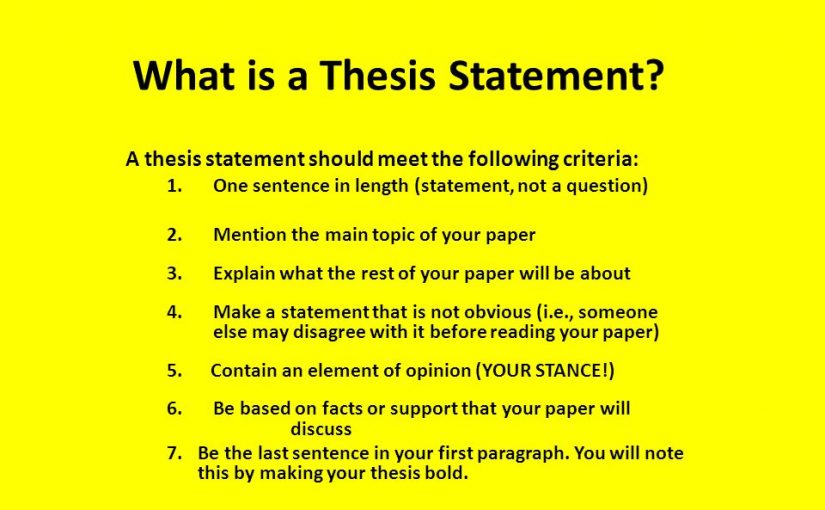
A thesis statement can be defined as a very brief statement of what the main point or contention of your essay or dissertation is. Essentially, you are stating what you will be writing about. However, there’s a little more to writing a good thesis statement than only this basic function.  

You can find an entire guide and eBook on how to write a thesis statement at the Academic Coaching website, www.writeyourthesis.com. We’ll go through the basics right now so that you can see how to use a thesis statement in planning your essay.

A thesis statement needs to do the following:  

  • Be an answer to the main question (direct or indirect) posed in your given topic 
  • Steer the course of your essay or thesis 
  • Clearly state your argument or main point 
  • Indicate the type of writing that you are doing 
  • Not just state something known, but state something disputable that  requires support or evidence 
  • Make the reader interested in your essay 

(Remember, if you need any of these points explained in more detail, simply go to the Academic Coaching website.) 

A thesis statement needs to act like a rudder that steers the massive ship (your essay or thesis) in the same direction. You can’t have an essay where you have a million tiny boats all going in different directions. This will confuse the reader, and you won’t be able to make a compelling point. Whenever you’re worried that you might be veering off course, you can just turn back to your thesis statement which will show you whether your points are all aligning with the same intention. 

This means that your thesis statement is that one part of your essay that ensures that the whole body of work has meaning and is coherent. Your thesis statement comes at the start of your written work, in the introduction, and it tells the rest of your essay which direction it should be going in. This helps your entire the- sis or essay to make sense and for the various points you are making to all lead to one conclusion. 

Your thesis statement needs to be a clear, direct and succinct answer to the questions being posed in your essay topic. You don’t simply repeat the essay topic as your thesis statement, but you provide an answer to the direct or indirect questions, an answer that informs how you’ll write the rest of your essay. 

Let’s look at an example. If you are given this essay topic:  

Compare the healthcare system of the US to the system in Sweden in terms of financial implications, health outcomes and public opinion. Which system is preferable for advanced democratic countries?  

A thesis statement will have to answer the main questions being asked by the topic, and not simply reiterate the topic. The following would be a weak thesis statement:  

In this essay, I will compare the healthcare systems of the US and Sweden and tell you which one I think is better.  

The author is not answering the question, but merely saying that at some point they will answer the question. The reader needs to know the answer right at the start of an essay, and the rest of the essay needs to offer support for that answer. 

A much better thesis statement would look as follows:  

In this essay, the healthcare systems of the US and Sweden will be compared, and it will ultimately be shown that the Swedish system is far preferable in advanced democratic countries since it involves drastically lower costs for individuals, it enjoys greater public support and it has much better health outcomes.  

You’ll see that the second thesis statement is much better because it actually answers the main question and gives reason for this answer. Even if the student had chosen the US system as the preferable one, if they had given good reasons for it, and if they rest of their essay could support it, they would receive a good grade for the essay. It’s not necessarily about the answer you give, but it’s about the way you support it with evidence and logic that counts. 

Your thesis statement is placed in the introduction of your essay, so that the reader knows exactly what your essay will be about. In a good academic essay, every single point and every paragraph will be linked to the thesis statement, and will support it with more evidence and explanation. Once you have a good, clear thesis statement, it’s like you’ve been handed the middle piece to a puzzle, and all of the other pieces have to fit around that central piece. 

Let’s look at one more example, and then draw a mind map of what the essay will look like with the thesis statement at the center. The topic is as follows:  

Discuss the symbolism of the red hood in the fairy tale “Little Red Riding Hood”.  

Your thesis statement could be something like this:  

This essay will show that the red hood symbolizes resilience and danger in the character of the little girl.  

And your mind map could look like this: 

You’ll notice the thesis statement right at the center. That’s where it belongs: it’s the one thing that each of your paragraphs needs to fit with, and needs to sup- port. The arrows between the thesis statement and each paragraph are pointing in both directions. This is because your thesis statement informs your paragraphs, and your paragraphs support your thesis statement; there is a reciprocal relationship, or a give-and-take link, between the thesis statement and each of your paragraphs. Notice how your thesis statement has helped you to plan your essay here in much more detail. If you understand this section, you’re now ready to move on to the final part of planning.  

Review Your Learning:  

  • A thesis statement is the main idea of your essay 
  • It shouldn’t just restate your question, but provide a succinct answer to it 
  • Your thesis statement provides the direction for your entire essay. All of the other points should link to it and support it 
  • Draw a mind-map with your thesis statement at the center and all of your paragraphs branching out from it 

Chapter 5: Planning Paragraphs

You now have everything you need to plan your essay. Once you’ve completed all of the steps in this guide, you should know exactly what your answer to the question is, as well as all of the points you are going to make in order to support that answer. 

However, there’s one more aspect of planning that is vital: knowing the field and being able to provide citations and data in order to support your points. You’ll need to show that you’ve thought about all of the different angles to a point, and that you’ve consulted the experts in the field, so that your essay can have authority and your ideas can gain more validity. That’s why it’s important to plan the structure and content of your body paragraphs in some detail as well.

For a detailed discussion of what goes into a body paragraph, you can once again go to the Academic Coaching website for more information. I’ll run through some of the basics of a paragraph with you here so that you know how to plan your paragraphs before you start writing them.

A body paragraph in an academic essay has one main point of discussion. Each paragraph looks at one different aspect of your argument; having more than one point in any paragraph usually comes across as disorganized and shows that you might not have planned your essay well. 

A good paragraph is made up of three parts. The first part is the topic sentence, where you let the reader know what your paragraph will be about. Your topic sentence is extremely basic, merely indicating the main point that your paragraph will focus on. Your topic sentence should flow from the previous paragraph in a logical way, and it should advance your argument, meaning that it shows how the new idea that you’re introducing fits in with the rest of the points you’ve already made. For the essay on “Little Red Riding Hood” given in the previous chapter, your topic sentence for paragraph 2 could look something like this:  

The resilience of the girl in the story can be seen in the fact that she is surrounded by danger, but never runs away from it.  

You’ve linked the paragraph to the main idea by stating that the girl is resilient, and you’ve introduced the point that your current paragraph will focus on, namely the danger that the girl is surrounded by. The reader immediately understands what the paragraph will be about and why you are writing the paragraph, because it ad- vances the argument you are already making about how the girl is strong and re- silient, and how the red hood represents these traits. 

The second component of your body paragraph is called evidence or  support. This is where you give some citations and look at all of the various aspects of the point that your paragraph focuses on. You might give examples of the point you are trying to make, such as pointing to the wolf as evidence of the danger in the story. This part of your paragraph is also where you show the research that you’ve done and how the research fits into your essay. 

The final component of a body paragraph is explanation. In this section, you explain how the evidence you’ve presented supports your thesis statement. How do all of the examples, research or citations that you’ve presented in this paragraph support not only the main point of your paragraph, but the main focus of your en- tire essay? This section should clarify this in a few sentences. 

You can find examples of good paragraphs on the website, but let’s go back to talking about your planning. Now that you know what goes into a paragraph, it will help you tremendously to plan your paragraphs in a lot of detail. Do as much search on your topic as you can, and every time you stumble upon a new citation or piece of data that might fit into one of your paragraphs, pencil it into your mind map. Rearrange the layout of your paragraphs, or delete points that seem less interesting when you think of something that could better make your point.

I even advise my students to go as far as giving themselves a word limit for each paragraph. If you know that your essay should be 3000 words long, decide how many words each paragraph might need, and don’t waste too much time on a paragraph once you’ve reached your word limit. This will help to ensure that your essay is balanced, and that you don’t spend half your essay only talking about one small aspect and then quickly try to cram the rest of the points you want to make into only a few sentences once you’ve run out of space. 

Finally, planning your paragraphs is also about planning the order that your paragraphs will be presented in. Make sure that the order is logical, and that your argument is developing with each new paragraph. If you have any explanations, they shouldn’t be found in the final few paragraphs of your essay, but should probably be right at the front. If you can arrange your paragraphs logically and ensure that they flow from one to the next, you’ll have a much more persuasive argument and a much more compelling essay.

Contents

Week 1: Good Grammar and Sentences 

  1. Weekly Overview 
  2. Free writing 
  3. Excerpts from the Online Materials 
  4. Controlled Writing 
  5. Editing 
  6. Vocabulary Check Vocabulary Check

Week 2: Paragraphs and Topics 

  1. Weekly Overview 
  2. Excerpts from the Online Materials 
  3. Free writing 
  4. Controlled Writing 
  5. Editing 
  6. Vocabulary Check

Week 3: Thesis Statements 

  1. Weekly Overview 
  2. Excerpts from the Online Materials 
  3. Free writing 
  4. Controlled Writing 
  5. Editing 
  6. Vocabulary Check 

Week 4: The Essay 

  1. Weekly Overview 
  2. Excerpts from the Online Materials 
  3. Free writing 
  4. Controlled Writing 
  5. Editing 
  6. Vocabulary Check 

Week 5: Improving Your Writing

  1. Weekly Overview 
  2. Excerpts from the Online Materials 
  3. Free writing 
  4. Controlled Writing
  5. Editing 
  6. Vocabulary Check 

Answer Key 

  • Week 1 
  • Week 2 
  • Week 3 
  • Week 4 
  • Week 5