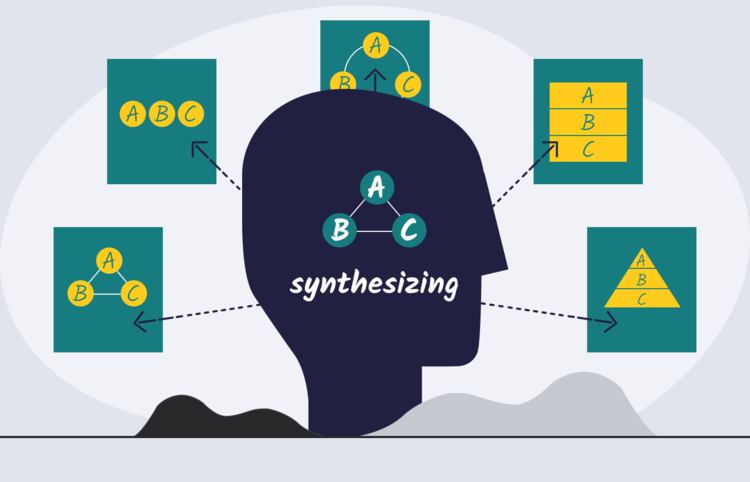
HOW TO WRITE A SYNTHESIS ESSAY
An excellent synthesis essay usually combines segments of different texts to create a whole new explanation of the information.
With this guide, we will discuss how to write a synthesis essay. And how to approach combinations of ideas that prove a point (AKA a Thesis). Usually, having strong analytical skills helps to revise the text for a better result.
TABLE OF CONTENTS
- Synthesis Essay Definition
- Writing Process
- Synthesis Essay Topic
- Outline
- Writing Process
- How to Format Synthesis Essay?
- Synthesis Essay Rubric
- Synthesis Essay Example
- How to Get a Qualified Writing Help
What is a Synthesis Essay?

Writing a synthesis essay is just like writing any other form of the thesis. According to the synthesis essay definition, this style of the assignment is a written discussion of ideas. They tend to draw two or more sources from academic papers, fiction sources, speeches, interviews, articles, lectures & observations. To define the synthesis essay easily, one can say that they are made up of both written and verbal sources.
Those who have written research papers have already written a synthesis without realizing. In any form of a thesis, writers are required to create relationships that have been referred between multiple different sources. Which is something none of us are new to.
Two Types of Synthesis
- Explanatory Synthesis Essay
Is intended to assist readers in getting a better understanding of a topic. Writers are required to make an explanation when they refer to segments from a source. These explanations may be in the form of a description to recreate what is stated in the reference in easy words. That could be anything from an object to a state of affairs. The purpose of this paper is to present facts reasonably, not to argue a point.
- Argument Synthesis Essay
Is to present your own opinion on what is stated in the sources. With the use of evidence and facts that are relevant to sources, and presented logically. An argumentative essay thesis is usually subject to debate. They create propositions that some people could disagree with. Multiple writers could write using the same source and could oppose each other. They are known as the opposite thesis.
How to Choose Synthesis Essay Topics
A synthesis essay prompt must be negotiable. Depending on your assignment, you may have to choose a primary text. Choose a book that might have opposing viewpoints.
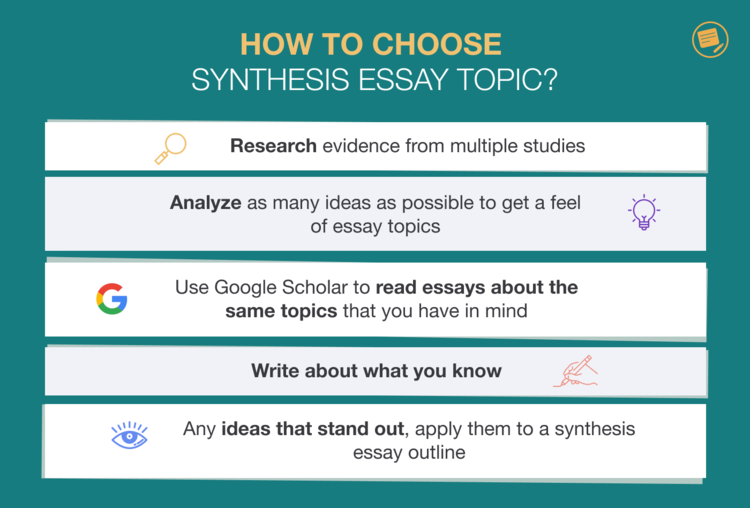
Step 1: Browse through topics and ideas. Read about some of some sources regarding selected topics, in-depth, to see if any of taking your interest.
Step 2: Choose a topic, and then gather relevant and useful sources to include in the synthesis essay.
Step 3: Apply ideas from the sources onto a synthesis essay outline. This should make writing far easier and save you time.

Good topics would be ones that are debatable, for example:
- Daylight savings
- Minimum wage
- Immigration policy
- Global warming
- Gun control
Synthesis Essay Outline
Creating an outline will be useful in maintaining the structure of your paper, and planning your writing. If your essay is split into three parts, break your outline into three chunks. Paste supporting evidence, sub-arguments, and specific points in the appropriate sections. Make sure that every aspect somehow proves the claim in your thesis. Extra information or tangents will only hinder your essay.
However, if information goes against your central claim, then you should acknowledge it as it will make your essay stronger. Make sure you have read all of your sources. When writing about the causes, do not summarize them; synthesis denotes analysis, not plot-summary.
Introduction
A synthesis essay introduction should be a brief description of what the paper will be about. When learning how to write a synthesis essay, you will find that the average paper is made up of 3 points.
- Main point 1
- Main point 2
- Main point 3
Thesis
Synthesis essay writing always includes a thesis. This is a description of the paper, but more in-depth, and backed with evidence, which is usually a quote from a source.
Body
Infer all sources from your previously written synthesis essay outline and explain the relationship between them.
- Main Point 1
- Evidence (quote from a source)
- Analysis of Evidence
- Main Point 2
- Evidence (quote from a source)
- Analysis of Evidence
- Main Point 3
- Evidence (quote from a source)
- Analysis of Evidence
Conclusion
A synthesis essay conclusion should be a summary of the overall paper. With a final sentence to conclude the synthesis essay. In other words, to restate main points and unanswered questions.
When it comes to synthesis paper writing, you will find that a synthesis essay template is made up of the same structure.
Writing Process
A key factor in writing a synthesis essay is an analysis of a given text or a prompt. To successfully analyze it, you must comprehend the text’s purpose, rhetoric, and the argument that the author’s claim, in other words, you are answering the question: “So what?”. Then, you must build your application, and write an essay around that.
- Avoid tilting the assignment as ‘synthesis essay’ followed or preceded by the relevant title
- Remember to address your readers appropriately
- Use precise vocabulary. Don’t be shy to use a dictionary
- Use a clear sentence structure. Avoid passive voice
- Proofread and correct errors: spelling, comma errors, shifts, subject-verb agreement, plurals, possessives. Avoid using “you.”
- Make sure your citations are correct
- Make use of sentence and paragraph transitions
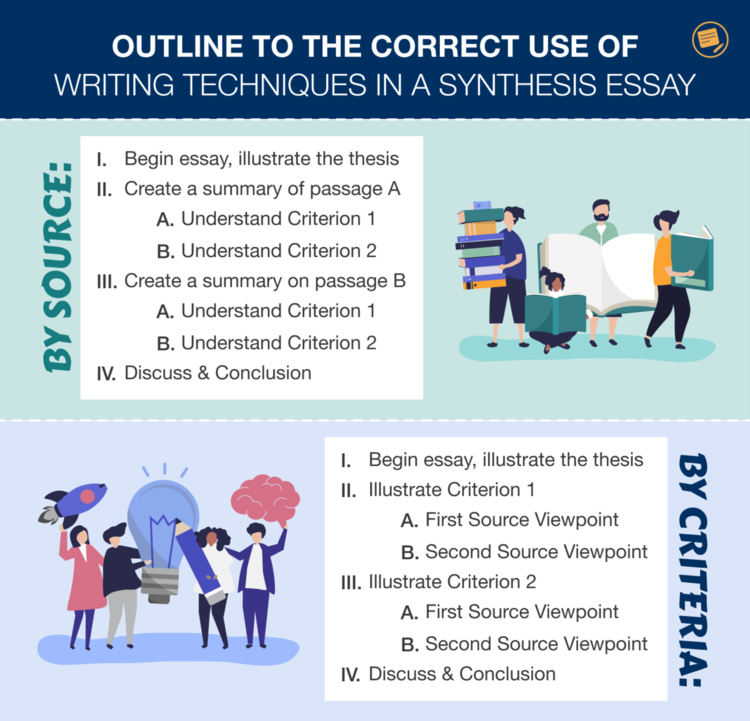
Writing Techniques
Make use of Summary: One of the simplest methods ways of organization. It allows you to summarize the sources that possess the highest amount of relevance. The issue is that this method doesn’t include independent thought.
Examples: Paraphrasing source material. Write segments of sources in your own words. Quoting the source also goes under this technique. In every case of using examples, make sure to cite the source.
Multiple Reasons: Using multiple reasons, mostly two goals, is known as an extremely effective method.
Strawman: Present one argument against a thesis. Though, show this factor is weak. The advantage of this method is to teach awareness about the other side of the argument. This type of evidence presents an introduction and description. It is followed by the opposing factor and a decisive factor.
Concession: This technique illustrates the opposing viewpoint. It shows the positives being much stronger than the negatives.
Compare and Contrast: Compare and contrast methods allow writers to examine two sources at once. Comparing shows similarities, as contrasting shows the differences. Illustrating an in-depth analysis of the chosen is possible.
How to Format Synthesis Essay?
The synthesis essay format depends on what style is required by your teacher or professor. The most common formats are: MLA, APA, and Chicago style. APA is used by fields of Education, Psychology, and Science. MLA is used for citing Humanities, and Chicago style is used for Business, History, and Fine Arts. Purdue Owl is a format guide that focuses mainly on MLA and APA, and Easybib is a citation multitool for any of your external sources.

MLA Format
Some key points are:
- Times New Roman 12 pt font double spaced
- 1” margins
- Top right includes last name and page number on every page
- Titles are centred
- The header should include your name, your professor’s name, course number and the date (dd/mm/yy)
- The last page includes a Works Cited
APA Format
Some key points are:
- Times New Roman 12 pt font double spaced 1” margins
- Include a page header on the top of every page
- Insert page number on the right
- Synthesis essay structure should be divided into four parts: Title Page, Abstract, Main Body, and References.
Chicago Style
Some key points are:
- Times New Roman 12 pt.
- Use double-spacing amongst the lines of the paper.
- Use one-inch margins.
- Use ½ Inch Idents for Paragraph Beginnings.
- Write with left-justified text that has a rugged edge.
- Use full names of people or organizations.
- The bibliography is to be on a separate page.
Synthesis Essay Rubric
High range essay (8-9 points)
- Effectively develops a position on the assigned topic.
- Demonstrates full understanding of the sources or text.
- Correctly synthesizes sources and strengthens a position. The writer drives the argument, not the sources.
- The writer’s argument is convincing.
- The writer makes no general assertions and cites specific evidence for each point. His/her evidence is developed and answers the “so what?” question.
- The essay is clear, well-organized, and coherent. It is a stand-alone piece rather than an exam response.
- Contains very few grammatical and spelling errors or flaws, if any.
Note: 8-9 essays are an extreme rarity. A strong ‘7’ paper can jump to an 8-9 if the writing style is mature and perceptive.
Middle-Range Essay (5-7)
- Adequately develops a position on the assigned topic.
- Demonstrates sufficient understanding of the ideas developed in sources
- Sufficiently summarizes the sources and assumes some control of the argument. ‘5’ essays are less focused than ‘6’ and ‘7’.
- The writer’s argument is sufficient but less developed.
- Writer successfully synthesizes the sources and cites them.
- Writer answers the “So what?” question but may use generalizations or assertions of universal truth. The writer cites their own experience and specific evidence.
- Essay is clear and well organized. ‘5’ essays less so.
- Contains few minor errors of grammar or syntax.
Note: A ‘7’ is awarded to papers of college-level writing.
A ‘5’ on one of the AP English Language and Composition essays designates a three on the AP exam. It most likely relies on generalizations has limited control of the claim and argument. ‘5’ essays often lose focus and digress.
Low-Range Essays (1-4)
- Inadequately develops a position on the assigned topic.
- The author misunderstands and simplifies the ideas developed in the sources.
- Over-summarizes the sources, lets the sources drive the argument.
- Writer has weak control of organization and syntax. The essay contains numerous grammatical/spelling errors.
- Writer does not cite the sources correctly, skips a citation, or cites fewer than the required minimum of the sources.
- Notes: ‘4’ or ‘3’ essays do assert an argument but do not sufficiently develop it.
- A ‘2’ essay does not develop an argument.
- A 1-2 essay has severe writing errors and do not assert a claim.
Synthesis Essay Example
Have you read the whole article and still struggling? Check out these winning synthesis essay examples – from our professional writers. Feel free to use them as a reference.
