Lab Report

HOW TO WRITE A LAB REPORT

Students and professionals alike are required to perform laboratory reports for various reasons. Usually, the results are used to highlight changes or establish a pattern with one’s management or lecturers. Lab reports are also written for archival purposes so that the work doesn’t have to be done again in the future. In the section below we will review a basic structure used to organize lab reports.

TABLE OF CONTENTS

  • Abstract
  • Introduction
  • Procedures
  • Results & Discussions
  • Conclusion and Appendices

It is important to note that this particular structure is designed to give you a general idea since one organizational format does not work for all types of experiments. Therefore, while performing any laboratory reports, it is essential to keep in mind the requirements given out by the instructor or supervisor if that is the case.

Lab Report Abstract

Without a shred of doubt, the abstract aims to summarize four essential elementspresent in any laboratory report.
First off it is vital to identify its purpose in order to establish relevance to our initial hypothesis or assumptions. Secondly, examine any key findings to use as a point of comparison which aims at either proving or disproving the initial premise. The next step now revolves around establishing its significance to us and the general public. That is important because without understanding why we conduct a specific experiment then it could all be for nothing. Lastly, it should sum up all of the facts and reach a conclusion. While doing so, it is crucial to have a realistic approach towards the initial hypothesis, results obtained, experiment expectations and methods used to get their results.

Quite often the individuals piecing together laboratory reports include a clear indication of the methodologies or theoretical work that has been put into practice. Keep in mind that no abstract, regardless of topic, should ever exceed 200 words. The sample provided here adds up to a total of 191 words.

DOWNLOAD

Introduction

As previously mentioned when learning how to write a lab report introduction one should remember to highlight the following key points:

  • Clearly establish what kind of experiment will be discussed or will be taking place. Give a brief understanding of its background.
  • The initial hypothesis behind undertaking the experiment, such as what we aim to achieve through it.
  • The importance or value the experiment to us as those performing it as well as what meaning it bears within the real world.
  • Establish what methodologies will be used to extractrecord, & analyze the data. This should be done in comparison to the initial expectations or hypothesis.

These elements combined give our laboratory report introduction a clear sense of purpose as well as establishing the means through which we will come to a conclusion. Thus, making use of these elements in an appropriate manner will allow the readers to follow along without any confusion occurring.

Procedures

The methods used to collect, store and analyze data are often referred to as “Procedures”. By documenting each of these steps in a clear and concise manner, it allows one to follow along while also being able to repeat the experiment if necessary. Keep in mind that historically laboratory reports and their procedures have been recorded as first-person narrative accounts, despite the fact that most instruction manuals prefer to make use of a second-person approach.

Due to the audience’s expectations of receiving a 1st-person narrative, it becomes tricky at times to produce an in-depth lab report. Since the “Procedures” represent the bulk of the work and should be easy to replicate, include any unexpected events that could have impacted the outcome.

Results & Discussions

In this section, one should present their data and discuss its meaning. Keep in mind that for some laboratory reports this section will be split into two distinct pieces, namely Results and Discussion. Nonetheless, the reason this example lists them together is due to the strong case put forth by P.B. Medawar in 1979. His reasoning indicates that when trying to present vast amounts of information, it is best to combine the two in order to avoid dumping too much data at the same time on the audience without much context.

The best option is adhering to the instructor’s requirements as well as applying your own judgment where appropriate. For example, in some scenarios, it might be best to combine them since this will make the meaning of the data clear to the audience. But in some cases, it is best to keep them separate and only enter the Discussion phase after a conclusion has been reached on the results of the laboratory report.

If the two sections must be split, keep in mind that ==the Discussion section should not only review the results but explore the implications of them to both scientists and the general public. Feel free to make use of any visual representations to help take the point across. Don’t forget to mention any events that could have altered the final results, if relevant.

Conclusion

Most laboratory reports will choose to make use of a conclusion to help wrap things up. In contrast to the Results and Discussion section, the conclusion aims to sum up the results as a whole instead of just examining them individually. This applies to their implication as well meaning that now it has to be compared to the assumptions presented in the introduction of the laboratory report.

Highlight how the results obtained compare to the initial hypothesis and explain why they match these expectations or why they failed to meet them. Remember that in most laboratory reports where the Discussion and Results sections are displayed separately one does not often encounter a conclusion.

It is not a must to make use of appendices. However, most detailed laboratory reports will have a few included as part of their content. Their purpose is to summarize information that is far too detailed to be included in the report itself. An example of such a scenario can be a table giving voltage-current measurements to an RLC circuit. Thus, one would summarize the information in a visually pleasing manner by using a graph and place the long table at the end as an appendix. Other examples usually revolve around annexing unrelated information that may not concern the laboratory reports goals directly.

There are two types of appendices: formal and informal.

formal appendix should contain a definite beginning, middle and end segment for the data being displayed. Even when presenting tabular information it is crucial to add all the necessary explanations so that it becomes easy to understand one’s train of thought without confusing the audience.
Due to various time constraints, supervisors or tutors may ask for an informalappendix. They may include multiple calculations or any additional information that is needed to understand the task at hand. In contrast to the formal version, they do not need an explicit structure but should still be titled, captioned, and include comments where relevant.
Narrative Essay

HOW TO WRITE A NARRATIVE ESSAY

Narrative essays are a popular type of academic writing. Both high school and college students write loads of them. These essays show your creativity, character, and ability to tell a compelling story. Telling a great story could be a challenging task. That’s why our team have compiled a list of things you need to know before writing a personal narrative essay.

TABLE OF CONTENTS

  • Definition
  • Good Narrative Essay Topics
  • Outline
    • Introduction
    • Body
    • Conclusion
  • Narrative Essay Example For College
  • Narrative Essay Example for High School
  • General Advice

Fear not, for we are all authors! Every person’s life is a story. Who else could be the author besides the person experiencing it? Writing a short story is different than writing an essay about your entire life. They key here is to cut out a memory or experience that stands out for you and turn it into a great story.

What Is A Narrative Essay?

A simple narrative essay definition is a piece of academic writing that tells a story. As the author, your purpose is to create a lifelike experience for the reader. You must place them in the middle of the action and keep them engaged. You would typically tell this story from your point of view.

Use vivid and evocative detail to create an atmosphere for the reader. You need to be specific with the information you use. Pick the type of vocabulary that sounds most realistic to your scenario. This will support the atmosphere you want to create.

There are several types of narrative essays to discuss.

Autobiographical Narrative Essay

This assignment prompts you to describe a memorable event that happened in your life. It’s not an autobiography, contrary to what the title suggests. You must think of a specific game that matters to you and explores it. Focus on the story and its purpose, instead of details.

Descriptive Narrative Essay

The autobiographical essay would have you focus on the story without exaggerating details. In a descriptive narrative essay, you have more creative freedom. You must describe a situation, memory, or experience in vivid detail. Your goal is to paint a picture for the reader and tell a beautiful story.

A well-written descriptive narrative paper is usually straightforward. It takes a complicated story and narrows it down, allowing the reader to infer the rest. Great writers avoid over-exaggeration and stick to their purpose. There are always some limits to the amount of content you can provide to your readers. Keep this in mind when choosing what to describe in your work.

The tricky thing about the narrative essay is that there are always some limits to the amount of content you can provide your readers with. Ideally, a well-written narrative paper is one that takes a == complex story and crunches it down into a limited number of words== while always remaining relevant to the purpose. At the same time, keeping the attention of the audience is crucially important.

Good Narrative Essay Topics

When it comes to topics, there are several things you need to take into account.

Start by carefully reading the directions of your assignment. Teachers will often tell you what they are looking for in your narrative piece. Most narrative essays share a few common characteristics:

  • A Conflict/Challenge: An inciting incident that creates the tone and sets the story in motion.
  • A Protagonist: A relatable character that faces the conflict or challenge to overwhelming odds.
  • A Change or Growth: Overcoming the conflict or challenge sparks some change in the protagonist. A realization may have sparked this change. It could also be an after-effect of the characters development throughout the story.

These variables are the essentials of storytelling. You need to spend time brainstorming to connect all the dots and create great story ideas. Search your memories and experiences, and you’ll find something worth writing about!

Here are some narrative essay ideas to help you brainstorm:

  • Overcoming Fear
  • Facing a Challenge
  • A New Experience or Discovery
  • A Moment of Excitement
  • Learning a Tough Lesson
  • A Thrilling Moment of Adrenaline
  • The Moment You Stood Up For Yourself
  • Relationship Experience
  • A Discovery That Changed Your Life
  • A Rebellious Act

These are a few typical examples that students tend to explore. Consider making a story based on your personal life experiences. The most vivid memories are usually the ones that tell a great story!

Narrative Essay Outline

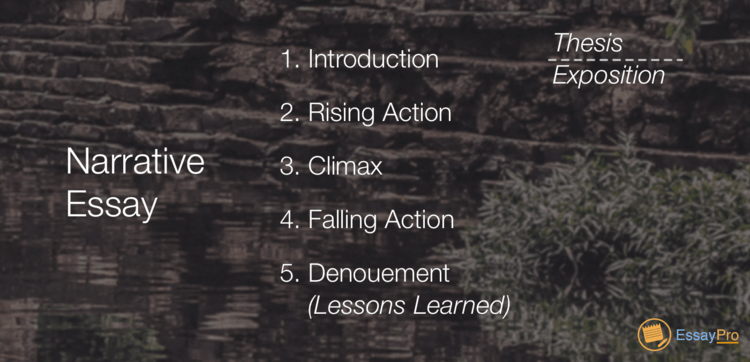
Narratives have a standard format. This includes the Introduction, the Body, and the Conclusion. Some follow the 5 paragraph narrative essay outline. Composed of 3 body paragraphs, each contains a new idea.

  • The Introduction must lay out the setting and ignite the movement of the story.
  • The Body Paragraphs travel through the story. Describing it in vivid detail, they slowly untangle the puzzle that is the purpose.
  • The Conclusion unravels the purpose for the reader. You must ensure that the reader understands the essence of your story.

Now let’s break down some critical parts of each section of the paper!

Introduction

The Introduction must accomplish three main goals:

  • Each Narrative Essay should start with a strong hook. It carries the reader through the introduction and gets them engaged in the story. To create a strong hook you can:
    • Bring up a future scenario as an initial starting point.
    • Offering a quote that will be relevant later in the essay.
    • Place your reader in the middle of the action.
  • Set the scene for the reader:
    • As authors, we want to throw the reader’s boat into a chaotic storm and get them engaged.
    • However, it doesn’t hurt to give them a life jacket, in case they start sinking in confusion.
    • Allow the reader to get an idea of what’s going on. Don’t give it all away, and keep them thinking!
  • Defining the purpose:
    • Without giving away too much information, provide insight into what the essay is all about.
    • Don’t give away the lesson you’ve learned just yet. Give your reader merely a sneak peek of what’s about to come.

Body Paragraphs

The Body Paragraphs Must Accomplish 4 Main Goals!

The body paragraphs will vary depending on the length of the essay. The range of the story should match its impact.

If it’s a quick life lesson that many others have experienced, don’t stretch out the plot. Perhaps you need to put the reader in your shoes for the story to work. In this case, you have a fair reason to make it more prolonged and intense.

  • Vivid and relevant detail: The narrative essay is all about creating a scene as well as a mood to follow. Even best essay writers spend hours and are meticulous when it comes to details. Don’t spam your sentences with literary symbols. As long as each sentence serves a purpose, then you are good to go.
  • Dialogue: Throwing the reader into a spoken scene is an effective way to refresh their attention. Dialogue is a great way to give a story life and support the atmosphere. Still, you must use it constructively. For example, if you have two New Yorkers talking to each other, using London slang won’t be a great choice.
  • Write chronologically: It’s hard for the reader to understand the timeline unless the author is blunt. Keeping things sequential is the best way to keep your paper organized.
  • Avoid narration deviation: If you are talking about personal experience, the first-person voice will work best. If this a story you heard from a friend – using the third person would make more sense.

Conclusion

Narrative essay conclusion has the task of stating your purpose and offering a final comment. As the story wraps up, the reader must have lived through your experience. In the end, it would be good to leave them with something to think about.

Narrative Essay Examples

The content of narratives essays can vary when it comes to different institutions. We have decided to provide you with examples in case you face a problem.

Example for College

College professors search for the following qualities in their students: the ability to adapt to different situations, the ability to solve problems creatively, and the ability to learn from mistakes. Your work must demonstrate these qualities, regardless of whether your narrative paper is a college application essay or a class assignment.

You want to demonstrate your character and creativity. Describe a situation where you have encountered a problem. Tell the story of how you came up with a unique approach to solving it. Connect it to your field of interest. The narrative can be exciting and informative if you present it in such a fashion.

DOWNLOAD

Example for High School

High school is all about showing that you can make mature choices. You accept the consequences of your actions and retrieve valuable life lessons. Think of an event where you believe you have acted exemplary and made an adult choice. A personal narrative essay example as such will showcase the best of your abilities.

Finally, use outside sources to help you get the best result possible. Try searching for a sample narrative essay to see how others approached it.

DOWNLOAD

General Advice

Writing a narrative essay should be a positive experience. It doesn’t restrict you to a linear format that doesn’t allow for variation. This is one of the most free-spirited and original essays to write. That doesn’t mean that rebelling against all rules and writing something absurd is fair play.

If you are still struggling in deciding what to write about – think of your story as a coming of age tale. An event that transformed you into the person you are today.

Your primary goal is to take the reader on a journey. Have them share your experience and take something away from it. The best stories are always the ones that teleport the reader out of their comfort zone.

Narrative Essay Topics

100 TOP NARRATIVE ESSAY TOPICS AND IDEAS

Imagine being put in a time capsule with an artificial intelligence chauffeur who asks “Which one of your memories would you like to access?”

In a narrative essay, this scenario is not far from the truth. What makes a narrative essay unique is your story, voice, and writing style.

TABLE OF CONTENTS

  • Narrative Essay Definition and Types of Essay
  • How to Choose Narrative Essay Topics?
  • Narrative Essay Topic Ideas
  • Narrative Essay Examples
  • How to Get a Qualified Writing Help

Narrative Essay Definition and Types of Essay

A few words about a narrative definition before we move on: a narrative paper is a type of academic assignment that tells a story about the writer’s personal experience with making some point. The goal is not just to share an entertaining story.

Narrative essays rely on settings, character growth, dialogue, conflicts & resolutions, and turning points.

Another purpose of such writing is to stress the reasons for sharing the episode and the significance of the provided experience. Unlike the heavily-structured persuasive essay, the narrative essay is more free-form. Every narrative has a beginning, middle, and end.

Mind that 4 types of such paper exist, and you should make a difference:

  • Exposition
  • Description
  • Narrative
  • Argument

How to Choose Narrative Essay Topics?

  1. Always keep in mind that narratives tell stories

The theme you choose should make it possible for the audience to connect to your personal experience and skills and learned a valuable life lesson.

  1. Pick useful ideas to discuss

If you have a passion for something, select issues that you struggled with, it is a unique chance to avoid writing about things that make you yawn.

  1. Be ready – do not miss the stage of planning!

Your paper has to prove a particular point, so be sure to check how much information you need to collect on different topics.

  1. Keep on experimenting through

Experiment by, for instance, mixing various episodes from your life/different topics. Think about the subject that will guarantee the best emotional experience to your readers.

  1. Recall the essay structure

An academic paper always requires a golden formula structure. Think about the list of ideas you choose from whether it is possible to develop the relevant, logical sections according to the intro-body-conclusion organization. As a body requires at least three paragraphs, decide whether you will be able to come up with three claims (topic sentences) to support the thesis statement.

Our essay writing service has compiled a whole list of narrative essay topics with descriptions to light your path. Scroll down and find some excellent narrative essay topics for college students.

Narrative Essay Topic Ideas

Experience Is a Teacher

Grab a pen and paper and jot down the experiences that spring to mind.Your experience could be something negative eventually turning positive or vice-versa. The most intriguing part of a negative experience is how you handled it and came out on top. Give your reader a setting, making them part of the story, and have them experience this moment of change with you.

  1. Fear is a sincere and relatable emotion. Describe the moment you overcame your biggest concern.
  2. Heroism takes bravery… or stupidity in separate situations. Write about your experience of courage.
  3. Nobody is perfect, and everybody makes mistakes. Talk about a mistake you’ve made and the lessons you’ve learned.
  4. When life gets too monotone, it’s always good to get out of your comfort zone. Share memories of the time you’ve experienced something new.
  5. First work experiences teach responsibility and give students a glimpse into adulthood. Write about your first work experience.

Childhood Memories

Take the memory trip to your ** open and sincere years*, and find a crazy story to share. If you have a setting, an idea, but no story – you can always make one up. Make it convincing, and people will think you’re a wunderkind!*

  1. Write about a childhood experience that showed the importance of teamwork.
  2. Remember when parties didn’t need alcohol to be fun? Recall the craziest party of your childhood.
  3. Write about your first experience of physical or emotional pain. How did you overcome it?
  4. Kids often have role models who are like superheroes in their eyes (from Hollywood actors to rock band players). Who was your role model and why?
  5. Write about a dream you remember from your childhood.

Growing Up in High School

Everyone is nostalgic for their school years in one way or another. It is a time of knowledge, development, and growth or skipping college classes and looking for trouble. Find something exciting from your high school experience and turn it into a narrative essay.

  1. The school was mostly dull, but some classes didn’t feel that way. Focus on a school subject that you cared about.
  2. Depict an experience of humiliation, whether it was you or someone else. How did people react and what did you learn?
  3. Hobbies (football, guitar, gaming, traveling) are what you looked forward to when rushing to complete homework. What was your after-school hobby?
  4. Describe your best friend from high school and how you’ve both changed growing up.
  5. Write about your greatest school achievement.

Personal Narrative Essay Topics

Relationships start with family. As a person grows, they extend to friendships, romantic interests, business relationships, and far beyond. Explore the vices and virtues of the people you’ve met.

  1. People change. Some stay together, and some fall apart. Write about an old friend who you’ve lost and why it happened.
  2. A few words can change a person’s perception of things. Write about a conversation you’ve had that changed your life.
  3. Discuss a productive business relationship where you’ve made a great achievement from working with your partner.
  4. Dads can be the voice of reason and moral discipline. Talk about the way your Dad has influenced you.
  5. As people grow and move around, they change their circles of friends. Have you had this experience? Talk about what it feels like meeting an entirely new group of people, sharing experiences, making friends, and building relationships.

Moral & Ethical Dilemmas

Laws keep the world in order. Or do they? Students from all over the world discuss many challenging moral questions. Times come when a person has to choose – do the legal thing or do the right thing according to their set of ethical standards. These points make morality an infinite pool of inspiration.

  1. Talk about the time you’ve done something illegal, but it was the right thing to do.
  2. Talk about your observation of a cowardly act. Explain why you think it was cowardly. Share what you would have done instead.
  3. Teachers, parents, police, government – the morals they preach can be wrong sometimes. Provide the details of your act of rebellion against ‘the man in charge.’
  4. Talk about the time you had to do something that undermined your morality.
  5. From a moral perspective, how do you think your government should deal with homeless people?

Hobbies & Interests

Hobbies are things that people enjoy doing most of all that spark lifetime interests in the community. Some people end up happy when their hobby becomes their job. Besides, people attract each other based on the things they do, and the places they go. Ask yourself “What do I enjoy doing?” Or “Why do I like this particular type of music?”

  1. Discuss the time you’ve dumped your responsibilities to do something in favor of your hobby and came out on top proving everyone what you are worthy of.
  2. Write about your talent and how you develop it.
  3. Would you turn your hobby into a class taught in schools?
  4. Tell us how your hobby or obsession managed to get you a job.
  5. Hobbies are often looked over by parents. They want their kids to do well in school. How do you think parents should act towards kids who care more about their hobby than getting good grades?

Moments of Inspiration

Ever had that moment that inspired you to do great things? As students, we often get inspired by the most straightforward observations. A field trip, or a beautiful view, a film with a moving story, or a classic book like ‘Catcher in the Rye’ – whatever your source of inspiration, you can always turn it into a fascinating piece of writing.

  1. Have you ever seen a movie that inspired you to go out and do great things?
  2. Have you ever been inspired by a book character to behave a certain way and how do you empathize with this character?
  3. The most successful people have failed millions of times to reach success. Tell us about a successful person that inspires you to keep trying.
  4. Write about the time when something seemingly insignificant greatly inspired you (examples: a close person, heroic deed, event, etc.)
  5. Have you ever felt like you could do better? Remember the time you saw someone do something, and it inspired you to do it better than them.

College Student Life

Entering college means getting catapulted into a new world enriched with new impressions. New circles of people, a new system of education, student living conditions, and much more. All the craziest stories happen in college; whether you’re there to party or use textbooks for pillows, there’s plenty of narrative essay topics for college and about college that you can write about.

  1. Tell us about the most unlikely exam that you’ve passed and how you prepared for it.
  2. College professors are open to discussions and reinterpretations. Describe the time you’ve won an argument against your professor.
  3. Describe a lecture that has inspired you to get out there and do great things.
  4. After the harsh transition from high school, there’s always a moment when you snap and suddenly realize that you’re in college now. Tell us about the moment that kick-started your college life.
  5. College can refer to partying, studying, or fulfilling your dream – which one will you choose?

‘Imagine If’ Scenarios

Narrative essays usually require the student to write about their life. What are the exceptions? Frequently narratives get dramatized in favor of telling a great story over blatantly stating facts. ‘Imagine If…” scenarios are massively amplified versions of reality, making it one of the most popular sub-genres in essay writing. Enter the realm of free-flowing imagination and see where it takes you:

  1. If you had your reality show – what would it be like?
  2. If you could travel back in time – where would you go and why? Would you change the past?
  3. If you had a superpower, which one would you choose, why, and would you use it for personal goals or help people to be happy?
  4. What if you were a movie director with an unlimited budget? Tell us about the movie you’d make!
  5. If you were a best-selling musician and you’ve just come off your most successful album ever – what would you do next?

Places You Have Attended

You should not necessarily discuss only places from your memories; it is also possible to describe locations that you would like to attend and provide reasons for doing so. Some ideas may include:

  1. Tales from history: the impression of a visit to the National Museum of the U.S. History
  2. Having a trip abroad for the first time in your life. Describing your ideas from that flight
  3. The very first time you traveled to Paris compared to your last visit to the ‘City of Lovers’
  4. Tasting that favorite dish in a cozy restaurant by the Red Sea
  5. Going to see a gig of a favorite rock band at the best venue in New York

Top-preferred Activities

This one is similar to your “hobbies” yet slightly different. It is better to focus on what you do well and share some useful recommendations instead of fake memories. Describing something, you have a passion for always adds a dynamic perspective!

  1. If you were a scriptwriter for “Game of Thrones,” what would you change about the plot of season three?
  2. If there is a book that changed your opinion on a specific topic, would you recommend it to others and why?
  3. Do you find any resemblance with your favorite Marvel or DC hero?
  4. If you were the head of a mobile app development company, which sort of game would you release first?
  5. Is there a music composition that always cheers you up in any situation?

Author’s Strong Sides and Expertise

If you believe you are an expert in a particular field, offer the reader some tips and tricks on how to succeed in the same area. I recall the personal experience and factors that helped you. It may look like recommendations, but do not forget that you are not writing a how-to guide – involve more creativity and descriptions.

  1. Reasons why people can always cry on my shoulder and get cheered up immediately
  2. Several things that make me the top specialists when it comes to social media marketing
  3. The art of telling lies: how my creativity once saved the day
  4. Features that make me the best football players in my team
  5. A paper for those who seek advice in cooking Japanese dishes

Good Narrative Essay Topics Without a Category

All of the previous narrative essay topics are tied to a particular genre or theme. Still, there are plenty good narrative essay topics you can pick from that is quite random, yet fun to write about. Check out some more topics for narrative essay assignments that we thought of.

  1. The first car you ever got
  2. Something that really ‘grinds your gears’
  3. The worst day ever
  4. Your guide to dancing at parties
  5. The moment you realized that Google saves all your data
  6. Your guide to relieving stress
  7. Your guide to reading books, listening to music, watching movies
  8. Things to do while waiting in line
  9. If you had a billion dollars for a day
  10. A dream that came true – by accident or through hard work

Fun Narrative Essay Topics for High School Students

This section is a pleasant bonus for our young readers! A good sense of humor is an excellent ace of the base in writing. You may turn a severe situation into something fun and relaxing by involving a relevant joke or anecdote. The rest of an essay will then be more alive and exciting. These ideas will help you to inspire:

  1. A bad experience with girls
  2. The time you almost died doing something stupid
  3. The time when your fun and naive high school persona got trapped in a harsh real world situation
  4. The most significant experience in your digital life
  5. The moment when math saved your life
  6. If you starred in ‘My Sweet Sixteen.’
  7. If you starred in ‘Sixteen and Pregnant.’
  8. The most random way you’ve made a friend
  9. The moment you realized that partying is destructive and decided to stop
  10. Your first experience with alcohol, cigarettes, or drugs. What would you tell a person who has never tried either?

Narrative Paper Topics about Personality

Each of us has its personalityIt is possible to express yourself in any light by choosing to write a narrative paper about your strengths, weaknesses, characteristics, mood, etc. We have analyzed some of the best topics for you.

  1. How patient can you be if you have to wait for something that matters to you?
  2. How much self-control can you boast?
  3. Have you been a leader at least once in your life?
  4. How would your life be different if you had lost your parents early in life?
  5. Do you have a competitive spirit when it comes to playing various sports games?
  6. Do you take higher risks when your best friends surround you?
  7. List and discuss personal superstitions
  8. Pranks, jokes, anecdotes, and hoaxes you have ever fallen for
  9. Assumptions that people usually make about you
  10. How much of a daredevil are you?

Gender & Sexuality

Any topic related to gender is a sensitive one. A writer should be careful not to tread on corns. A paper on one of the ideas about sex should be objective and written in neutral tone, and here we go with some issues that you may find interesting to discuss:

  1. Are there any boys in your company that regard women as “prey”?
  2. Is there too much pressure on women to have ideal bodies?
  3. The difference between male and female roles based on your family/parents
  4. Effective preventive measures to deal with online adult content
  5. The best way to learn about sex in school
  6. The basic principles and purposes of the feminist movement
  7. Is it acceptable to have gender and sexual education at school?
  8. Why so many parents possess different hopes for their sons than for their daughters?
  9. The way sexuality is presented in the “Game of Thrones” book series
  10. Did you have any negative experiences with gender bias in school?

After finding a topic that suits your mood, do some brainstorming. Write all possible scenarios on a piece of paper and organize it into a unique narrative essay outline. Follow the instructors of your professor. Most of your questions have probably been answered there.

Narrative Essay Examples

  1. One of the narrative essay examples to offer is The Climb (it is an extract – not a complete essay).

“ I suffer from this fear. I am climbing great causes my legs to shake, breaking me out in a cold sweat. Each time I achieve a certain height, thoughts of sudden death run through my mind, and terra firma shows up as a treasured place. I imagine my funeral. I feel sick to my stomach, and my palms become clammy, all because I have been scared of heights since before I can remember. It is not a fear of a particular place, it is the view of the long way to fall, of mountains surrounding me, taking into account no solid wall exists between me and the edge. My sense of safety has vanished at that moment.”

  1. Another sample chosen from the list of grand narrative essay examples is a Playground Episode. Some people say that childhood memories are the strongest.

“It is difficult to select the specific event or memory from my childhood. Many of the situations I used to go through made it hard to decide what left me with the fabled and fuzzy feelings. I used to travel by plane a lot. My father was an Air Force Major, so my family and I used to get flight tickets cheap no matter where we were heading. The large trees of Sequoia National Forest on the edge of The Grand Canyon impressed me more than anything else. Those are details that make my childhood experiences unique.
Once, I stood in the playground of my elementary school. The power of the wind was gusting a storm that day, Standing in the stadium pulling my hoodie over my ears I feared the rain would drench me. Miniature tornados surrounded me. It scared me to death!

Nature vs Nurture Essay

NATURE VS NURTURE ESSAY WRITING GUIDE

Nature vs nurture debate – genes or environment? Do we act the way we do because of the genetic heritage or is there something else hiding behind the reasons? What is the impact of climate on human behavior? These and many other questions pop up in the nature vs nurture debate essay. Why won’t you look at the tips on writing nature vs nurture essay along with the good topics and examples from experts?

TABLE OF CONTENTS

  • What is a Nature vs Nurture Essay?
  • What to Discuss in a Nature vs Nurture Paper
  • Essay Outline
  • Best Topics
  • Free Essay Examples
  • Writing Tips

What is a Nature vs Nurture Essay?

Nature vs nurture essay is a type of academic writing assignment high school & college students face while studying the following subjects:

  • English Composition
  • Literature
  • Anthropology
  • Biology
  • Religion
  • Psychology
  • Social Sciences
  • Law
  • Gender Studies
  • Political Science
  • History
  • Etc.

As you can see, this essay topic is popular. It helps to understand our role in the world and our actions. It is one of the oldest arguments in the field of psychology.
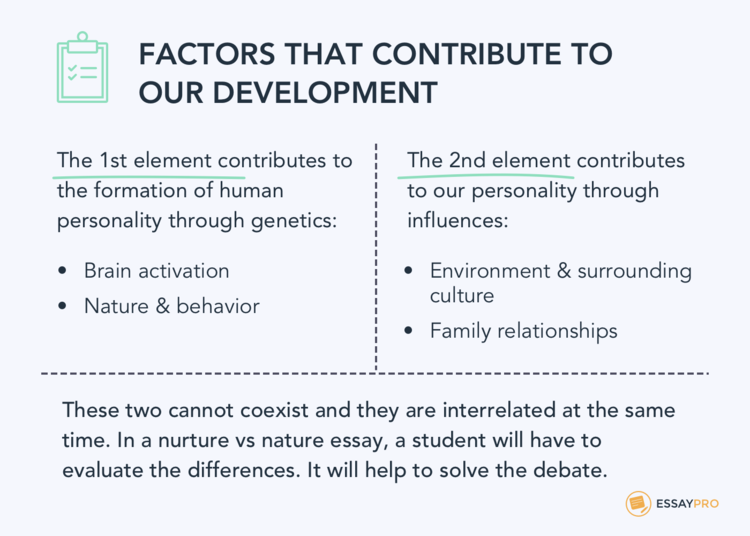
From one side, a student has to talk about the coding of genes and the way it dominates physical traits like the color of eyes, hair, height, weight, etc. On the other side, it is impossible to underestimate the role of environmental factors that are the true origins of human behavior. What are the specific topics to analyze in such paper? Start with the nature definition and nurture definition as shown in the examples below.
Keep on reading to discover more tips.

Goals of the Nature vs Nurture Debate Essay

What are the specific things to cover in nature vs nurture debate essay?

The main difference between these phenomena is that the first element stands for the inherited skills while the second one is about personal skills. It means nurture is free of heredity impact. In the primary case, we deal with the genes identified by the physical and personal qualities. In another case, it is about one’s childhood and growing up. We can say that taking part in such debate is arguing whether biological & family factors matter more than social or vice versa. What is an innate behavior and which one is learned? That is what a student should explain in the nature vs nurture debate.

One more good question is whether a nature vs nurture essay outline is similar to the structure of the ordinary essay or not? Find out in the next section!

Nature vs Nurture Essay Outline

The structure of the outline and entire paper depends on whether you write a nature and nurture essay or research paper. Let’s say; it is a nature versus nurture essay. Stick to this plan:

  • Opening paragraph – Introduction with a thesis statement
  • Body paragraph 1 – Definition of the 1 term
  • Body paragraph 2 – Definition of the 2 term
  • Body paragraph 3 – Compare & contrast analysis
  • Conclusion
  • References

It is a structure of a 5-paragraph essay on nature vs nurture. How about a research paper on the same topic? Here you go:

  • Cover page
  • Table of contents
  • Abstract
  • Introduction
  • Methodology
  • Results & discussion
  • Conclusion
  • Bibliography
  • Appendices (optional)
  • Glossary (optional)

You can find more information on writing research papers in one of our blog posts.
In the paper, provide a short description of the definitions and their significance.
Illustrate the relevant observations that are part of the explored terms.
Compare & contrast the influence on the case studies concerning the explored elements.

30 Nature versus Nurture Essay Topics You May Consider

To make your life easier, we will provide some of the nature vs nurture essay ideas divided into subcategories. It will speed up the pre-writing process!

Nature vs Nurture Argument Essay Questions

  1. The origins of the controversy between the inherited genes & the environment impact
  2. The tests done on identical twins to prove one of the opinions
  3. Personal opinion towards the human essence
  4. Reasons to support the primary role of genes in human life
  5. Factors that do influence the way people act
  6. Things that predetermine personality, development, skills, and intelligence
  7. The interaction of both elements is what drives development
  8. Nature cannot exist without nurture
  9. Factors that predetermine our instinctive preferences
  10. Survival instinct as the way to prove the role of genes

Nature vs Nurture Essay Topics

  1. Biological determinism
  2. Human essence
  3. Intelligence quotient
  4. Frankenstein’s role in the theory development
  5. The impact of these elements on child
  6. Behavioral response patterns of a human being
  7. The history of the never-ending debate
  8. The conflict of generations
  9. The role of the family in the personal development
  10. Biological factors that can explain the way we act

More Good Ideas You Can Consider

  1. Analyzing famous identical twins
  2. Mary Shelley’s opinion on the conflict
  3. Factors that influence individual’s height & weight
  4. Corporal punishment
  5. Survival instinct
  6. Differences between men & women
  7. Genetic determinism
  8. Things that make us who we are
  9. Human emotions under the scope
  10. Analyzing reflection in the mirror

To make a student understand the main point of this essay, we recommend observing some free nature vs nurture examples written by the academic writers.

3 Vivid Nature versus Nurture Examples

We have prepared several nature vs nurture examples from various categories. Choose the one you like the best to serve as your template.

Nature vs Nurture Definition Paper Sample

“Nature & nurture are one of the oldest philosophical terms to be argued. What is the meaning of each? Nature explains the way we are through the scope of genes and hereditary factors. Nurture explains the way a human behaves or feels based on the environmental variables such as childhood experience, treatment, care, relations with surrounding society, and culture.
Various psychologists try to prove which factor is more important. The experts in the field of biology support the first theory as they believe in the role of genetics and biological influences. Those who study behaviorism think that the second factor matters more. The debates around these two theories used to take a single-sided approach some time ago. in my essay, I will try to prove the critical role of each.”

Argumentative Essay on Nature vs Nurture Example

“Those who support nature in the endless debate have proven that human genes shape the result in such qualities as individuals’ temperament, intelligence, and behavior. A study of complex mental disorders such as autism and neurasthenia has proven that a certain clinical syndrome can be caused by the numerous genetic risk factors, meaning that there could be many routes from nucleotide to behavior (Walsh et al., 2008). What about the opposite side?
Advocates on the nurture side claims that everything associated with environmental factors, from education to job relationships, have a greater impact on human traits and development. It is impossible to argue that the everyday lives since the day of one’s birth shape their personality (Ridley, 2003).
I believe the dichotomy should end. both of these elements are the determinants of our personal traits like temperament or intelligence, and I will try to prove it.”

Nature vs Nurture Debate Psychology Essay

“Personality is a critical part of the whole being an individual. It makes a person who he or she is. This term stands for one’s enduring or consistent opinions, mood, and feelings in a particular situation. It is the way a human being thinks about the things and cases happening around; it is emotional feedback and the reaction to what takes place (Santrock, 2005).
Two major factors form and impact people’s personalities. Those are nature and nurture, and the main purpose of this paper is to reveal the role of each element in human development from the psychological point of view.”

Those are not the entire nature vs nurture essay examples, but the samples of best introduction. Depending on the type of your essay and specific topic, choose one of them. You can either take a certain position in this debate or try to prove both factors are equally important in the process of personality development.

Personal Essay

HOW TO WRITE A PERSONAL ESSAY

A well written personal essay can inspire and galvanize readers to act (for example to change something in their lives). It can be defined as a nonfiction narrative story in which authors share their personal experiences, incidents, insightful information or lessons learned from finding themselves in a predicament. In order to write a compelling piece, the first step is to understand the personal essay format and its implicit structure. Then, it is best to explore multiple personal essay topics by coming with basic outlines allowing one to examine which one would be the most compelling.

TABLE OF CONTENTS

  • Proper Format
  • Personal Essay Topics
  • Crafting An Outline
  • Personal Essay Writing Process
  • Writing A Rough Draft & Submitting
  • Examples

Proper Format

Like most academic tasks, the personal essay format can be easily outlined in five-paragraphs. Start with an introductory paragraph. It gives your reader a clear understanding of what the story will be about. Then, catch their attention and motivate them to read the rest of the paper with an awesome title. As you can see learning how to write a personal essay doesn’t have to be a pain when the process is clearly explained.

The following step requires students to include a thesis statement to the introduction and all the points you would like to discuss.

After creating an introduction, you must then formulate three body paragraphs that support your thesis statement. Each new point should contain its own body paragraph. Don’t forget to make transitions from one paragraph to another to make sure that everything flows smoothly.

In the end, it will be essential to wrap everything up and give your audience a sense of completeness by writing a proper conclusion. Restate your thesissummarize the main points that you have stated in body paragraphs and leave your reader with a specific emotion, depending on the subject of your paper.

Before looking at some prominent personal essay examples, let us discover what criteria can be used to select the most suitable topic for oneself.

Personal Essay Topics

If you have got a lot of exciting stories to tell, your personal essay can shine brightly by interactively engaging the reader. Put in a little extra effort and dig deeper to find a unique or interesting experience or an unusual moment in your life.

Looking at a life lesson from another angle can turn into deep and purposeful subject matter. If you decide to pick a topic from a huge list of personal essay topics that you found in the internet, be precise and careful because not all of them can meet the requirements of your professor.

Personal Narrative Essay Topics

In this type of writing, try to explore a unique experience that created a sense of conflict in your life. Explore how and why you were confused, annoyed, or hurt by the experience. Imagine your piece of paper as a place where you can freely express your emotionsdiscuss significant moments, & reflect their impact on your life. This tip can help you to create a bunch of really good essay topics, but if you need a motivation, you can find some examples below.

Examples:

  • “One small step that helped me skyrocket in my career!”
  • “Why controlling urges teaches you master self-control.”
  • “People only learn from their own mistakes.”
  • “Life is not a one-dimensional path: it is curvier than a snake!”
  • “What I learned about conquering my fears.”
  • “A moment when you should have made a better choice.”

Write about Specific Emotions

You may also talk about a specific event in your life that left a long-lasting impression on you. Usually, this type of essay acts as a reflection of an incidentthat took place in your life and shifted it in some way. Dive deeper into your mind and find an event that is unique and personal to you. The weirder the occurrence, the more likely the essay will be engaging to read.

Examples:

  • “Moment when your life changed forever.”
  • “A disappointment you’ve experienced.”
  • “An accident that changed everything.”
  • “A near death experience.”
  • “Most terrifying thing you’ve witnessed.”
  • “An event that changed your life.”

If you have not noticed, each of these titles can bring a fascinating vibe to the table. The names grab your attention, but you can only honestly know what they are about when you start reading them. That is the secret to a provocative title! Check out our TOP 25 Personal essay topics to help you get started.

DOWNLOAD

Crafting An Outline

This is one of the most important steps of personal essay writing at any level. Your outline will serve you as a navigator, and you don’t want to get off the track, do you? It will be important to understand how to start a personal essay, what to write in body paragraphs and how to conclude it appropriately.

Introduction

Start your paper with a statement about your story, while at the same time catching the reader’s attention by making use of a hook sentence. It may be a suitable quotation, definition, fact or even an intriguing question.

Don’t leave your readers in the dark by explaining the important things such as:

  • Who are the major characters?
  • When and where is it taking place?
  • What kind of story is it?

The great introduction should also have a narrative thesis.
It must be written in one concise sentence that will bring the reader to the starting point of your essay.

Body

It should include supporting evidence for your narrative thesis. Usually, it is presented in the form of your experiences and your reflections on these events. You should also note the passage of time in your body sections, so make sure that the reader is aware of when and how each specific chapter took place.

Conclusion

Naturally, it should include a conclusion to the events and experiences discussed throughout the essay. Students should also come to discover a life lesson by going through the story. It is a moment where you show what you have learned from your experiences or how previous events have changed your life.

Use 1 for the introduction, 2-3 for the body section, & 1 for the conclusion. Doing it allows one to put together a solid outline from the start. Keep in mind that you do not need to be limited to five paragraphs as long as you have all three sections covered in the personal essay.

Personal Essay Writing Process

We are going to explore the various stages of personal essay writing. Follow the tips of our essay writer and don’t skip anything.

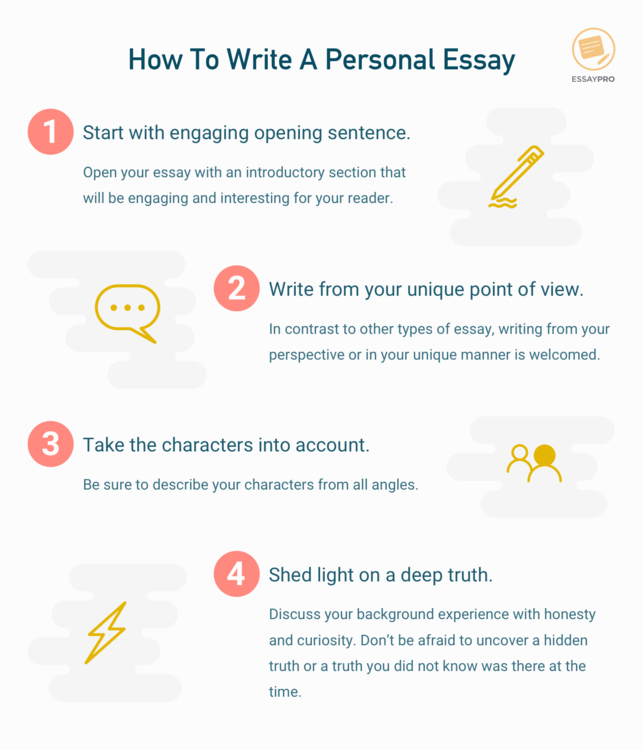
Start with engaging opening sentence

Open your personal essay with an introductory section that will be engaging and interesting for your reader. In the opening section, introduce the principal characters of the story as well as the central theme or themes. It should also present the fundamental question of the essay.

Write from your unique point of view

You are free to write from your point of view or in your own unique style. In contrast to other types of essay, writing from your perspective or in your personal manner is welcomed.

Take the characters into account

Be sure to describe your characters from all angles. Even though it is your real life experiences, you should still consider storytelling elements like the plot and characters. Using these ingredients in your writing will keep your reader engaged and help your essay flow smoothly.

Shed light on a deep truth

Discuss your background experience with honesty and curiosity. Don’t be afraid to uncover a hidden truth or a truth you didn’t know was there at the time. Expose a thing that is uncomfortable or difficult for you to discuss. No matter who will read your essay. Whether it will be a teacher or somebody else, they will definitely appreciate your honesty and strive to share your experience.

Personal Narrative Essay

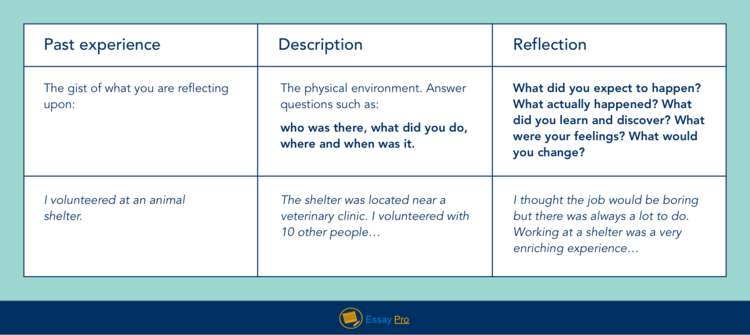
Writing a personal narrative essay is an easy way to share your (writer’s) personal experience or a story from your life. Writing a good paper will require you to focus on many vivid details and look at them from another angle. You will need to identify crucial points and pay a lot of attention to the information you want to present.

The 1st line should let the audience know what you will be talking about and your opinion. In the body, give the reader a full idea of what happened (personal experience, event, etc.) and how you feel about it. Your story can be told chronologically, or group the facts by importance.

In the end, you will need to wrap everything up and present the main idea of your story, whether it is a lesson that you’ve learned, the impact of a particular experience, etc. Using this type of personal essay format will allow the author to keep their audience in an interactive manner throughout the entire piece.

Writing A Rough Draft & Submitting

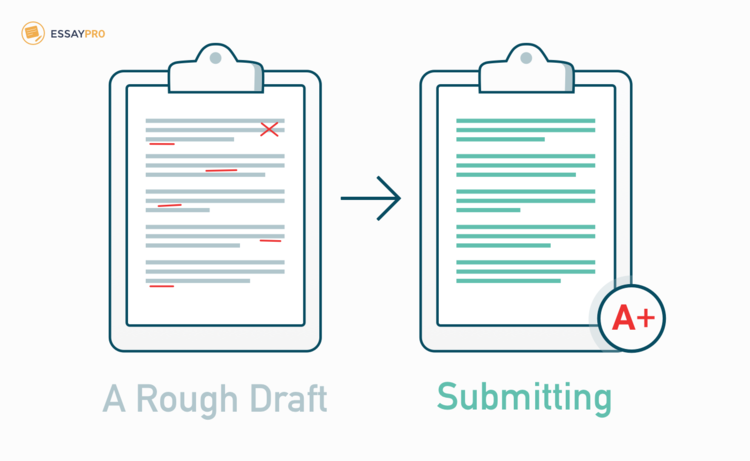
After you have completed all the previous steps, it’s time to write a rough draft. Writing a rough draft gives you the opportunity to get some new ideas about what you’re writing. Moreover, it’s a great place to polish your essay up and correct small grammar, spelling and other types of mistakes. Get a second pair of eyes: No one can rate your writing as well as a neutral party. As soon as you have checked everything, you can start to write the final paper.

Before submitting your personal essay, double check everything once again and make sure to present the central theme. After it, go through it and proofread your entire piece. It is somewhat frustrating to read an essay full of grammatical mistakes, which can be easily avoided. You can ask your classmate for help, so by that way, you will save each other. Don’t forget to meet the deadline – and you’re officially finished!

Personal Essay Examples

In our time it’s much more easier to find things on the Internet, and examples are not an exception. Remember one simple thing: not everything that you can find on the Internet is done correctly. If you need some inspiration to get started, you can find several examples of personal essays below, or you can use our free essay samples to sharpen your skills on any type of writing.

DOWNLOAD

DOWNLOAD

Persuasive Essay

HOW TO WRITE A PERSUASIVE ESSAY

The broadness of persuasive writing is what makes it extremely valuable to learn. It is taught early on in schools. Students learn how to dissect political speeches, advertisements, and various other media. Most persuasive writing addresses contemporary issues. It challenges writers to take a stance and provide an educated opinion. So what is a persuasive essay?

The persuasive essay definition is an academic piece of writing aimed to persuade the reader to agree with a specific point of view. When writing a persuasive essay, the writer must conduct solid research and analysis to understand their subject to the fullest extent. They must be aware of their own (and the readers’) biases. Upon finishing reading a persuasive essay, the reader must be convinced that there is no other correct point of view.

TABLE OF CONTENTS

  • Correct Format
  • Persuasive Essay Topics
  • Crafting A Thesis Statement
  • Persuasive Essay Outline
  • Grading System
  • Beneficial Tips
  • Examples

Correct Format

In schools and colleges, persuasive writing is taught using the five-paragraph essay structure. You will often be required to format your essay according to one of the common citation styles, such as APA or MLA.

The format of a persuasive essay relies on the way arguments are structured in the outline. For example, a typical body paragraph is the presentation and solidification of one argument. The section opens up with an introductory sentence which leads to the argument. After the argument is presented, the writer uses sources to prove that their argument is valid. Next, the writer transitions into the next argument, and so forth. The ‘outline’ section of this article provides further insight on how to format a persuasive essay.

Persuasive Essay Topics

When thinking of persuasive essay ideas, it is best to choose a topic with many contrasting opinions. Broad issues such as gun control and abortion rights can spawn novel length essays. These best be avoided unless you’re writing a dissertation.

Say you want to argue in favor of space exploration. It perfectly fits the description of a widely explored contemporary subject. Creating a structure where every body paragraph explores a different planet might be a bit too much. Why not narrow it down and argue in favor of building a base on the moon? This way, you can convince the audience of the benefits of creating a moon base, and giving them a small idea of what can be achieved from space exploration on a larger scale.

Hence, you have persuaded your reader on a small topic connected to a much broader one. This will leave them inspired with plenty of thoughts to feast on, allowing them to dive further into the world of space.

Topics For High School

Perhaps the concept of space exploration is long and tedious and makes your stomach turn. Don’t worry – you can come up with plenty simple persuasive essay topics for high school. Perhaps you have already debated on some of these with your friends:

  • Should sex ed be taught in public schools?
  • Should ‘To Kill A Mockingbird’ be banned in school because its language makes some kids uncomfortable?
  • Should cellphones be banned in classrooms?
  • Should students wear uniforms in school?
  • Should students influence the school curriculum?

Topics for College

Persuasive essay topics for college get a bit more complicated. The best essay topics are ones that take into account the events of contemporary lifediscussing moralethicaltechnological, and environmental issues. Students have the opportunity to make a serious impact with their writing, fearlessly breathing new life into the old world. For college, it is best to choose controversial persuasive essay topics. They challenge the writer to engage in relevant intellectual issues. Here are some examples:

  • Media marketed for teenagers advertise morally and ethically wrong messages.
  • Federal courtrooms must have live cameras that televise all trials.
  • Beauty contests should not be encouraged.
  • With the amounts of information available online, college education should be made significantly cheaper.
  • Create a prisoner rehabilitation system using music and art.
  • Arguing in favor of Net Neutrality.

Crafting A Thesis Statement

The primary concern when writing a persuasive essay thesis should be the writer’s position on the selected topic. The thesis must be brief and direct, providing a clear idea of the essay’s stance. The writer’s mission is to create a piece that will solidify the thesis, proving it as valid and unchallenged.

Bad Thesis Statements:

  • Homeless people are becoming a nuisance in Chicago, and someone should take care of them.
  • There are many pros of buying food from local markets.
  • Life on Mars is possible if we make it so.

Good Thesis Statements:

  • The government of Chicago must take the homeless problem more seriously, providing them access to services such as food donations, public restrooms, and camping facilities.
  • Buying food from local markets is hugely beneficial in improving the economy of small towns and villages, and the country as a whole.
  • Mars colonization might be the only hope left for humanity, as pollution levels on Earth will soon make the planet uninhabitable.

As you may have noticed, lousy thesis statements offer a generalized and neutral view. Good thesis statements take a stable position in the argument.

Persuasive Essay Outline

After getting well-versed in your topic, it is essential to create an outline. The outline will assist you in organizing your argument. Every body paragraph presents an argument and backs it up with sources. These arguments and references used will all be placed in your outline which you can always refer to when writing your essay. The end of this section contains a persuasive essay outline example to help you get it done.

Introduction

There are plenty of ways how to start a persuasive essay. The introduction of the essay must begin with a hook to grab the audience’s attention. You can start with a humorous statement to break the ice and suggest a less formal writing approach. Alternatively, you may begin with a robust controversial statement. Put the reader straight into the action!

Any opener or headline serves as a tool to paint a broad picture of the work, leading to the main point. The same goes for a persuasive essay introduction. While it seems like a small structural element without any reliable info, the opening is crucial to capturing and maintaining the reader’s interest. It is best to write the introduction in the end. Knowing the content that follows will help you lead into it.

Body Paragraphs

Here’s where the heavy artillery comes into play. The persuasive essay body paragraphs are where the viewpoint is backed by hard facts and evidence. Good persuasive writers know the topic inside out. They can anticipate any opposing views and provide counter-arguments. Here are ways you could support an argument in a persuasive essay body paragraph.

  • Use Facts. Factual information will come from reading and observation, as well as personal experience. These facts always have to be backed up by sources to make them credible.
  • Quotes. “If I have seen further than others, it is by standing upon the shoulders of giants.” It is highly likely that there have been writers who already tackled your topic. Referring to them, and solidifying your argument with quotes can have a tremendous impact.
  • Statistics. Some things just can’t be argued with. Always have statistics from a reliable scientific source to make your argument solid.
  • Examples. These can include all of the above. Painting a specific scenario as an example could also work – depending on how it’s written. A good essay writer can persuade on just about any point.
  • Concessions. An excellent way to prove your expertise in the field is by accepting part of your opponent’s argument as valid. Creating a concession will put you in a right place from an ethical perspective. It will help you find common ground with your opponent. “True, building a border wall will help keep drugs out of the country. However, people who fully rely on it are missing the point…”

Conclusion

It is precious to know how to end a persuasive essay efficiently. The persuasive essay conclusion does not delve far from the introduction. However, certain elements are exclusive for conclusions. Restating the thesis and summarizing main points is the obvious first thing to do.

To make a conclusion effective, one must write a meaningful personal comment. This could be a call for action to leave the reader with something to ponder about. This can be a prediction based on the information presented in the essay. It could be a quote that you believe perfectly summarizes the piece and its main points. Perhaps you’ve already found the solution to the problem, and you want to use the conclusion to suggest a way to solve it? Whatever the case, your mission here is to get creative and leave an impact.

The final version of your outline should look something like this.

Grading System

There are specific things instructors will look for in your essay. Following this persuasive essay rubric will help you win the praise of your professors.

  • Focus: The thesis statement, as with the whole paper, must state a concrete point of view instead of being neutral. Every piece of writing in the paper exists to defend that thesis statement.
  • Supporting the thesis: The thesis is well defined through solid arguments and references to credible sources. There is a minimum of 3 supporting points, which are organized in the essay outline.
  • Organization: Every transition from one idea to the next is executed smoothly. There are transitional sentences which help the essay flow. Arguments are presented in the most suitable order.
  • Conclusion: After reading the essay – the reader must have understood the writer’s point of view. The point of view is unbiased and educated and presented in a way that challenges the writer to take part in the argument.
  • Conventions: Punctuation and grammar rules are supported. The essay isn’t hard to read due to a balance between short and long sentences.

Having ticked off these points, you can rest assured you’ve done everything correctly.

Beneficial Tips

With all being said, here are some final tips for writing a persuasive essay.

  • Avoid fancy vocabulary: Having some variety when it comes to vocabulary is fine – but don’t expect your grade to go up because of some fancy synonyms. Find your style and write in a way that makes sense.
  • Search for different persuasion techniques. There are plenty of them in countless different mediums. Perhaps doing some research on persuasion might help you with your essay.
  • Triple check your work! Practice makes perfect, and so does proofreading. Check the essay for readability. Make sure that everything flows in harmony with the thesis. Get a second pair of eyes by giving your essay to a friend for reading!
  • Every paragraph is a mini-essay: This is the best out of all the persuasive essay tips you will find. Take the essay outline, compress it, and apply it to every paragraph. This way, every section has an introduction with a hook, a mini-thesis, a sustained argument, and final concluding sentence. The structure is everything!

Persuasive Essay Examples

Check out our persuasive essay examples below. To get a better understanding with writing this type of paper.

Are Women Weaker Than Men Today?
This is an example of a well structured persuasive essay. The author challenges an assumption that women are weaker than men and provides evidence to support his claim.

DOWNLOAD

DOWNLOAD

Persuasive Essay Topics

150 GOOD PERSUASIVE ESSAY TOPICS ON EVERYTHING

Without having some good persuasive essay topics in your pocket, a student could not write a paper of this type. The goal is to take a position and defend it. This means the topic must be debatable. A student must check whether credible enough, up-to-date, and relevant information is available on the web.

TABLE OF CONTENTS

  • What is a Persuasive Essay?
  • How to Write a Persuasive Essay?
  • How To Write Persuasive Essay Outline
  • How to a Persuasive Essay Topic
  • Persuasive Essay Topics
  • How to Get a Qualified Writing Help

What is a Persuasive Essay?

By definition, a persuasive essay is a style of writing which convinces the reader that your point of view or argument is the best view. This is a typical college or high school assignment to teach students the art of persuasive writing. It is essential to check whether your claim has strong evidence to be believable. A compelling paper can be an argumentative essay depending on the use: whether the prompt advises to pick a position or defend it.

Before we get to the persuasive speech topics, let’s see the secrets of persuasive writing and how to outline your work!

How to Write a Persuasive Essay?

Pick a side. Be confident with the angle chosen and demonstrate it well through the persuasive essay.

  • Understand the audience. It is essential to adjust the language used and to see if there is any biased that needs to be addressed.
  • Do the research required. The best results will depend on the solid well-researched material from multiple sources including other professionals in the field.
  • Offer the evidence based on importance. While compiling the research and your notes try to keep it in order of significance as this will help with writing later.
  • Is the thesis well proved? Look at the thesis statement and compare it to your conclusion and see if there any gaps in the persuasive paper.
  • Check over the work. It is imperative to double check the paper for errors, wait a couple of days after you finished writing and look through the essay with a fresh mind. It is even a good idea to get a friend or colleague to look through.
  • Personal touch. Although strong evidence is vital, do not be afraid to include examples and explanations of points along with references to things that have been experienced first hand.

How to Write a Persuasive Essay Outline?

There are some key features to bear in mind when planning out a persuasive essay outline, and the structure is essential.

Introduction
Try to open with a “hook” and make the audience want to continue reading the work. Include a thesis statement at the end.

Body Paragraphs
The main content of the arguments go here, and it’s important to back up every point with evidence and start a new paragraph with a new argument. Include an opposing view.

Conclusion
In your conclusion, restate the thesis statement and provide a summary of the most important or influential points from the body paragraphs.

How Do You Choose a Persuasive Essay Topic

Most, if not all students are looking forward to writing that essay of their choosing and try to persuade another person their belief or opinion is right. The idea is fabulous, to be given free reigns and charged with not only coming up with the topic but also the content, allowing your imagination and creativity to persuade or influence your reader.

Now you have your chance, but when you sit down to write, you realize your brain seems to have died. Do not despair; we have a tremendous list of topics that you could be creative with.

  • Stay calm – the main thing is not to panic or get frustrated.
  • Brainstorm – with other students in your college or school. Do not think “will the professor like it?” You should not even be thinking about whether it is politically correct, debate your argument towards a train of thought where your idea is the correct one. After all, you are writing a persuasive essay.
  • Research – what is in the news whether national or international, what topics are hot, what is in fashion and always jot these ideas down for later, after all, you do carry a mobile phone around with you, so you have no excuse.
  • Be clear – with your idea of a persuasive essay, do not under any circumstance be vague in your topic, if your paper is too broad the details of the argument may get lost in the telling, do not be that student, do not let it happen to you.

Persuasive Essay Topic List for Everybody

Here we have compelled an extensive list of good persuasive essay topics divided into popular categories to help you get started with your paper.

Easy Persuasive Essay Topics

  • Should school classes be divided up by gender
  • Are french fries healthy enough to be served in the canteen
  • Should Breastfeeding be allowed in public spaces
  • The legal age for drinking alcohol is 21
  • Are exams a fair measure for a students ability
  • Are genetically modified foods acceptable
  • Should nuclear weapons be abolished
  • Is the voting system reliable

Persuasive Speech and Essay Topics for Kids

  • Carrying the latest iPhone is ok as it is part of our image or how much money our family earns
  • Making friends around the world is good for our future
  • Is it right to eat meat
  • The government should impose household plastic trash limits
  • Why you should never lie
  • Should you learn another language
  • Being a single child versus having brothers and sisters
  • Dogs make better pets than cats.
  • What would be the best superpower to have
  • We can change the world
  • Why should you respect your elders

Sports Persuasive Speech and Essay Topics

  • Does participating in sport make you a competitive person
  • The importance of Physical education in schools is overrated
  • Both girls and boys can play on the same team
  • Athletes should never drink alcohol
  • Swimming is the healthiest and best sport
  • Children should not take part in extreme sports
  • Should children take responsibility for themselves in sport
  • Women are better at dancing and water sports than men are

Persuasive Essay Topics for Middle School

  • The best vacation destinations
  • Should there be harsher punishment for bullying
  • Is less homework a good idea
  • Kids should have more pocket money
  • The impact of violent TV shows on the population
  • Do violent computer games hurt kids
  • The present generation lacks strict rules and regulation due to fear
  • Can students be held in detention
  • Who should be responsible for students bad grades

Persuasive Essay Topics for High School

  • Should students take a gap year after high school?
  • Students should be allowed to wear whatever clothes they wish
  • Should the voting age be lowered
  • Free condoms being available for students
  • Couples expecting a baby should receive lessons about parenting
  • Should sex education be made more available
  • National security is more important than privacy

Persuasive Speech and Essay Topics About Music

  • Pirated music is a severe threat to the economy of the country
  • Lyrics play a role in how the younger generation thinks
  • Music is an underrated treatment for mental illness
  • Can some genres of music push children to suicide
  • Playing bass guitar is more comfortable than standard electric six string
  • Can music be seen as a language
  • Music of the 70s have better lyrics than modern songs
  • Depressive tracks encourage young adults to commit suicide?

Persuasive Speech and Essay Topics About Animals

  • Hunting wild animals is immoral
  • Beauty products should not be tested on animals
  • People should stop wearing leather and fur
  • Why should we protect endangered animals
  • Is it ethically ok to breed dogs from different breeds
  • Do animals deserve the same rights as humans
  • Being a vegetarian does not help the animal world the way we think
  • Is it ok to clone an animal

Persuasive Speech and Essay Topics for Elementary Students

  • Small monkeys would make good house pets
  • Train ticket sellers have the most boring job
  • The average school day should be shortened
  • Junk food should be banned from school
  • The prettiest time of year is fall
  • Classrooms should be outside
  • We should all grow our vegetables
  • Kids should not receive corporal punishment from parents for misbehavior

Persuasive Essay Topics on Education

  • Information technology should have a role in everyday life at school
  • Do SAT, and ACT scores matter?
  • Should school guards be armed to cut down on shootings
  • Stay at home education compared to traditional schools
  • Do we need to attend public education and should society accept it
  • The average school day should be shorter
  • Physical education should be a voluntary subject
  • Should teachers be paid more to compensate with stress

Science Persuasive Essay Topics

  • Marijuana should be used for medical treatment
  • Are mobile phones safe
  • Information technology should be treated as the most valuable subject
  • Humans are the most significant cause of pollution
  • Is 5G safe
  • Global warming is caused by man
  • The use of fossil fuels is killing the planet
  • Is renewable energy a reliable fuel for the future
  • Should the police be allowed to use DNA profiling in the public database

Funny Persuasive Essay Topics

  • Are Blondes less intelligent
  • Drinking wine every day is healthy
  • Getting free donuts at school motivates studying
  • The best comedy show of all times
  • Do men gossip more than women
  • Pets think their humans are great
  • Men say the best chat up lines ever
  • Being a pro gamer
  • Do you believe in love at first sight

Argumentative Persuasive Essay Topics

  • The media should stop marketing to kids
  • Ban smoking in all public places
  • Constant talk about religious differences evokes aggression around the world
  • Has the internet been commercialized
  • How fashion has changed a woman’s/man’s body over the last 50 years
  • Should we do away with high street banks all together
  • Military service should be compulsory
  • The gay couple adopting kids

College Persuasive Essay Topics

  • Homeless people come before foreign aid
  • Social networks are more threatening than people think
  • Parents being held responsible for the crimes of their children is a good idea
  • Can you trace a person via the internet
  • Has feminism changed parenting
  • Should supermarkets show where food comes from
  • Selling weapons to foreign countries should be stopped
  • Was the swinging 60s a significant part of our art history

Persuasive Essay Topics 5th grade

  • Early bed is essential for students health
  • Taking pets to school can be beneficial
  • After school activities should be compulsory
  • Is snacking in class acceptable
  • The dress code at school is terrible for individualism
  • School breaks should be longer
  • Being skillful is better than being a hard worker
  • Should morning classes start later than they currently do

Controversial Persuasive Essay Topics

  • Bailing out financial institutions with taxpayers money should be stopped
  • Media advertisements are sending unhealthy signals to young women
  • Lesbian couples should not be allowed to have a child
  • Medical testing on animals should be illegal
  • There should be a border wall with Mexico and Canada
  • Sex education should be available in schools
  • Every driver over the age of 60 should take their driving test again
  • Should political figures star in movies

5 paragraph Persuasive Essay Topics

  • Vaccinations should be made compulsory
  • Should college education be free to everyone
  • What is true friendship
  • Is college success the key to a good life
  • Every weekend should be a long weekend
  • Homework is faster when you play music
  • The governments need to invest in more energy resources
  • Is fracking harming the world

Environmental Persuasive Essay Topics

  • Plastic should be made illegal
  • Private cars should be banned from city centers
  • When building houses, they should plant new trees
  • Cutting down the rainforest should be unlawful
  • Fossil fuel companies should pay for nature conservation
  • Is enough being done about CO2 emissions
  • Chemtrails need to be identified and stopped
  • Should a maximum fine be given for littering
  • Are humans the cause of climate change
  • Should public transport be free to reduce pollution
  • Is waste disposal being dealt with properly

Immigration Persuasive Essay Topics

  • Can use the Appropriations Bill Strengthen in favor to ‘Remain in Mexico’
  • Illegal immigration is strongly connected with acts of war and terrorism
  • Should orphaned children automatically get legal status when crossing the border
  • Illegal immigration can promote terrorism
  • Illegal immigration is higher in wealthier countries
  • Immigration improves attitudes towards foreign cultures
  • When should an immigrant become a citizen
  • The United States should build a border wall with Mexico and Canada

Process Essay

HOW TO WRITE A PROCESS ESSAY: STEP-BY-STEP GUIDE

The process essay, also well known as the “how-to” essay is commonly written for people or companies that need tutorials. Whether it’s building a robot or cooking a chocolate cake, process essays use a similar format for any variation. They follow a step-by-step style, with the initial step influencing the second which influences the third, etc. Each step carries its own importance, and a poor explanation of one step can ruin the entire process. It’s important to stay concise as well as efficient. However, before you begin writing your essay, do some small preparations.

TABLE OF CONTENTS

  • Small Stuff
  • Sample Topics
  • Outline
  • Post-Writing Tips
  • Examples

Prepare The Small Stuff

  • Determine the Audience’s Skill Level. It’s important to center the complexity of the essay based on who the readers will be. For example, if you need to teach a friend or coworker how to do a simple fix or create a certain tool, then it would be intelligent to stick towards more basic terminology. However, if you are writing an essay for your astrophysics professor about the creation of a black hole in our planet, use more sophisticated and informative terminology.
  • Make a List of Materials. Obviously, the creation of anything comes with some prerequisites. Whether it’s items or ideas, the importance of having the necessities beforehand and ready to go is substantial. Make sure to place each item in accordance with its importance. The more impactful a part is, the higher up on the list it should be. However, each item should obviously be obtained.
  • Write out Each Task. In a step-by-step tutorial, each individual task carries some sort of weight. Since an entire process can not be complete if any step is skipped, it’s crucial to write out every single step. However, don’t go overboard in your explanations. It’s not necessary to bring the tutorial to a microscopic level, but each step should be understandable!

Sample Topics

  • The Full-Scale Production of a Movie.
  • From fresh and ready to a “burned out” student.
  • How things decay (Half-Life concept).
  • The development of a bad habit.
  • The process of building a business from scratch.

It’s important to note that these essay topics are just some common examples used by several college students for their course papers. Feel free to use anyone you want or think of your own. Just make sure it’s a PROCESS!

Outline

Most essay outlines follow the standard scheme: Intro > Body Paragraphs > Conclusion.

Every process is different: some can take a couple of minutes while others take months or years to complete. The length of the essay is generally based on the difficulty and number of steps it takes. However, the structure doesn’t maneuver.

Introduction

The first thing that you want to do as a writer is to interest the readers about your individual process. For somebody to be keen on approaching your process, they have to express interest in it. Though that generally goes without saying, many writers ignore this fact. Let’s break it down into subsections:

  • Give a little bit of historical background. People often want to know the origins of whatever it is that they’re working on. Introducing this part of the process helps to intrigue the reader, as well as give him a sense of purpose for the task.
  • Create an approximate timeframe. Unfortunately, your readers don’t have all day to spend on this one event. As well as its purpose, people want to know how long the task will take. This way, they can decide how to break up the work. If it’s a quick fix, then they can knock it out in one session. However, if it’s a large-scale operation, then the readers will obviously have to create their own time schedule.

Body Paragraphs

This is the point in the process essay where you start introducing the step-by-step process you need to take. A lot of the time, it helps to break down each process into subsections. For example, if a step has many moving parts, it would be smart to create its own paragraph just for that step. Remember, it’s important to keep things smooth and efficient. Break down the body paragraphs in unity with the steps. Let’s go into more detail about each step.

  • Each step should be carefully explained. Every step will vary in length.** Think about it: every instruction manual has several steps. Some are more difficult to comprehend or perform than others. For this reason, create your steps and explanations accordingly. You should be able to get a sense of their length and difficulty based on the explanation.
  • Don’t forget to explain the purpose. People don’t want orders barked at them aimlessly. Besides just accomplishing a task, people want to learn as they perform.
    • Why did they do this?
    • What was the purpose of this method?
    • Why did we do it this way and not this other way?
  • To make everything flow smoothly use transitions. Make the steps flow one after another to create a well-structured essay. As you introduce next step, consider using transition words like “next”, “now”, “then”, “so that”, etc.

Showing the readers that they are learning and not just repeating is one of the most effective ways to lock down their attention and keep them coming back!

Conclusion

After going through every step meticulously and explaining the whole process, the essay needs a confident conclusion. This paragraph should be short, sweet, and to the point. It’s main goal is to accomplish 2 tasks:

  • Talk about the main result. After the readers have completed the process, they should be left with a final result. It’s important that you explain to the readers what the end result will look like, and what can be done with it.
  • Think about it like this. After completing a task, you obviously would like to know its overall purpose. When the reader feels that he accomplished a challenge, learned something from it and has a path to take the result towards, he will be satisfied!
  • Restatement as well as Overall Conclusion. To put a pretty tie around the process essay means that you need to neatly wrap things up! Restate some of the highlightable points as well as the key overall purpose. Make sure that the reader feels accomplished after going through your process, and strengthen the necessity of the purpose with a nice concluding sentence!

Post-Writing Tips

  • Make sure the work is simple enough to follow. Worst-case-scenario – an author can create is a feeling of absolute confusion in the reader’s mind. To avoid this problem, always remember that your readers can be beginners. Because of that don’t try to impress them with complicated words or sentences, use simple language to provide clear directions on how to do something. Give as much details as possible, but do it plainly.
    “Why is he making me do this?”
    “What was the purpose of this?”
    “I don’t understand this step at all!”
  • If the reader is asking himself these questions, then it’s time to do some editing!
  • Experiment and try it for yourself, or ask a friend. There’s no better way to experience success then actively attempt through your own instructions. If everything truly makes sense, then you should have no problem solving the task through your own words. Even better, ask a peer to try it through your words to get an outside point of view.

Examples

DOWNLOAD

DOWNLOAD

Problem Solution Essay

HOW TO WRITE A PROBLEM SOLUTION ESSAY

To start thinking about a problem solution essay, go outside and take a look at the world around you.

There are many problems: povertypollutioncorruptiondisease, bad roads, etc.

Some of them can be addressed and solved quickly. Others require critical thinking and significant proposals to business people or your local government.

A problem solution essay is a great mind-opener. After all, most people who go into academia want to help the world. Regardless of whether you’re a doctor or an artist.

In this article we will first give you some topics to think about. Then we will present a step-by-step guide on how to write a problem solution essay effectively.

Make sure to stick around for useful tips near the end of this blog!

TABLE OF CONTENTS

  • Problem Solution Essay Topics
  • The Key Components of a Problem Solution Paper
  • The Proposal
  • The Outline: Block & Chain Structures
  • Writing a Problem Solution Essay
  • Thesis Statement
  • Exploring Solutions to your Problem, Step by Step
  • Proofreading and Tips

Problem Solution Essay Topics

The best way to find problem solution essay topics is to look at common issues.

We have created a list of simple topics to get you thinking:

  1. Bullying on social media has caused lots of teens to get depressed. How can we address cyberbullying in your school/hometown?
  2. What is the best way to drag a friend out of depression?
  3. Smoking is highly addictive and extremely hard to quit. How can we address the smoking problem and educate teens that it isn’t cool to smoke?
  4. People can often be manipulative and Machiavellian, getting into other peoples’ way. What is the best way to deal with such people?
  5. People litter without thinking of environmental consequences. How can we educate these people?
  6. Teens often struggle with expressing their feelings. These struggles can flow into adulthood and make people closed and lonely. How can we get teens to open up?
  7. Stereotypes and racism are ever present in 2nd and 3rd world countries. How can we educate people about the dangers of racism and stereotypical thought?
  8. Lots of teens struggle with internet addiction. How can we teach them to appreciate the real world?
  9. Private college is an extremely expensive privilege. How can we lower prices for students who deserve it?
  10. Lots of students in college lose themselves to alcohol and drugs. How can we prevent this?
  11. Lots of people buy their driver’s license, ending up terrible drivers. How can we fix that?
  12. Textbooks are costly for college students. Will digital textbooks fix this issue?
  13. How can colleges raise pay for professors without raising the price for students?
  14. What is the best way to tackle problematic kids at school?
  15. What is the best way to help a creative child explore their potential while doing good at school?

These are just a few problem solution essay topics. There are plenty more problems in the world that you could address.

Think of a topic that motivates you to help.

The Key Components of a Problem Solution Paper

After you’ve chosen your topic, you must do some brainstorming.

A problem solution essay is divided into four main components. You should focus on them while brainstorming. These components are:

Situation: give background to the case in your own words.
Problem: state the problem and why it is essential to address.
Solution: offer your answer to the problem.
Evaluation: evaluate your paper, listing the main ideas and offer a final prediction or call to action.

A problem solution essay can address several problems if they are in the same subject area. These problems can be linked to a bigger picture, inspiring more research from your peers.

The Proposal

Before doing any outline and brainstorming, you must convince yourself that the problem matters.

Creating a proposal will be essential to solidify your understanding of the problem. Here are some general steps to follow when writing a proposal:

  • Solidify how much you know. Write down everything you’ve learned about the issue and make sure you know it inside out.
  • Prove to yourself that the problem matters. After learning everything there is to it, you should be confident that the problem is real and that you can solve it.
  • Determine what needs to be learned. Extra research goes a long way. This can also help you call to action for further study in your conclusion.
  • Design a research plan. Will you use the library or go online? Will you go outside and talk to real people who can offer insight based on experience?

The proposal will help you clarify where you currently stand on the problem.

Some useful advice: get early feedback on your proposal! Talk to your teacher, family member or friend. They will tell you if you’re on the right track.

The Outline: Block & Chain Structures

There are two common types of outlines for a problem solution paper. They are slight variations on the classic 5-paragraph essay format.

Use the format which fits your paper best.

Block Structure

One way to do it is by using the block structure. Here you must list the problems first, and then propose the solutions:

  • Introduction and background
    • Problem 1
    • Problem 2
  • Transition paragraph
    • Solution 1
    • Solution 2
  • Evaluation and conclusion

Chain Structure

The second format is the chain structure, where you present a problem followed by a solution. This format works best for quickly written papers, such as exam questions or homework assignments.

  • Introduction with background
    • Problem 1 and solution
    • Problem 2 and solution
    • Problem 3 and solution
  • Conclusion and evaluation

Writing an outline first will do magic for your writing. Just do some brainstorming, and fit the information into one of these structures.

Now let’s move on to the writing process.

Writing a Problem Solution Essay

The most logical place to start is the problems section. This section should give the reader most of the information they need to understand the problem.

Here are some useful steps to follow:

Students usually pick local problems. This helps establish a better connection with their peers. If your city is dealing with garbage disposal problems, then pretty much everybody can relate to that.

However, other problems such as climate change are more global. It is vital in such cases to give the reader enough background so they could make a better connection with the problem.

As an example: to fully apprehend the genocide of Native American culture in America, one must fully understand the culture of these indigenous people in relation to American history.

Writing a Thesis

A thesis statement is your essay in a nutshell.

Rules say that the thesis must be in the introduction paragraph. It must also give the reader a general outlook of what will be discussed.

Here’s a tip: most students write their thesis last.

Writing the thesis last is a great idea. You will already know the content of your paper and have developed a personal rhetorical style. All you need is to compress all that info into one sentence.

We have an entirely separate blog dedicated to writing an effective thesis statement. Be sure to check it out!

Exploring Solutions to your Problem, Step by Step

You want to gain the trust of your reader.

To do so, you must show that you have studied every aspect of your problem. Look at solutions made by other scholars (if any), and analyze them critically in your essay.

  • Has somebody else tackled your problem before?
  • What have they missed, that can be included?
  • Have they failed or succeeded in solving the problem?
  • What was their call to action?

In brief: if other solutions are weak, show how your solution will work.

Now that we’re done with the theory let’s organize your solution in 3 simple steps.

Step 1: Propose a Plan of Action

Proposing a plan of action is like pitching a new business idea to a board of administrators. Expect your audience to be sceptical. To avoid misunderstandings, give them the broadest spectrum in the simplest words.

  • Present a step by step process of how your problem can be solved.
  • Be aware of potential critiques and address them.
  • Make it all seem as simple as possible. Simple solutions can convince and inspire.

Ideas are only ideas without a plan. Explain not what you will do but how you will do it.

Step 2: Support your solution with examples

Back to the business idea: if you were to pitch a new smartphone to rule them all, you want to make the board almost feel like they’re holding it in their hand.

  • Examples (especially relatable ones) ease the tension of heavy loads of info. Use many examples in your step-by-step process.
  • A picture: if you can’t tell, show. A picture is worth a thousand words.
  • Statistics. People tend to believe statistics, especially when they come from a reliable source.
  • Descriptive storytelling: mesmerize your audience with a story related to your topic. Jason once calculated how many plastic bottles he throws away in a month. It turns out, he contributed to plastic pollution with an average of 5 plastic bottles a day! From then on, Jason started recycling plastic.

Step 3: Don’t Conclude, Call To Action!

A conclusion is that part of the essay where you give final ideas and wrap the paper up.

It gives the reader a sense of completion, implying that the problem has been solved; the thesis has been proven. However, we don’t want that to happen in a problem solution essay.

If you want the reader to stand up and try to save the world, you must leave the ending open.

Make the conclusion feel like “This is where the paper ends, but your action only begins.”

It’s all about the call to action.

You must encourage your reader to join the fight for the greater good. Using projection is a great technique: it shows your reader how the community will improve if your solution is adopted.

Inspiring one person to quit smoking could have a significant effect on the community. Who knows, maybe they’ll inspire someone else and save their life.

Proofreading and Tips

Your best bet is to leave the paper for a day or two. Come back to it with a fresh mind to properly review it.

  • Confirm that it covers all four elements of a problem solution essay.
  • Check that the thesis works in line of your arguments.
  • Check that the introduction is interesting and hooks your reader.
  • Confirm that you’ve fully explored the problem and left nothing out.
  • Confirm that you’ve used vivid language in describing the problem.
  • Check that the solution you presented is achievable.
  • Check if you’ve given the reader all the necessary steps to address the solution.
  • Finally, check that the conclusion section is inspiring, uses projection, and has a strong call to action.

In the meanwhile, check for grammar issues and punctuation errors.

There are plenty of online grammar checkers which can help you with that.

  • Grammarly helps you find major and minor spelling and punctuation errors in your text.
  • Hemingway helps you keep your sentences short and to the point.
  • Thesaurus helps you find synonyms for overused words, or it can help you make your language more colourful if you wish so.

Alternatively, give the paper to your peers or family for proofreading. They always have a tendency of spotting stuff you’ve never noticed!

If no one in your class is ready to start solving the problem, maybe you can inspire someone in your community or hometown! You never know.

Reflective Essay

HOW TO WRITE A REFLECTIVE ESSAY

A reflective essay is a type of writing in which you (the author) interact with an audience and describe some moment or experience from your life. This “experience’ explores personal ideas, feelings, and opinions about the event and how it affected you. This App will share an effective writing guide with you!

TABLE OF CONTENTS

  • What is a Reflective Essay?
  • Writing An Essay
  • Personal Reflective Essay
  • MLA & APA Formats
  • Outline
  • Ideas & Topics
  • Writing Process
  • Rubric

What is A Reflective Essay?

A reflective essay is the type of academic writing assignment aimed to reveal more details about the author’s identity. Reflective writing allows an author to:

  • Analyze and draw conclusions about what they have read, heard, or seen;
  • Make connections between the text and themselves, or other texts and the world;
  • Think about what they have learned and how they can or will use the newly acquired information;
  • Write subjectively (from their point of view); Identify areas for further reading.

The guide below will lead you to the perfect reflective essay.

Writing A Reflective Essay

Reflection essays are usually requested by professors or teachers, as they allow you to share your experience about an article, lesson, or lecture. Reflections are very personal and subjective, but they must maintain a formal tone and should be well organized.

If you are reflecting on a certain text, annotate your initial emotions and thoughts while reading it. If you are writing about yourself or an event in your life, brainstorm by making a chart with three columns: past experiences, description, and reflection. This table should help you brainstorm and structure the introduction and the body of your essay.

Example: You are writing about your experience at an animal shelter.

Personal Reflective Essay

Personal reflective essays are papers that reflect your personality, your experiences, and your influences. Ultimately, they help the reader of your paper get to know you. Unlike other types of essays that you’ve written before, this one does not rely on facts or research.. Instead, they are focused on you. Application essays or cover letters for a job are, in a way, reflective essays too. One thing that separates a good essay from a bad one is organization; thus, start by building an outline.

Format

The format of a reflective essay greatly differs from that of a normal argumentative or research essay. A reflective essay is more of a well-structured story or a diary entry. You will probably be required to arrange your essay using the APA format or the MLA format. The typical reflection essay length will vary between 300 and 700 words

  • Ask your instructor about word length to make sure you follow the instructions.

Here, it is important to adhere to the academic style of writing. This essay is about you, therefore you should try to avoid too informal language. If your instructor asks you to format your paper in APA or MLA style, here are a few shorthands:

MLA

  • Times New Roman 12 pt font double spaced;
  • 1” margins;
  • Top right includes last name and page number on every page;
  • Titles are centered;
  • The header should include your name, your professor’s name, course number, and the date (dd/mm/yy);
  • Last page includes a Works Cited.

APA

  • Times New Roman 12 pt font double spaced;
  • 1” margins;
  • Include a page header on the top of every page;
  • Insert page number on the right;
  • Essay should be divided into four parts: Title Page, Abstract, Main Body, and References.

Outline

To start organizing your reflective essay, take a look at your brainstorming table. The ‘past experience’ and ‘description’ should constitute less than 10% of your essay. Limit listing events and tell events as little as possible. Instead, show the events in your reflection.

Your introduction should consist of:

  • The hook: grab the reader’s attention in a short preview of what you’ll be writing about.
  • Example: We found Buffy head-to-toe covered in tar, starved and fur in patches, under an abandoned garbage truck.
  • The reflective essay thesis statement should include that ‘past experience’ information; a brief statement of what your essay is going to be about.
  • Example: That summer’s volunteering experience at the animal shelter inspired me to pursue this type of work in the future.
  • The structure of body paragraphs is best discussed in chronological events. Answer the bold questions in the ‘reflection’ section of the table; this should naturally create a linear storyline. No matter what you’re writing your essay about.

The body paragraph outline should look something like this:

  • Expectation about the shelter
  • First impression
  • Expectations: “Thought it was going to be boring and mundane”
  • Working experience
  • Finding and rescuing Buffy
  • Other experiences with rescuing animals
  • Discoveries
  • Newly found passion and feelings toward the work
  • A newly developed mindset about animal treatment

Conclusion

Must wrap your ideas up and demonstrate development. Feelings newly found discoveries, and most importantly, plans for the future are important factors of the conclusion.

Example: Buffy’s case inspired me to pursue a career as a veterinarian, hopefully, one day working in an animal shelter.

Ideas And Topics

The reflective essay is probably the one essay you can’t borrow a topic for, because the essay should be about your own experiences. However, here are some prompts to help you begin:

  • An experience you can’t forget.
  • Time you overcame a fear.
  • The most difficult choice you had to make.
  • A time your beliefs were challenged.
  • Have you ever discovered something life-changing?
  • The happiest moment or the most frightening moment of your life that far.
  • What can people do to improve the quality of the world?
  • Name a time you felt lost.
  • Are you always making the right choice? Can you think of time you made a wrong choice?
  • A moment in your life you would like to relive.

You may find it convenient to create a chart or table to keep track of your ideas. Split your chart into 3 parts.

  • In the first column, write key experiences or the main points. You can grade them from most to least important.
  • In the second column, list your personal response to the points you have stated in the first column.
  • In the third column, write how much of your response to share in the essay.

How You Write

Watch what you are writing

A reflective paper is a very personal type of writing because it includes your feelings and opinions about something. Before including something in your paper, ask yourself is this information appropriate to include or not?

  • If you feel uncomfortable about something personal, avoid including it in your essay, or write about this issue in more general terms.

Stay Professional

Even though a reflection paper is personal, you should keep your mind organized.

  • AVOID SLANG: Use only correct spelling and grammar. Abbreviations like “LOL”, “OMG” or “ROFL” should be avoided in professional custom writing.
  • This is your story, so there is no need to drag someone else into your custom essay. Even if this person made the experience you are going to talk about, you must maintain professionalism and describe the actions, not the person. Additionally, you should frame those actions within the context of your writing.

Do Not Be Lazy

Review your paper sentence by sentence to eliminate all mistakes.

  • Keep your sentences to the point. Avoid squeezing two thoughts into one sentence.
  • Don’t leave sentences unfinished; make sure that all your sentences have a purpose.

Put The Cherry On Top Of Your cake

Use transitional phrases to shift between arguments and introduce specific details. Using transitions will help your paper look professional. Additionally, you can ask our experts to smoothen out your writing.

Essay Rubric

Satisfactory essay:

  • The reflection provides the ‘big picture’ of the person’s experiences.
  • The student interweaves information regarding specific artifacts and how these artifacts were beneficial. The student’s experience paints details that are unique.
  • The reflection shows that the student has learned from their experience. Reflection reveals insight into personal goals
  • Demonstrates an ability to reflect on own work and an adequate number of examples are provided.
  • Reflection demonstrates personal perspective.
  • The essay has no grammatical and spelling errors, is an overall organized paper.

Unsatisfactory essay:

  • The reflection provides the pieces of the student’s experience. The essay is not written in a linear manner.
  • The students essay consists of generalizations and is not unique or memorable.
  • The reflection does not adequately demonstrate that the student has received knowledge from experience. The student does not state personal goals.
  • The essay insufficiently reflects on own work.
  • Reflection demonstrates universal perspective.
  • The essay has many grammatical and spelling errors, the paper is incoherent.

Reflective Essay Example

DOWNLOAD