Reflection Paper

HOW TO WRITE A REFLECTION PAPER

Students analyze and reflect on hundreds of academic articles throughout their studies. This makes reflective writing a vital part of every college writing experience.

What is a reflection paper:

Reflection papers are where students share their learning experience regarding class-related material. In other words, you must tell your professor how a particular academic article or experience has helped you understand the subject better.

A good reflection essay shows that the student has fully understood the material – to the extent that they’re willing to offer personal feedback or criticism.

Writing a reflection paper can be easy because they are purely subjective. In the end, it’s your feedback that counts! However, technical and structural aspects will still come into play.

We hope that after reading this guide, you will be able to write a reflection paper with relative ease. Stick around until the end to get some useful writing tips from this APP

TABLE OF CONTENTS

  • Analyze Your Article
  • Reflection Paper Format
  • Writing an Outline
    • Introduction
    • Body Paragraphs
    • Conclusion
  • Writing Tips
  • Free Examples

Analyze Your Article and Write Down Your Thoughts

The first thing to do when working on a reflection essay is to read your article thoroughly and take notes. Whether you are reflecting on an activity, book/newspaper, or academic essay, you want to highlight key ideas and concepts.

After you have finished reading your article, it’s time to brainstorm.

We’ve got a simple brainstorming technique for writing reflection papers! Just answer some of the basic questions below:

  • How did the article affect you?
  • How does this article catch the reader’s attention (if it does)?
  • Has the article changed your mind about something? If so, explain how.
  • Has the article left you with any questions?
  • Were there any critical issues unaddressed in the article?
  • Does the article relate to anything from your past reading experiences?
  • Does the article agree with any of your past reading experiences?

Another good way to organize your ideas is to write them down in a 3-column chart or table.
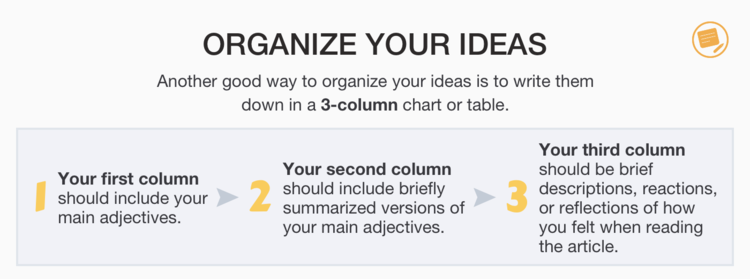
After some simple brainstorming and organizing, you should be able to write a reflection paper quickly!

Reflection Paper Format

Academic essays usually stick to the 5-paragraph format. It is the most accessible and most understandable essay format that helps you hold to the point. It consists of an introduction, three body paragraphs, and the conclusion.

Each body paragraph focuses on one point, or objective, of your reflection paper. If you have more than three points you wish to include, you may rightfully expand your essay beyond the 5-paragraph format.

All of this usually depends on the criteria of your assignment.

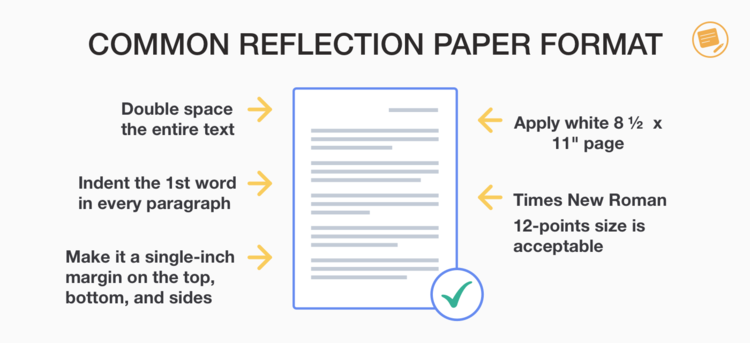
College reflection papers are typically around 400 – 800 words. Professors usually don’t go into other formatting details, other than specifying whether your paper must contain MLA style citations.

If you are not familiar with the 5-paragraph essay structure – be sure to check out our guide before writing your reflection paper!

Writing an Outline

Introduction

Your introduction should specify which work you have studied. Make sure that your thesis informs your reader whether or not the article was useful for you in your studies.

  • State what you are reflecting upon: a passage, a lecture, an academic article, etc…)
  • Briefly summarize the work.
  • Write a thesis stating how the article has affected you in one sentence.

One way to start your thesis is to write:

Example: “After reading/experiencing (your chosen topic), I gained the knowledge of…”

Body Paragraphs

The body paragraphs should describe what you have learned from the article you have read. Each body paragraph must have:

  • A topic sentence.
  • A reference to the section of the article you’re discussing.
  • A concluding statement offering your opinion on the matter.

If you are writing about academic articles, your reflection may include quotes and passages. They give your reader a point of reference to fully understand your feedback.

If you are writing about an activity, a seminar/lesson, or some event:

Compare your experience to previous events you may have attended (which bear relevance to your topic).

Example: “We set up our charity cake fare in the hall. I stole the idea from attending a cake fare of an international school in our neighborhood.”

Describe what you saw, what you heard, and how you felt.

Example: “I saw many people participating in our charity cake fare. The hall was very noisy. I felt amazed by the turnover of our event.”

Conclusion

As with any conclusion, you must summarize what you’ve learned from the article. Tell the reader how your newfound knowledge has affected your understanding of the subject in general.

There are a few good ways to conclude a reflection paper:

  • Give a summary: go over each topic sentence of your body paragraphs and tie them all together.
  • Restate your thesis to make the paper come full circle.
  • Make your opinion clear as day; allow the reader to infer whether this article will be useful for them.

We have a separate blog post dedicated to writing a great conclusion. Be sure to check it out for an in-depth look at how to make a final impression on your reader!
Writing Tips

Writing a reflection paper should be easy by now but hold on! Don’t pick up the pen just yet!

Here are some tips to help you write better, and maintain clarity in your writing.

  • Avoid vagueness in your writing; it will look not very academic.
  • Remember: You are not writing a full-on essay about your topic. You are writing about how the work you have read has affected you.
  • Think about your sentence structure. Avoid writing multiple ideas into one sentence.
  • Don’t use modern internet slang words. E.g., “OMG,” “LOL,” “BRB.” Even if they’re in the Oxford dictionary.
  • It is perfectly okay to use the word ‘I’ in your reflection. It is one of the few academic papers you can use first person language.
  • As you are writing an academic, personal journal, it is always a good idea to think about what information you reveal about yourself.
  • Make sure the information about yourself, or an opinion about your chosen topic, is relevant and appropriate for your reflection.
  • If you have a personal opinion that opposes your conclusion, do not include it.
  • To make any necessary corrections on your reflection, it is always a good idea to proofread it. Proofreading is vital before submitting any assignments to your professor.

Examples

DOWNLOAD

DOWNLOAD

Scholarship Essay

HOW TO WRITE A SCHOLARSHIP ESSAY

Applying for college takes a lot of effort. Each applicant must go through a long and thorough process that includes completing university and financial aid applications and writing college admission and scholarship essays.

Winning scholarship essays share a certain quality: a distinctive style employed by the author and a unique insight into the author’s past, present, and future. The unique style is key. Demonstrating your passion, personalizing your essay, and making it stand out is what catches the judge’s eye and ultimately defines a winner.

TABLE OF CONTENTS

  • How To Start
  • Re-adapt and Re-use
  • Writing Process
  • Outline
  • Do’s And Dont’s
  • How To End
  • Proper Format

How To Start

The first step to any writing is to read the prompt. Scholarship essay prompts are very tricky, so you should read and re-read it multiple times to identify key themes.

  • To be considered for the Scholarship, you must submit an essay of 400-500 words. Your submission should illustrate your perspective on what makes a successful leader of global business and consider the following questions:
  • What makes a good global leader? Explain how you have demonstrated these attributes.
  • What are your career aspirations?
  • From these words, “leader,” “perspective” and “aspiration” jump out the most. A good rule of thumb is to add the word “unique” and “you” to these words.
  • What are your unique aspirations?
  • What makes you a unique leader?
  • What unique perspective can you bring?

In scholarship essays, you are, in essence, convincing someone to sponsor you and give you money. You need to illustrate why you are worthy of their sponsorship and why you, out of all people, should be the one receiving the money. Let’s get down to business and find out how to write it.

Grab the Attention

You need to remember that you should never undervalue the importance of a strong introduction, especially when it comes to the opening line. Look at these examples and see if you can notice the difference.

  • Example 1: Being unique is very important for business.
  • Example 2: June 23, 2003, was the day I almost died.

Let’s analyze. Example 1 is imprecise and tedious. However, the second one is intriguing, catchy, and particular.

If you don’t grab the attention of the judges, they will simply mark your essay as “same as all the others” and move on to others.

Make your first sentence thrilling. This will make your essay stand out from the herd of sheep.

Re-adapt and Re-use Your Essay

There is no need to spend hours and hours sweating over writing a different essay for every scholarship competition you enter. From time to time, scholarship essay topics can be alike. So, with a bit of effort and small corrections, one scholarship essay can easily fit the requirements of several other scholarship contests.

Be Unique In Your Writing

For example, if the question is: “ Who in your life has had the biggest impact on you?”. Most of the time people will write about their parents or other relatives.

You should not jump into writing as soon as you read the question. Think about it wisely; maybe someone like Steve Jobs or Nelson Mandela has had the biggest influence on you. Of course, it is not traditional, but at least it’s more engaging.

Write According To The Rules

Do not write over the limit. Your main goal is to give the admission officers what they want because big money is at stake.

Nobody Cares

They are reading thousands and thousands of scholarship essays. They definitely do not have enough time to read about your pet aquarium fish Joey (unless it helps you to show the main point). Make sure that your essay has one clear point and then revolve the rest of writing around it.

Check Your Writing for Errors

Do you think that judges want to read all the scholarship essays they receive? Of course not. They are looking for some reasons to kick some essays out of the big pile. You should not give them a reason to kick yours.

Make An Outline

Usually, your scholarship essay outline will be something like this:

  • Introductory Sentence
    • State your full-name
    • State the name of the scholarship you are applying for
  • Obstacle
    • What has been a significant challenge in your life?
    • How did you overcome this?
  • Educational And Career Goals
  • What are your current educational goal(s)?
  • Why did you choose this particular college?
  • Why did you choose this field of study?
  • How will a scholarship help you achieve your educational goal?
  • What are your long-term career goal(s)
  • What will you do with your degree?
  • How will the scholarship help you in achieving your long-term career goal(s)?
  • Conclusion
  • Briefly interweave your story together
  • Restate how the scholarship will help you to attain your goals

The difference between an excellent scholarship essay and a bad one stems from a lack of confidence. Keep in mind that the person reading your essay wants to give out money. Show the reader that you know who you are and that your past and present experiences are valuable and will make a positive impact on the future. Ask yourself if you’re the person you want to be. If the answer is yes, write about who you are today and what brought you here; If the answer is no, write about how you intend to get there.

Why You Deserve It: Topic

“Deserving” something is a broad concept. Most likely, there are going to be people who deserve scholarship money more than you, but if their essay isn’t as good as yours, then they won’t be the winners. The key here is to explain to the reader what makes you different from other applicants in a memorable and articulate way.

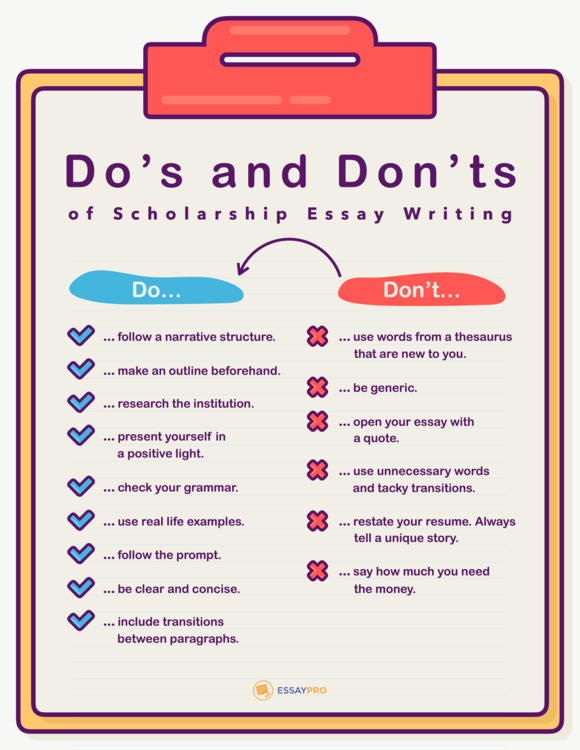
Do’s And Dont’s

DO

  • DO follow a narrative structure. Tell a personal story of your experiences.
  • DO outline your essay beforehand. While outlining, make each part of the thematic keywords its section of the essay.
  • DO research where you’re applying and make sure you’re suitable and match the qualifications.
  • DO make yourself sound like a success story. Mention problems and weaknesses as stepping stones that made you the person you are today.
  • DO use spellcheck and grammar check on your computer but also ask someone to read over your essay and proofread your grammar. Even better if it’s multiple people. Proofread it as many times as you can.
  • DO use real-life examples in your essay to back up your argument as to why you would receive the scholarship.
  • DO follow the prompt and the instructions exactly how they appear.
  • DO be clear and concise. Simple sentences and straightforward ideas are always your friends.
  • DO include transitions between paragraphs to keep the writing eloquent.

DON’T

  • DON’T use words from a thesaurus that are new to you. There is a high chance you are misusing that word in some way. Implementing perplexing lexicon does not win you plus points.
  • DON’T be generic. Personalize your essay as much as you can.
  • DON’T open your essay with a quote. This is the most ineffective way to write an essay for a scholarship. Use your words and avoid cliches (like the plague).
  • DON’T start your sentences with anything like “In this essay, I will… ”. In fact, don’t do that in any piece of writing. Transitions like “In conclusion,” or “First I’m going to talk about” also have no place in your scholarship essay.
  • DON’T restate your resume. Always tell a unique story.
  • DON’T say how much you need or want the money. There are always going to be people who need it more than you. Instead prove that you’re the one who deserves it.

How To End

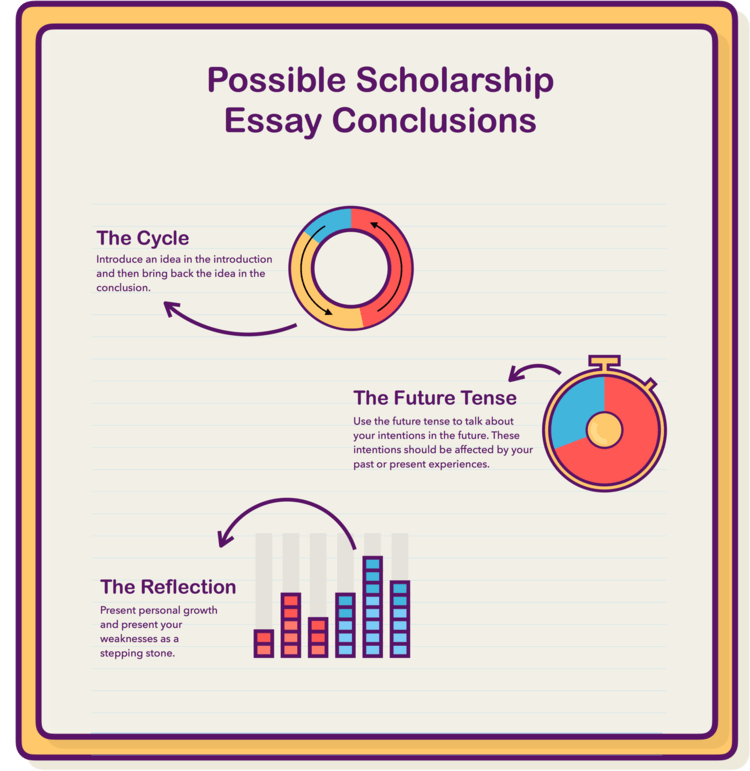
The ending of your scholarship application essay is the most important part of the piece. First and foremost, you need to restate the thematic keywords and summarize your experience into a gist. However, this can’t be it; this is the part of the essay that the reader will remember. There are several ways to conclude your essay in a powerful way.
Here are a few strategies and examples from our experienced essay writer:

  • The Cycle: If you introduced a certain idea in the paper introduction, then you can bring the idea back for a satisfying effect. For example, if your essay is about your passion for veterinary services, a cycle essay would go something like this:
    • (Introduction): When I was a little boy, I had a dog called Perry.
    • (Conclusion): If I become a vet, maybe I can save another little boy’s, Perry.
  • Not only is this very effective, but it also makes the reader feel like an insider. They are instantly more connected to the essay they are reading.
  • The Future Tense: In this type of conclusions, the future tense is the way to go. If your essay is about your past or present experiences, then talking about how those experiences shaped what you will do with your in the future is a good strategy. Here is an example of the last sentence of an essay:
  • In the future, I plan to use this valuable knowledge of content marketing in other types of business.
  • The Reflection: This third type of conclusion is perfect for demonstrating personal growth and presenting your weaknesses as stepping stones. Here is an example:
  • Although working at my experience with archery was shot in the dark, but I persevered and learned countless valuable lessons. Today I am able to shoot with better aim.

Proper Format

Even before starting your essay, make sure you follow a rule of thumb when formatting your essay:

  • Double spaced
  • 12 point Times New Roman font
  • 1” margins (top, bottom, and side)
  • Each paragraph should start with an indent
  • Insert your last name and page number (for longer essays) on the top left

Synthesis Essay

HOW TO WRITE A SYNTHESIS ESSAY

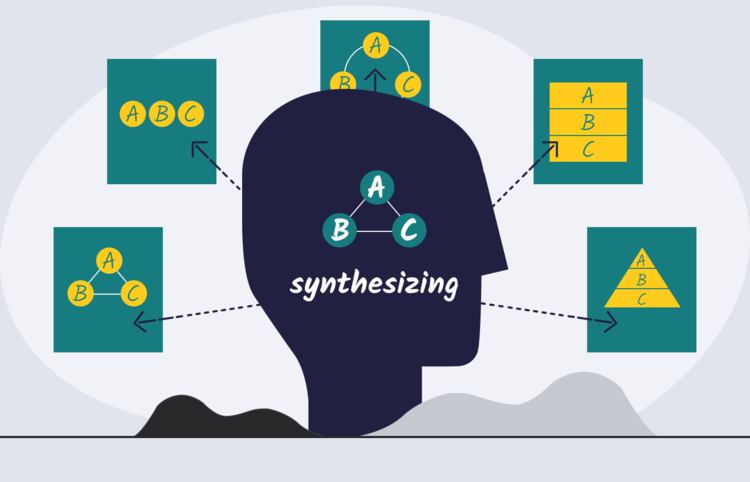
An excellent synthesis essay usually combines segments of different texts to create a whole new explanation of the information.

With this guide, we will discuss how to write a synthesis essay. And how to approach combinations of ideas that prove a point (AKA a Thesis). Usually, having strong analytical skills helps to revise the text for a better result.

TABLE OF CONTENTS

  • Synthesis Essay Definition
  • Writing Process
  • Synthesis Essay Topic
  • Outline
  • Writing Process
  • How to Format Synthesis Essay?
  • Synthesis Essay Rubric
  • Synthesis Essay Example
  • How to Get a Qualified Writing Help

What is a Synthesis Essay?

Writing a synthesis essay is just like writing any other form of the thesis. According to the synthesis essay definition, this style of the assignment is a written discussion of ideas. They tend to draw two or more sources from academic papers, fiction sources, speeches, interviews, articles, lectures & observations. To define the synthesis essay easily, one can say that they are made up of both written and verbal sources.

Those who have written research papers have already written a synthesis without realizing. In any form of a thesis, writers are required to create relationships that have been referred between multiple different sources. Which is something none of us are new to.

Two Types of Synthesis

  1. Explanatory Synthesis Essay

Is intended to assist readers in getting a better understanding of a topic. Writers are required to make an explanation when they refer to segments from a source. These explanations may be in the form of a description to recreate what is stated in the reference in easy words. That could be anything from an object to a state of affairs. The purpose of this paper is to present facts reasonably, not to argue a point.

  1. Argument Synthesis Essay

Is to present your own opinion on what is stated in the sources. With the use of evidence and facts that are relevant to sources, and presented logically. An argumentative essay thesis is usually subject to debate. They create propositions that some people could disagree with. Multiple writers could write using the same source and could oppose each other. They are known as the opposite thesis.

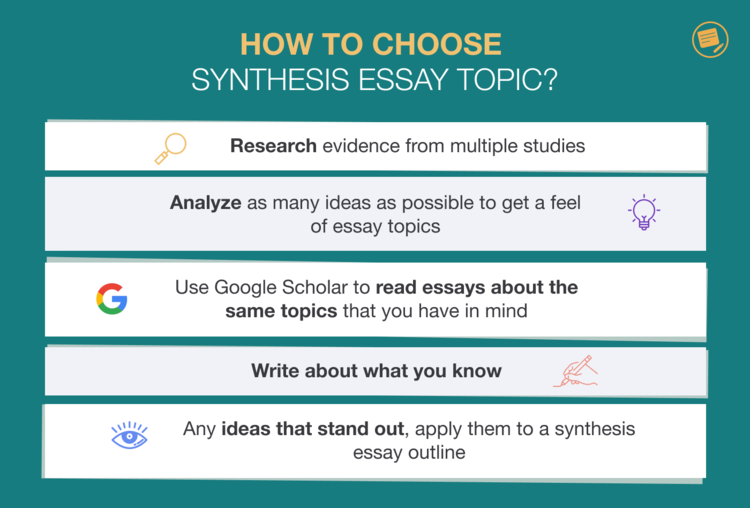
How to Choose Synthesis Essay Topics

A synthesis essay prompt must be negotiable. Depending on your assignment, you may have to choose a primary text. Choose a book that might have opposing viewpoints.

Step 1: Browse through topics and ideas. Read about some of some sources regarding selected topics, in-depth, to see if any of taking your interest.

Step 2: Choose a topic, and then gather relevant and useful sources to include in the synthesis essay.

Step 3: Apply ideas from the sources onto a synthesis essay outline. This should make writing far easier and save you time.

Good topics would be ones that are debatable, for example:

  • Daylight savings
  • Minimum wage
  • Immigration policy
  • Global warming
  • Gun control

Synthesis Essay Outline

Creating an outline will be useful in maintaining the structure of your paper, and planning your writing. If your essay is split into three parts, break your outline into three chunks. Paste supporting evidence, sub-arguments, and specific points in the appropriate sections. Make sure that every aspect somehow proves the claim in your thesis. Extra information or tangents will only hinder your essay.

However, if information goes against your central claim, then you should acknowledge it as it will make your essay stronger. Make sure you have read all of your sources. When writing about the causes, do not summarize them; synthesis denotes analysis, not plot-summary.

Introduction

A synthesis essay introduction should be a brief description of what the paper will be about. When learning how to write a synthesis essay, you will find that the average paper is made up of 3 points.

  • Main point 1
  • Main point 2
  • Main point 3

Thesis

Synthesis essay writing always includes a thesis. This is a description of the paper, but more in-depth, and backed with evidence, which is usually a quote from a source.

Body

Infer all sources from your previously written synthesis essay outline and explain the relationship between them.

  • Main Point 1
    • Evidence (quote from a source)
    • Analysis of Evidence
  • Main Point 2
    • Evidence (quote from a source)
    • Analysis of Evidence
  • Main Point 3
    • Evidence (quote from a source)
    • Analysis of Evidence

Conclusion

A synthesis essay conclusion should be a summary of the overall paper. With a final sentence to conclude the synthesis essay. In other words, to restate main points and unanswered questions.

When it comes to synthesis paper writing, you will find that a synthesis essay template is made up of the same structure.

Writing Process

A key factor in writing a synthesis essay is an analysis of a given text or a prompt. To successfully analyze it, you must comprehend the text’s purpose, rhetoric, and the argument that the author’s claim, in other words, you are answering the question: “So what?”. Then, you must build your application, and write an essay around that.

  1. Avoid tilting the assignment as ‘synthesis essay’ followed or preceded by the relevant title
  2. Remember to address your readers appropriately
  3. Use precise vocabulary. Don’t be shy to use a dictionary
  4. Use a clear sentence structure. Avoid passive voice
  5. Proofread and correct errors: spelling, comma errors, shifts, subject-verb agreement, plurals, possessives. Avoid using “you.”
  6. Make sure your citations are correct
  7. Make use of sentence and paragraph transitions

Writing Techniques

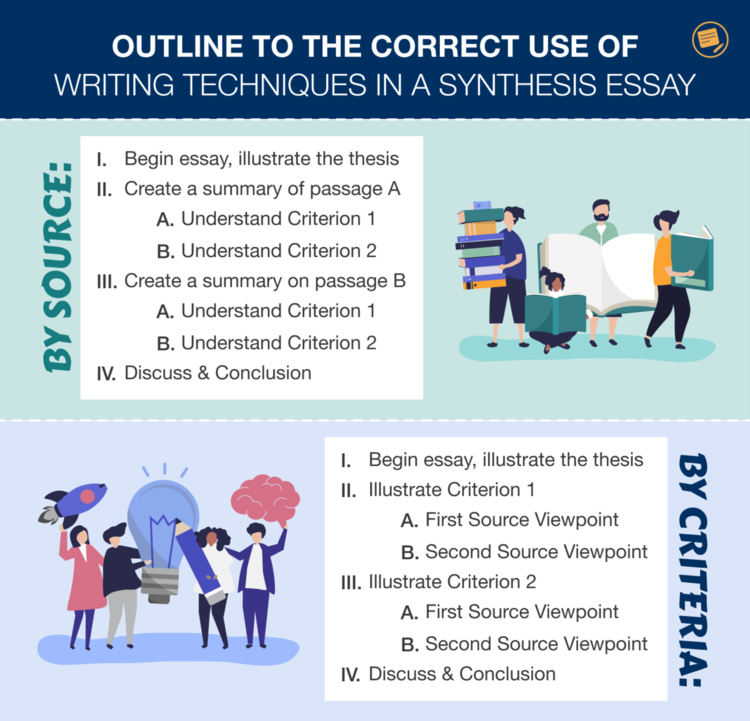
Make use of Summary: One of the simplest methods ways of organization. It allows you to summarize the sources that possess the highest amount of relevance. The issue is that this method doesn’t include independent thought.

Examples: Paraphrasing source material. Write segments of sources in your own words. Quoting the source also goes under this technique. In every case of using examples, make sure to cite the source.

Multiple Reasons: Using multiple reasons, mostly two goals, is known as an extremely effective method.

Strawman: Present one argument against a thesis. Though, show this factor is weak. The advantage of this method is to teach awareness about the other side of the argument. This type of evidence presents an introduction and description. It is followed by the opposing factor and a decisive factor.

Concession: This technique illustrates the opposing viewpoint. It shows the positives being much stronger than the negatives.

Compare and Contrast: Compare and contrast methods allow writers to examine two sources at once. Comparing shows similarities, as contrasting shows the differences. Illustrating an in-depth analysis of the chosen is possible.

How to Format Synthesis Essay?

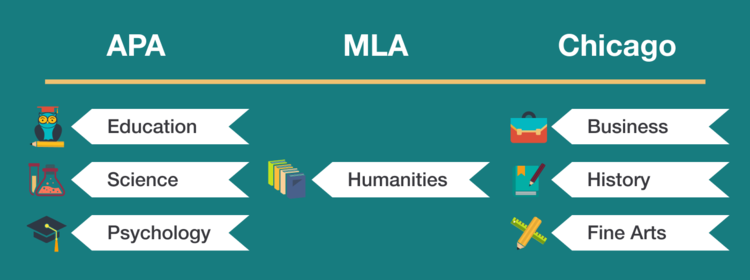
The synthesis essay format depends on what style is required by your teacher or professor. The most common formats are: MLA, APA, and Chicago style. APA is used by fields of Education, Psychology, and Science. MLA is used for citing Humanities, and Chicago style is used for Business, History, and Fine Arts. Purdue Owl is a format guide that focuses mainly on MLA and APA, and Easybib is a citation multitool for any of your external sources.

MLA Format

Some key points are:

  • Times New Roman 12 pt font double spaced
  • 1” margins
  • Top right includes last name and page number on every page
  • Titles are centred
  • The header should include your name, your professor’s name, course number and the date (dd/mm/yy)
  • The last page includes a Works Cited

APA Format

Some key points are:

  • Times New Roman 12 pt font double spaced 1” margins
  • Include a page header on the top of every page
  • Insert page number on the right
  • Synthesis essay structure should be divided into four parts: Title Page, Abstract, Main Body, and References.

Chicago Style

Some key points are:

  • Times New Roman 12 pt.
  • Use double-spacing amongst the lines of the paper.
  • Use one-inch margins.
  • Use ½ Inch Idents for Paragraph Beginnings.
  • Write with left-justified text that has a rugged edge.
  • Use full names of people or organizations.
  • The bibliography is to be on a separate page.

Synthesis Essay Rubric

High range essay (8-9 points)

  • Effectively develops a position on the assigned topic.
  • Demonstrates full understanding of the sources or text.
  • Correctly synthesizes sources and strengthens a position. The writer drives the argument, not the sources.
  • The writer’s argument is convincing.
  • The writer makes no general assertions and cites specific evidence for each point. His/her evidence is developed and answers the “so what?” question.
  • The essay is clear, well-organized, and coherent. It is a stand-alone piece rather than an exam response.
  • Contains very few grammatical and spelling errors or flaws, if any.

Note: 8-9 essays are an extreme rarity. A strong ‘7’ paper can jump to an 8-9 if the writing style is mature and perceptive.

Middle-Range Essay (5-7)

  • Adequately develops a position on the assigned topic.
  • Demonstrates sufficient understanding of the ideas developed in sources
  • Sufficiently summarizes the sources and assumes some control of the argument. ‘5’ essays are less focused than ‘6’ and ‘7’.
  • The writer’s argument is sufficient but less developed.
  • Writer successfully synthesizes the sources and cites them.
  • Writer answers the “So what?” question but may use generalizations or assertions of universal truth. The writer cites their own experience and specific evidence.
  • Essay is clear and well organized. ‘5’ essays less so.
  • Contains few minor errors of grammar or syntax.

Note: A ‘7’ is awarded to papers of college-level writing.
A ‘5’ on one of the AP English Language and Composition essays designates a three on the AP exam. It most likely relies on generalizations has limited control of the claim and argument. ‘5’ essays often lose focus and digress.

Low-Range Essays (1-4)

  • Inadequately develops a position on the assigned topic.
  • The author misunderstands and simplifies the ideas developed in the sources.
  • Over-summarizes the sources, lets the sources drive the argument.
  • Writer has weak control of organization and syntax. The essay contains numerous grammatical/spelling errors.
  • Writer does not cite the sources correctly, skips a citation, or cites fewer than the required minimum of the sources.
  • Notes: ‘4’ or ‘3’ essays do assert an argument but do not sufficiently develop it.
  • A ‘2’ essay does not develop an argument.
  • A 1-2 essay has severe writing errors and do not assert a claim.

Synthesis Essay Example

Have you read the whole article and still struggling? Check out these winning synthesis essay examples – from our professional writers. Feel free to use them as a reference.

DOWNLOAD

Thematic Essay

HOW TO WRITE A THEMATIC ESSAY

Every piece of writing ever written has its agenda.

Whether it is to teach a lesson, show the impact of a particular emotion or portray the reaction to some action, a central theme can be developed.

The goal for us as readers is to uncover what the author was trying to say between the lines in their thematic paper. When we do finally discover it, we have accomplished the first step of thematic essay writing! Let’s see in details how to write a thematic essay on our Essay writing guide.

TABLE OF CONTENTS

  • What Is A Thematic Essay?
  • Topics
  • Outline
  • Introduction
  • Body
  • Conclusion
  • Wrap Things Up
  • How to Get a Qualified Writing Help

What Is A Thematic Essay?

When looking at the thematic essay definition, it is a piece of writing in which an author develops the central theme in some literature using literary devices like foreshadowing, imagery, personification, etc.

A pro essay writer will uncover the primary subject, elaborate the literary devices employed, and express the overall significance of the theme. The primary challenge comes from the fact that although there are various subjects, finding the most meaningful and impactful one can be challenging.

After all, each person has their varied interpretation, making it hard to agree on a central theme wholesomely. In short, a well written thematic essay comes from a healthy central idea that is conclusively proven via literary devices and logical arguments.

How to Pick a Thematic Topic?

Talking about how to write an excellent thematic essay, the crucial aspect is choosing a theme. Follow the listed hints to pick a thematic topic.

Recall what you were talking about in a class, with your mates or parents. Do some of these conversations recall you some book, novel or another piece of literature?
Write down every idea that comes to your mind. Sometimes most absurd is a first sight is the best way to go.
List your favourite literature pieces. Which one is the most touching for you? What it’s subject? Try to analyse its problematics and make some notes.
Dive into details of literature pieces: make sure you have something to work with. Find clues and examples, write down some key scenes and keywords what answer the essay prompt.

Still, have no idea what to write about? No worries, we have your back.

Thematic Essay Topics

  • What is George Orwell trying to show after portraying a “Perfect Utopia” in his book 1984?
  • What main idea is George Orwell painting about Communism in the book Animal Farm?
  • What is Harper Lee saying about innocence in her novel To Kill A Mockingbird?
  • What is John Steinbeck speaking about loneliness and isolation in Of Mice and Men?
  • What is F. Scott Fitzgerald saying about the American Dream in The Great Gatsby?

Finding and Exploring The Central Theme

As stated before, uncovering the main subject and central theme respectively is the first significant step in a thematic paper. However, with all the variety flowing around, it may be difficult to decide on the main subject confidently. To make sure you choose the central theme correctly, follow these steps:

  • Summarize the Literature: If you take the SparkNotes version of the book, what the main idea is the author trying to purvey? Usually, there will be many hints along the way, so choosing the right direction may not be so challenging.
  • Pick the Most Prevalent Subject: One thing to note is the significant difference between a subject and a theme. An issue is the general topic of conversation whether it be love, bravery, deception, etc. An idea is a specific point an author is making about said subject. So, find the talking point that is most commonly being brought up. This will be the focal point of the essay.
  • Read Between The Lines: After finding the most suitable subject, decipher what main point the author is trying to make. This will become clearer as you get deeper into the literature since clues and examples will appear frequently. After fully deciphering the central theme, there is one more significant step.
  • Overall Significance: What is the overall significance that comes from the author’s point? What can be taken from this and applied to our personal lives? In other words, what is the lesson from all of this? What have we learned?

Thematic Essay Outline

The thematic essay has several key components. First of all, it should be five paragraphs or more, depending on the depth of the theme. Next, it must have a concrete thesis statement, which in other words is the thematic statement that comes from the main subject. The introduction presents the reader with the subject and the thesis statement. The body paragraphs each discuss one literary element or more to defend the validity of the thought, all the while providing many supporting details from the text itself. Lastly, the thematic essay conclusion summarises the main arguments presented and finishes off with a statement of overall significance.

Introduction

Thematic essay introduction presents the main subject of discussion in a captivating way. The first sentence of the intro should be a hook statement that makes some intriguing claim about the topic of debate. If done correctly, this will grab your reader’s attention. Afterwards, provide any necessary background information from the literature that will help the audience understand your claims later on. Lastly, put together a well thought out thesis statement that reflects the central theme of the novel.

Body Paragraphs

The body paragraphs follow a strict thematic essay format. Since each body paragraph’s purpose is to present a literary device as evidence, the topic sentence should introduce the claim and gateway into the evidence. Every topic sentence must have a literary device, the author’s name and the relationship to the application.

Afterwards, to validate the claim, using examples from the book that strengthen the reasoning of your statement. These can be actions from the plot or quotations that are in parallel with the central theme. It is imperative to explain how the action/quote links back to the thesis statement, as it shows that you can support your logic.

Remember: each claim must use a literary device. It can not just be a random moment or inference. Thematic essays are all about proving thesis statements through the use of critical literary devices.

Conclusion

The thematic essay conclusion has three main objectives to complete before wrapping up the entire essay. It should NEVER present any new information or facts but merely go through the information already given. First of all, restate your thesis statement with the use of a transition such as “In conclusion,” Then, summaries your three central claims and their influence on the thesis statement. To finish off the entire work, present an overall concluding statement with a global analysis of the subject. Leave your reader with a call to action, interesting them to dig deeper into the topic.

Wrap Things Up

Before submitting your thematic essay for a grade, make sure to check off a couple of things to clean up any possible errors.

  • Double-check and confirm that the central theme you have decided is the one that the author MOST LIKELY meant to focus on. Unless you can provide a secondary issue and present it strongly enough as a primary, validate the primary subject.
  • Go through and proofread your entire essay. Nothing makes reading more irritating than grammatical mistakes, clean that stuff up as much as possible.
  • Get a second pair of eyes to read through your essay. It would be helpful to ask a classmate for help, as they most likely had a similar assignment. Another great way to polish things up is to ask one of our essay writers to give you some helpful advice.

Thematic Essay Example

The best way to familiarise yourself with this type of writing is to learn from a thematic essay example.

DOWNLOAD

HOW TO WRITE AN ESSAY

As you get closer to the essay writing, let’s get familiar with a definition of an essay first. An essay is a short composition based on a particular subject or theme, usually done by students as a part of the workload at school or university. It may be written to:

  • Describe (a particular topic or situation)
  • Persuade (convince a reader to adopt a certain point of view)
  • Inform (to present information that your readers don’t know)
  • Explain (to explain a certain process or situation, for example how to bake a cake)

TABLE OF CONTENTS

  • Deciding On Topic
  • Carrying Out A Research
  • Coming Up With A Thesis
  • Outline
  • Writing A Rough Draft
  • Polishing Up

Now, let’s learn how to write a great essay. Your paper needs fresh ideas and insight. Firstly begin by brainstorming and picking an interesting topic.

Essays follow a structure and a citation format to help you fully develop your topic. In this article, we will learn how to write an essay by following these steps:

  • Decide On Topic (If it wasn’t assigned)
  • Do Some Research
  • Come Up With A Thesis
  • Create An Outline
    • Introduction
    • Body
    • Conclusion
  • Write A Rough Draft
  • Write The Final Draft
  • Polish It Up

Deciding On Topic

Before writing an essay, you must make sure to choose a suitable topic; this is important because it will set the tone of the whole paper. Selecting a proper topic can also make the difference between an interesting essay and a dull one. Consider these things before choosing a topic for your paper.

  • Make sure to have access to all the materials you may need before writing a paper.
  • If allowed, choose a topic that is familiar to you. It will be easy and interesting for you to write about a theme in which you are well versed.
  • Define The Purpose: What is the purpose of your essay? Are you trying to inform the audience of something interesting or persuade them to agree with your opinion? Even if your goal is just to tell a story, have a clear understanding of the purpose of the writing. This ensures that the audience will understand you properly and that you waste both time and effort.
  • Subject Depth: At what point on the spectrum of depth do you plan on reaching? How broad or narrow do you want to go in your discussion? The best option is to find the golden middle. Make sure that your subject is not too deep so only you can understand what you are talking about. Then, check that it is not too broad/narrow, to make sure that you will be able to find enough information.

Typical mistakes when choosing an essay topic:

  1. Choosing a boring topic because it is easy to write about. Writing about a boring topic will lead to a boring paper on the outcome.
  2. Choosing a broad topic, for example, “computer games” and not narrowing it down to something more specific like “computer games violence and kids.”
  3. A desire to look smart by choosing hard and strange topics.
  4. Creating an inappropriate title that doesn’t match the content. Remember, a good essay title can make your paper stand out.

The best place to start researching information for an essay is the Internet. Use the most popular search engines like Google and Yahoo to conduct simple research. An Essay writer will use online databases such as InfoTrac, LexisNexis, Google Scholar, etc. Primary sources such as Academic Journals, Encyclopedias, might be very useful in your research. Do not forget about the libraries; you may find a lot of trustworthy materials for researching.

Tip: Stay away from sources in which information may be edited by multiple users, or check the reliability one more time.

Coming Up With A Thesis

A thesis statement is a short one-sentence statement that appears at the end of the first paragraph and sums up the main point or idea of an essay. It should be specific and based only on what you are going to discuss in your writing, and then it should be supported by some evidence.

Good thesis statement examples:

  • Due to the deception that lies in appearances, more often than not, people find themselves influenced by just what they see.
  • The constitution provides everyone with a right to life; however, there are some limitations regarding this providence in the law.

After reading these examples, you can understand what the rest of the paper is about, and they probably make you want to read the rest of the story.

Essay Outline

Writing a thesis is only the beginning. Now it’s time to put your ideas in order using an essay outline.
Outlines help you see the logical steps of development in your essay. Use it to list ideas, main arguments, and supporting sources. It’s crucial to make an outline for essay writing, as it will guide your pen and keep you on track.

Introduction

First impressions always count. The essay introduction is your chance to grasp the reader and convince them to read the rest of the paper.
Every introduction must:

  • Grab the reader’s attention;
  • Provide background information on the topic;
  • Reveal the main argument or thesis statement.

The attention grabber is often referred to as a hook. Hooks can be anecdotal or informative, depending on the circumstance and the audience. A strong hook will make the audience want to read more.

Good attention grabber: The point where my life changed was when I lost my elder brother in drastic suicide almost 14 years ago at his home.

Background information gives the reader context and allows them understand the writer’s point of view fully.
The thesis statement is the primary argument or focus of the essay.
We have a separate article dedicated to crafting unforgettable openers – with essay introduction examples. Be sure to check it out!

Essay Body Paragraphs

This is the part of an essay in which you need to explain and develop main ideas of your topic. It comes after an introduction and before the conclusion. Usually, this is the longest part of the paper. Start each paragraph with a topic sentence, then write down a supporting point for that idea and end up with writing an elaboration (it can be a description, explanation or example).

The structure of the body paragraphs should look like this:

  • A clear topic sentence;
  • Specific evidence or supporting detail;
  • Transitions between sentences and paragraphs;
  • A concluding sentence that will tie the evidence or details back to the main point and brings the paragraph to the logic end.

Conclusion

This brings us to the final part: the essay conclusion.
Here you summarize the paper briefly, remind of your thesis, and leave the reader with some final thoughts. Here’s what to include in your conclusion:

  • Mirror your introduction by speaking about specifics, and ending with a general statement;
  • Rephrase your thesis; it will have more meaning after the reader has read your essay;
  • Remind the reader why your arguments are important;
  • Don’t bring new ideas to the conclusion;
  • End with a final impression, call to action, or general statement.

Here is an example of an essay outline:

  • Introduction Paragraph:
    • Hook statement;
    • A preview of the subtopics you will discuss in the body;
    • A thesis statement;
  • Body Paragraphs:
    • Topic sentence (must state the first subtopic and be opened with a transition);
    • Claim (piece of argument that will be defended);
    • Evidence (Information to support claim);
    • An explanation (Describes how the evidence defends the claim);
    • Concluding sentence;
  • Concluding Paragraph:
    • Restatement of the thesis statement;
    • Rephrasing main subtopics;
    • Concluding statement.

Writing A Rough Draft

The purpose of writing a rough draft is simple. No one can write an essay without mistakes from the first try. After you have written a rough draft, read it one more time and follow this advice:

  • Check the clarity of your writing and if necessary remove all worthless parts of content.
  • Check it for grammar mistakes.
  • Check the flow of your writing and if necessary add transition between paragraphs.
  • Make sure that your paper is based on the topic that you have chosen previously.

Polishing Up

To ensure that your paper makes logical sense, the first thing you need to do is check that your essay was written according to the topic. Then, check your paper for the grammar and other types of mistakes like punctuation, spelling, etc.Another great way to get rid of mistakes is to run your paper through a spell or grammar checker like Grammarly.

Make sure to include transitions between paragraphs, so your writing flows smoothly instead of just jumping from one idea to another.

As you have finished all the process, read your paper one last time to be completely sure that you don’t need to make any corrections. Check the requirements so you could meet the deadline. Finally, your essay is done and you are ready to submit it and get your A+!

10 Most Common Types of Essays

  • 5-Paragraph Essay: Essay written in the classic five-paragraph style. Can be used for persuasive, expository or narrative texts!
  • Persuasive Essay: Essay aimed to persuade the audience about a certain topic or idea!
  • Cause-and-Effect Essay: Essay in which a situation is presented and followed up with an in-depth analysis of the results!
  • Compare-and-Contrast Essay: Essay that requires a critical analysis of the similarities and differences between 2 things.
  • Creative Writing Essay: A type of writing in which the author chooses his own topic and style to put together a cool story!
  • Narrative Essay: Similar to creative writing in the sense that the writer is creating a story, however, they are following a specific set of formatting instructions in this case.
  • Expository Essay: An essay aimed to educated a reader or audience about a certain topic or idea. This does not include persuasions or opinions.
  • Process Essay: A type of essay in which the “How” is explained; It usually follows a step-by-step structure!
  • Descriptive Essay: An essay that gives a full overview of a certain topic or thing. Includes a full explanation of each of the five senses!
  • Analytical Essay: A type of essay that requires a full analysis of a topic or idea. Critical thinking and implementation of personal inferences are required.

Topics

THE BEST ESSAY TOPICS & IDEAS

One of the hardest steps to complete when you start writing an essay is figuring out what topic you will be writing about (unless it’s preassigned). Commonly, students are tempted to write about something they have great passion towards or are genuinely interested in. Though there is never a correct answer about choosing the best topic, there are filters to use when brainstorming ideas. After having plenty of writing experience, it becomes apparent that certain topics fit better with specific categories than others; this means that your point of discussion should be chosen only AFTER knowing the type of essay you have to create.

TABLE OF CONTENTS

  • College Essay Topics
  • Essay Topics By Category
    • Cause and Effect Essay Topics
    • Argumentative Essay Topics
    • Narrative Essay Topics
    • Research Essay Topics
    • Informative Essay Topics
    • Expository Essay Topics
    • Definition Essay Topics
    • Descriptive Essay Topics
    • Process Essay Topics
    • Personal Essay Topics
  • Persuasive Essay Topics

TABLE OF CONTENTS

College Essay Topics

Writing a good college admission essay is crucial to increasing one’s chances of being accepted to a first-choice university! This type of essay requires a student to express themselves in a way that portrays their character. Alongside that, colleges want to know what makes each applicant unique, so it is important to present some of your best or most intriguing traits. With these objectives in mind, here are five college essay topics that will help guide you towards that acceptance letter!

  1. Talk about a trait that makes you unique? Did it come from nature or was sculpted from hours of practice?
  2. What one accomplishment are you most proud of? Why specifically that one?
  3. Describe something you are deeply passionate about. How was that fire ignited and how did it grow?
  4. What challenge or setback brought forth a period of large growth? Describe the experience and the lessons you took from it.
  5. Talk about a long-term goal you have set. Why did you set it and how do you plan on fulfilling it?

Essay Topics By Category

As stated earlier, the topic of choice for your essay depends entirely on the style of essay you write. That being said, there are various essay styles that every student should know, and they can be broken down into four main groups.

Persuasive Writing (Group 1) – This essay type asks the writer to pick and defend a point of view on a certain position. Argumentative, research and persuasive essays fit into this category.

Expository Writing (Group 2) – This group is all about presenting facts and informing the reader on some topic or idea. Cause & Effect, Research, Informative and Expository essays fit into this category.

Descriptive Writing (Group 3) – This style asks the author to unleash their inner artist by lively vocabulary and coherent idea flow to explain an idea, describe a concept, etc. Definition and Descriptive essays fit into this category.

Narrative Writing (Group 4) – This less common but still certainly present style requires the author to tell a story or explain a process (something with a chronological order.) Narrative, Process, and Personal essays are seen into this category

Here are some good essay topics for the most common style varieties:

Cause and Effect Essay Topics

  1. Do adult-rated video games provoke violence in society?
  2. What effect does social media have on an individual’s interpersonal skills?
  3. Does isolationism gateway certain people towards drug-addiction?
  4. What are the main causes and effects of global warming?
  5. Does learning a new language improve overall cognitive ability?
  6. Explain the effect of junk food on the immune system.
  7. How does advertising promote stereotypical images of men or women in the media?
  8. What are the causes and effects of bullying in high school?
  9. Why do teens start smoking early and how does it affect their health?
  10. Explain the causes and effects of Prohibition in the United States.
  11. Explore the causes and effects of Christianity in history: how it was born and how it changed the world.

Good Argumentative Essay Topics

  1. Should the death penalty be abolished nationwide?
  2. Would the legalization of marijuana help or hinder societies productivity?
  3. Has society become too dependent on technology?
  4. Is it economically intelligent to lease a vehicle, rather than just buy it?
  5. Should production and distribution of tobacco be illegal?
  6. Argue or defend: Disney has ruined Star Wars by targeting kids instead of longtime fans.
  7. Obsessing over celebrity role models has a negative impact on a teenager’s self-esteem.
  8. Rock music promotes violence and glorifies drugs even if the music itself has a positive message.
  9. Agree or disagree: in the case of rap music it is vital not to separate the artist from the art.
  10. Subscribing to PewDiePie is crucial for YouTube and the internet because it’s about empowering the individual rather than a money-hungry corporation.
  11. Brave New World by Aldous Huxley is prophetic and visionary, while Orwell’s 1984 is a dystopian fantasy.

Narrative Essay Topics

  1. Talk about an adventure of a lifetime.
  2. Describe a scene in which you became a champion.
  3. Create and develop a story that illuminates the importance of honesty.
  4. Describe a scenario in which the pen acts with more might than the sword.
  5. Build a tale that shows the innocence of luck and its effect on people.
  6. Describe a room in which you lived. Pick several objects and describe their importance in your life.
  7. Create an alternative scenario of World War II where Hitler won.
  8. Tell a real story from your childhood which perfectly describes your character.
  9. Create an alter ego of yourself and put this character in an extremely challenging situation.
  10. Tell the story of when you stumbled into a parallel universe and gained a superpower.
  11. Tell a story about bravery.

Research Essay Topics

  1. Do college graduates deserve to make more money than non-grads?
  2. In what ways can technology hinder society?
  3. Should medical care become more affordable?
  4. Should college education be paid for by the government, in return for higher taxes?
  5. What long lasting effect does depression leave on our bodies?
  6. What causes certain people to choose violence over communication?
  7. How are monkeys different from other animals and similar to humans?
  8. How does a bacteria or virus infect the human body?
  9. Explore a typical day of an Amish person. How do they live without technology?
  10. Explain how modern technology can be used to build a base on the moon.
  11. Show how asteroid mining can improve the global economy and halt global warming.

Informative Essay Topics

  1. Should laws for illegal immigrants be more or less strict?
  2. What steps can we as a society take to minimize the effects of racism?
  3. What is the best way to handle the music censorship situation?
  4. Will cryptocurrency become an essential component of the world’s economy?
  5. Why do we procrastinate? What steps can we take so as to get out of our own way?
  6. Pick a musical instrument and explain how it works.
  7. Explain how a wristwatch is made.
  8. Explain how communism functions in China.
  9. What is the current role of a monarch in the United Kingdom?
  10. Inform the reader on ways they could increase their productivity.
  11. Explain the historical significance of the trial of Socrates.

Expository Essay Topics

  1. What can you do to save money as a student in college?
  2. What are the most important things to look for when buying a new car?
  3. What criteria should you use to help you decide between Apple and Microsoft?
  4. What is sociology? How can we use this subject to better society?
  5. What is the placebo effect? What has it told us about medicine today?
  6. Discuss the pros and cons of buying a bike vs. a car in the city where you live.
  7. From a perspective of psychology: why do parents have to be strict on children?
  8. Explain why teenagers are genetically predisposed to rebel at a certain age.
  9. The invisible magic of music: explain how music affects the brain.
  10. How does a materialistic person make decisions?
  11. Provide a factual analysis of why The Beatles were the most influential band in history.

Definition Essay Topics

  1. What is love? How do you know if you’re in love?
  2. What is bravery? What are some examples of brave acts?
  3. In your opinion, what is happiness all about?
  4. What makes a person in beautiful?
  5. What is your definition of success?
  6. How can some expectations have a positive outcome while others have a negative one?
  7. What is your definition of justice?
  8. Pick a famous quote and define several layers of it’s meaning.
  9. Define internet freedom: is it right to censor music and memes?
  10. Define communism from the perspective of Karl Marx.
  11. Explore how the Soviets have misinterpreted Karl Marx’s definition of communism.

Descriptive Essay Topics

  1. Describe a childhood memory that is burned into your mind.
  2. Describe the scariest nightmare you have ever had.
  3. Describe the culture shock of moving to a different country.
  4. Describe the feeling of graduating from college.
  5. Describe the scenario in which you had your first kiss.
  6. Look at an abstract expressionism painting and describe its layers of meaning.
  7. Pick a musical single from 2018 and vividly describe how it sounds.
  8. Picture and describe a scenario where the polar ice caps have melted. How will people live?
  9. Describe the ideal husband or wife.
  10. Take a complicated political situation and describe it in the simplest words.
  11. Describe a fictional character who is your role model.

Process Essay Topics

  1. Describe the process of baking a cake.
  2. Explain the process of mastering a skill.
  3. What steps must a player go through so that they can properly curve a soccer ball?
  4. Explain the process of learning how to code.
  5. Explain the steps necessary to do well on a certain test, presentation, paper, etc.
  6. Explain how the voting system in the United States works.
  7. Pick an electronic device, like a computer or a TV, and explain how it’s made.
  8. How does an art critic evaluate art? What is their process; what is the first thing they notice?
  9. Pick a relevant country and explain in the simplest terms how the government passes a bill.
  10. Process analysis of recycling: where do your plastic and glass go?
  11. How do genuine Italians make their food so tasty?

Personal Essay Topics

  1. What makes you unique from most people? How can you use those traits to be the best possible version of yourself?
  2. Talk about a time that you overcame a fear? What was the fear and how did you beat it?
  3. Explain a situation in which life pulled a switcheroo on your? How did you react?
  4. What is your favorite movie? Why is that movie specifically your favorite?
  5. Talk about an addiction you struggled to overcome. What made it so hard?
  6. Use persuasive techniques to sell yourself to an imaginary company.
  7. Show your creativity skills. Create a fake captivating story about yourself, and reveal that it’s false in the end.
  8. Explain a strange ability or talent that you may have.
  9. Describe your role model if you have one. It could be the future you.
  10. Explain that one time you were humiliated and how it’s made you stronger.
  11. Talk about how you got out of a sticky situation.

Good Persuasive Essay Topics

Although persuasive and argumentative essays may sound like the same exact thing, they do have one distinct difference. What separates persuasive essays from argumentative ones is the type of reasoning they use to defend their point of view. While argumentative essays tend to rely on logic and statistics to make their point, persuasive writing is all about convincing through emotions and morality.Having said that, both of these writing styles could discuss similar topics. The difference comes from the methodology used to make their point. Anyways, here are five good examples.

  1. Is one’s sexual orientation a choice or a predetermined natural belief?
  2. Should students in the USA start learning a second language at a younger age?
  3. Should gun laws be more strict for young adults (Under the age of 25)?
  4. Should the USA cut its military spending?
  5. Are punishments for DUI’s fair? Is the sentencing too rough?
  6. Persuade a non-believer that aliens exist.
  7. The reason why video games are good for brain development in teens.
  8. The N-word has changed its meaning and should no longer be considered a racial slur.
  9. Minors under the age of fifteen should not have access to social media.
  10. Provide a reasonable explanation of why it’s necessary to test medicine on animals.
  11. Persuade the government that they should entirely focus on preventing climate change.

Title

HOW TO TITLE AN ESSAY, COMPLETE GUIDE

The Do’s and don’ts to titling your academic paper. What are the most eye-catching ideas that make the target audience WANT to start reading your paper? The goal of this article is to explain how to title an essay, research paper, article, and even a book.

TABLE OF CONTENTS

  • Importance Of a Good Title
  • A Guide to Choosing the Right Topic
  • Take The Style of Your Paper Into Account
  • Keep It Short and Simple
  • Use Only Relevant Words
  • Bad and Good Samples
  • Top Essay Title Ideas

How to Choose a Good Title for an Essay and Why Is It Important?

A title can make or break an essay paper. A boring headline does not catch anyone’s attention. Your headline should engage your teacher or reader and incentivize them to read the rest of the paper. Without reading the entire work, the tutor will not grade it objectively. Having a catchy attention grabber is crucial when writing an essay as it is the primary thing that readers notice.

Naming an essay is different from titling a research paper. This type of academic assignment focuses more on attracting attention and impressing the reader. A research paper is about supporting a particular claim or finding solutions to the existing problem.
Each student should know how to choose a good title for an essay. Brainstorming is what comes first. When brainstorming, keep in mind your goal is to get the “Oh my god, I want to read the whole story” reaction. After reading a title, the reader should understand what the story will tell. The title is a concise summary of the main topic.
Before starting to sort out ideas in your head, learn more about features every title should have. A good headline must be:

  • Attention-grabbing
  • Credible
  • Coherent
  • Written in an active voice (in case it contains verbs)
  • Concise
  • Accurate

How to Come up with a Title for an Essay: Student’s Guide

It doesn’t take a sensei to compose a catchy essay title. There are a few core principles to be taken into account. The following tips will help you stay on track and avoid common pitfalls.

Essay Goes First

Never start with a title! If you write it before the rest of the text, it will be based on it, and it should be vice versa. Writing an essay before choosing a heading will give you a clear understanding of what should make sense to the reader. Re-read the finished paper several times to decide on the title.
The last thing to create is a title – such strategy will give more time to spend on crafting an essay outline, conducting research, or writing the paper itself.

Take The Style of Your Paper Into Account

What are you writing about? What is the style of your paper and is it an academic essay, or a free-form like a narrative essay? If the topic of your essay is “Do people who commit heinous crimes deserve the death penalty?” your title should not be humorous. It must be strict and to the point.
If your topic is “Why do people like watching funny cat videos?”, feel free to craft a funny heading. Determine the tone of your essay and base your title on it, considering the topic.
The tone could be:

  • Serious
  • Funny
  • Friendly
  • Strict
  • Persuasive
  • Informative
  • Warm
  • Humorous
  • Melancholic
  • Etc.

Keep It Short and Simple

The main goal of the title is to name a paper. There is no need to tell the whole story in the beginning or provide any useless details. Sum up your paper in a few words! Another way is to sum up the thesis statement as it represents the main idea of your essay. Take your thesis and squeeze it into 3-4 words. Imagine that you are creating a header for your favorite newspaper or a slogan for Coca-Cola.
Use Relevant Words
Do not use fancy words! Take 2-3 main words (keywords), put them together, and stop wasting your time. Avoid jargon and abbreviations.

Involve a Little Bit of SEO

Search engine optimization (SEO) is something that can make any student and young writer benefit. While working on the title, detect the quote related to the central idea of the paper. Type the certain word in the search field of Google and add the word “quote.” A search engine will show numerous web pages with the in-text quotations that could be useful. Select the fragment you like. It is possible to learn how to make a creative title for an essay this way.

Get Help Online

If you are not ready to pay for the online tools, apply a free title generator offered by one of the academic services. Keep in mind such tools are not half as effective as professional writing services like EssayPro.

Final Tips

Discover several more tips from experts!
Never forget about “What,” “Who,” “When,” “How,” “Why,” and “Where” questions (if you start with one of these questions, your title has a chance to be noticed);
Come up with an unexpected image, not related to the selected topic;
Sometimes, starting with the lie increases the chances of a header to catch an eye;
Review our catchy essay title examples.

Bad vs. Good Essay Titles

The best essay titles take a paper and sum it up in a few words. To create one, the writer must consider their stylistic decisions and the essay structure. Here are some examples from a veteran essay writer to show you what differentiates bad and good essay titles.

Bad: How Television Altered Our World.
GOOD: The Electronic Babysitter: A Social History of the Uses of Television Technology.

BAD: The Ara Pacis Augustae.
GOOD: The Modern Historical Significance of the Ara Pacis Augustae to the City of Rome.

BAD: The Most Poisonous Frog.
GOOD: A Deadly Beauty: The Evolution of Skin Coloration and Toxicity of the Poison Dart Frog.

BAD: A Brief History of Subcultures and How They Manifest Themselves in a Constantly Changing Socio-Economic Environment
GOOD: Reconsidering Counterculture in Contemporary Society

BAD: The Little Mermaid 29 Years Later: Selling a Harmful Sexist Message Through a Vivid and Attractive Image
GOOD: The Projection of Gender Stereotypes in The Little Mermaid

Bad titles fail to give the audience a sense of perspective. They are often generalized and thus incomplete. Adding key information and structure to a title will make it informative and convincing.

After exploring how to write a title for an essay, it is time to move on and review some of the examples.

30 Catchy Essay Title Examples

Argumentative Essay Titles Examples

  • The importance of family ties
  • Prostitution should never be legalized
  • The Trojan Horse: A closer look at the event
  • It is just a painting: When art matters
  • The drinking age should be higher
  • No point in sentencing imprisoned juveniles
  • Gun ownership made legal to protect our lives
  • Cameras in public places: security measure or violation of privacy?
  • Why is cosmetic surgery a threat to modern teens?
  • Why a physician-assisted suicide (euthanasia) is unethical?

Persuasive Essay Titles Examples

  • Atheists as the most adequate religion
  • When sorrow feels better than excitement
  • Adventures of an introvert: It is better off alone than with other people
  • A tale of love and allergies: Reasons to avoid flowers in spring
  • Never judge an employee by its tattoos
  • Dreamers have a right to stay in the US
  • Heinous crimes deserve nothing but a death penalty
  • How schools can use video games in the learning process
  • It is time for the women to start wearing less-revealing clothing to curb men’s catcalling
  • Hiring a candidate who smokes: pros and cons

English Essay Titles Examples

  • The day I left my childhood behind
  • The power of music: The way heavy metal changed my life
  • Why Buffy the vampire slayer is my hero
  • The appropriate age to start discussing sex
  • Would children be better off alone when being paid for the grades?
  • What is the true age of a personal computer?
  • Which parenting styles work?
  • Various dialects of English language: The bridge between different worlds
  • The impact of same-sex couples on the modern world
  • Instagram: A breakthrough in social media

Outline

HOW TO CREATE A WINNING ESSAY OUTLINE

TABLE OF CONTENTS

  • About The 5-Paragraph Essay
  • Outline Template
  • Template Explained
  • Example

About This Type Of Essay

The 5 paragraph essay is one of the most common academic writing assignments given to students. Starting from middle school and working all the way up to college level tasks, this particular style is seen in all educational levels. The reason this type of writing is so popular has to do with its main perk: it allows the writer complete freedom when choosing between topics.

As there are many different types of essays that each contain their own sets of rules and writing styles, one will be limited when it comes down to choosing a topic for more specific types. For this reason, the 5 paragraph format is the most versatile among all essay types.

5 Paragraph Essay Outline Template

Most commonly, a student will be asked to write a 5 paragraph essay that defends a side of an argument (persuasive) or develops their own idea from an original question (analytical). Sometimes, they will be asked to tell a story (narrative essay) or write using their imagination (creative writing), but for most academic assignments, one will be asked to write about the former of the two groups.
That being said, the outline is broken down into five main sections (1 per paragraph), and each section will have between 3-5 subpoints. Each subpoint has its own objective, so to build a complete essay outline, one will need to accurately come up with 15-20 guidelines. Down below is an example of an acceptable template:

Introduction

  • Hook Statement
  • Background Information
  • Thesis Statement

Body Paragraph 1

  • Topic Sentence
  • Claim
  • Evidence
  • Concluding Statement

Body Paragraph 2

  • Topic Sentence 2
  • Claim #2
  • Evidence
    Concluding Statement

Body Paragraph 3

  • Topic Sentence 3
  • Claim #3
  • Evidence
  • Concluding statement

Conclusion

  • Restatement of Thesis
  • Summarization of Main Points
  • Overall Concluding Statement

The Outline For A 5 Paragraph Essay (Template Explained)

To start any five-paragraph essay, the author should always implement an exciting hook to grab the reader’s attention from the get-go. This can be something like an interesting fact, rhetorical question or humorous idea; the main goal is to keep your reader interested! Following this step, you want to provide your reader with any necessary background information regarding your topic.

This is especially true if the majority of your information can not be classified as general knowledge. The main goal of this step is to clear up any possible confusion that your audience may have encountered. Lastly, you want to conclude your introduction by presenting a well-thought-out thesis statement that covers the main idea of your entire essay. As this is the central point of your paper, it is important to ensure that the focus of the body revolves around this statement.

After presenting your introduction, the next step is to create a topic sentence that transitions the essay from the previous point to the ongoing one. Using strong transitions words such as firstly, afterwards and moreover will keep your writing flowing smoothly. That being said, the topic sentence should reveal the supporting idea that will defend your thesis. After finishing this step, you must create a claim. In essence, this illustrates the link between your supporting idea and the thesis statement.

So, if we consider the thesis statement to be the focal point of our entire essay, then likewise, we can consider the claim to be the central piece of its respective body paragraph. After presenting a claim, you must then defend it with evidence.Facts, statistics, logic or anything else that can be used to support the claim should be presented. This will usually be between 1-3 sentences. Lastly, to finish a body paragraph, one must present a concluding statement. This sentence presents the significance of the link between the claim and thesis statement, strengthening the validity of the body paragraph accordingly.

It is important to note that each body paragraph follows the same structure; however, each should have their own unique claim as well as separate evidence to help build a well-rounded essay. Lastly, the order of argument strength does indeed matter.

This means that your best argument should come in the first paragraph, the second best in the second, and the weakest argument in the third (although you shouldn’t have weak arguments… but, you know what I mean). The reason for this has to do with reader attention span, and most likely their mind will start wandering off as they get deeper into the writing, so make sure they get the best at first!

To finish off a good 5 paragraph essay, the author has three final objectives. First of all, they must restate their thesis in a different language using conclusive phrases such as: in conclusion, to wrap things, in the end, etc. Afterwards, the next step is to summarize the claims made from each body paragraph and their significance.

Make sure to do this for all three claims. To finish the entire essay, the author should present an overall concluding statement that offers value from a real-world perspective. In other words, how can the information be taken from the writing and applied to a real-world situation? This leaves the reader with a call to action and motivation for further investigation.

5 Paragraph Essay Outline Example

Topic: Why is history and culture important to society?

Introduction

  • Humans tend to repeat mistakes, whether it be personal ones or general faults of our species. Thankfully, we finally understood that war never changes, and this acceptance has brought great prosperity. (Hook)
  • Introducing the importance of traditions, understanding our roots, and dialoguing the growth of the human race. (Background info)
  • Remembering and embracing our past while simultaneously learning and building from it can help the human race achieve great things at an ever increasing rate!

Body Paragraph 1

  • Topic sentence introducing traditions and why they hold value.
  • Linking the value of our traditions and how we can build from them.
  • Evidence of this done in the past (Sounds → Language) (Sticks + Stones → Rifles)
  • Concluding statement about the significance of tradition.

Body Paragraph 2

  • Topic sentence introducing the importance of embracing our culture.
  • Showing our origins and highlighting the value of understanding ourselves
  • Provide examples (Civilizations → Empires → Cities)
  • Concluding statement about the value of our origins

Body Paragraph 3

  • Topic sentence that exclaims the importance of dialoguing our race.
  • Using our past to better our future and learning from our mistakes
  • Examples (Less War, Technological Growth, Human Rights)
  • Significance of the documentation

Conclusion

  • By analyzing our cultural and historical past, we can build a future for a better tomorrow! (Thesis Restatement)
  • Summary of traditions claim.
  • Summary of the cultural claim.
  • Summary of value that comes from dialoguing our race.
  • If we don’t consider our past as a valuable pool from where to obtain information, then we are showcasing ourselves as an ignorant race. (Overall Concluding Statement)

Format

LEARN THE STANDARD ESSAY FORMAT: MLA, APA, CHICAGO STYLES

Being able to write an essay is a vital part of any student’s education. However, it’s not just about listing ideas in a linear fashion. A lot of institutions will require a certain format that your paper must follow; prime examples would be one of a basic essay format like MLA, the APA and the Chicago formats.

This article will explain the differences between the MLA format, the APA format, and the Chicago format. The application of these could range from high school to college essays, and they stand as the standard of college essay formatting. 

TABLE OF CONTENTS

  • Tips
  • How To Choose A Topic
  • Outline
  • Format & Structure
  • How To Write In MLA Format
  • Example
  • MLA vs. APA
  • How To Write In APA Format
  • Chicago Style

Tips for Writing an Academic Paper

There isn’t one proper way of writing a paper, but there are solid guidelines to sustain a consistent workflow. Be it a college application essay, a research paper, informative essay, etc. There is a standard essay format that you should follow. For easier access, the following outline will be divided into steps:

Choose A Good Topic

A lot of students struggle with picking a good topic for their essays. The topic you choose should be specific enough so you can explore it in its entirety and hit your word limit if that’s a variable you worry about. With a good topic that should not be a problem. On the other hand, it should not be so broad that some resources would outweigh the information you could squeeze into one paper. Don’t be too specific or you will find that there is a shortage of information, but don’t be too broad or you will feel overwhelmed. Don’t hesitate to ask your instructor for help with your essay writing.

Start research as soon as possible

Before you even begin writing, make sure that you are acquainted with the information that you are working with. Find compelling arguments and counterpoints, trivia, facts, etc. The sky’s the limit when it comes to gathering information.

Pick out specific, compelling resources

When you feel acquainted with the subject, you should be able to have a basic conversation on the matter. Pick out resources that have been bookmarked, saved or are very informative and start extracting information. You will need all you can get to put into the citations at the end of your paper. Stash books, websites, articles and have them ready to cite. See if you can subtract or expand your scope of research.

Outline

Always have a plan. This might be the most important phase of the process. If you have a strong essay outline and you have a particular goal in mind, it’ll be easy to refer to it when you might get stuck somewhere in the middle of the paper. And since you have direct links from the research you’ve done beforehand, the progress is guaranteed to be swift. Have a list of keywords if applicable that will surely boost the informational scope. With keywords specific to the subject matter of each section, it should be much easier to identify its direction and possible informational criteria.

Draft

Before you jot anything down into the body of your essay, make sure that the outline has enough information to back up whatever statement you choose to explore. Do not be afraid of letting creativity into your paper (within reason, of course) and explore the possibilities. Start with a standard 5 paragraph structure, and the content will come with time.

Peer Review

Before you know it, the draft is done, and it’s ready to be sent out for peer review. Ask a classmate, a relative or even a specialist if they are willing to contribute. Get as much feedback as you possibly can and work on it.

Final Draft

Before handing in the final draft, go over it at least one more time, focusing on smaller mistakes like grammar and punctuation. Make sure that what you wrote follows proper essay structure.

What is an Essay Format: Structure

Be it an academic, informative or a specific extended essay – structure is essential. For example, the IB extended essay has very strict requirements that are followed by an assigned academic style of writing (primarily MLA, APA, or Chicago):

  • Title Page
  • Abstract: comprised of 3 paragraphs, totaling about 300 words, with 100 words in each.
    • Paragraph 1: must include research question, thesis and outline of the essay’s importance.
    • Paragraph 2: Key resources, scope and limits of research, etc.
    • Paragraph 3: Conclusion that you’ve already reached in your essay.
  • Table of Contents (with page numbers)
    • Research question
    • Thesis
    • Introduction
    • Arguments
    • Sub-headings
    • Conclusion
    • Appendix
    • Works cited (bibliography)
  • Introduction
    • Research question is required
  • Body
  • Conclusion
  • Bibliography (Works Cited)

This outline format for an extended essay is a great example to follow when writing a research essay, and sustaining a proper research essay format – especially if it is based on the MLA guidelines. It is vital to remember that the student must keep track of their resources to apply them to each step outlined above easily.

How to Write an Essay in MLA Format

To write an essay in MLA format, one must follow a basic set of guidelines and instructions. This is a step by step:

  • Font: 12pt Times New Roman
  • Spacing:
    • Double spaced everywhere
    • No extra spaces, especially between paragraphs
  • Heading: Example of the heading on the first page of the essay (upper left corner)
    • Your name (John Smith)
    • Teacher’s / Professor’s name (Margot Robbie)
    • The class (Depends on course/class)
    • Date (20 April 2017)
  • Margins: One-inch margin on the top, bottom, left and right.
  • Page Numbers: Last name and page number must be put on every page of the essay as a “header”. Otherwise, it would go in place of the text.
  • Title: There needs to be a proper essay title format, centered and above the first line of the essay of the same font and size as the essay itself.
  • Indentation: Just press tab dude (1/2 inch, just in case)
  • Align: Align to the left-hand side, and make sure it is aligned evenly.

It’s important to remember that the essay format of MLA is usually used in humanities, which differs from other types of academic writing that we’ll go into detail later. For now, feast your eyes upon an MLA format essay example:

Essay in MLA Format Example

DOWNLOAD

MLA vs. APA

Before we move on to the APA essay format, it is important to distinguish the two types of formatting. Let’s go through the similarities first:

  • The formatting styles are similar: spacing, citation, indentation.
  • All of the information that is used within the essay must be present within the works cited page (in APA, that’s called a reference page)
  • Both use the parenthetical citations within the body of the paper, usually to show a certain quote or calculation.
  • Citations are listed alphabetically on the works cited / reference page.

What you need to know about the differences is not extensive, thankfully:

  • MLA style is mostly used in humanities, while APA style is focused more on social sciences. The list of sources has a different name (works cited – MLA / references – APA)
  • Works cited differ on the way they display the name of the original content (MLA -> Yorke, Thom / APA -> Yorke T.)
  • When using an in-text citation, and the author’s name is listed within the sentence, place the page number found at the end: “Yorke believes that Creep was Radiohead’s worst song. (4).” APA, on the other hand, requires that a year is to be inserted: “According to Yorke (2013), Creep was a mess.”

Alright, let’s carry over to the APA style specifics.

How to Write an Essay in APA Format

The APA scheme is one of the most common college essay formats, so being familiar with its requirements is crucial. In a basic APA format structure, we can apply a similar list of guidelines as we did in the MLA section:

  • Font: 12pt Times New Roman
  • Spacing: Double-space that bad boy.
  • Margins: One Inch margins on all sides.
  • Page Numbers: Insert a header at the top left of every page that includes a shortened title of your essay, below 50 characters including punctuation. Slap a number in there too (top right corner).
  • Title Page: Title of the paper, author’s name, institutional affiliation. Additional information may be required, such as course title, instructor name and date.

Note that some teachers and professors maybe have deviations to some of the characteristics that the APA format originally requires, such as those listed above.

Essay in APA Format Example

DOWNLOAD

Chicago Style

The usage of Chicago style is prevalent in academic writing that focuses on the source of origin. This means that precise citations and footnotes are key to a successful paper.

Chicago Style Essay Format

The same bullet point structure can be applied to the Chicago essay format.

  • Title Page
    • Chicago style title page is all about spacing.
    • down the page should be the title, with regular text. If longer than one line, double-spaced.
    • Next, in the very middle, center your full name.
    • Down the page – course number, instructor’s name and the date in separate double-spaced lines.
  • Margins: Use one-inch margins apart from the right side.
  • Spacing
    • Double spaced everywhere.
    • No extra spaces, especially between paragraphs.
  • Font: Times New Roman is the best choice (12pt)
  • Page Numbers
    • Last name, page number in the heading of every page on the top right
    • Do not number the title page. The first page of text should start with a 2.
  • Footnotes: The Chicago format requires footnotes on paraphrased or quoted passages.
  • Bibliography: The bibliography is very similar to that of MLA. Gather the proper information and input it into a specialized citation site.

Introduction

HOW TO WRITE AN ESSAY INTRODUCTION

“In this story, I want to tell you about the time I almost got burned in the car riding 200 miles per hour trying to get away from cops.” Fortunately, I don’t have such a story to tell, but I bet that I grabbed your attention. You might ask: “how did I do that?” I did this with a catchy opening line that makes you want to read more. A great opening line and catchy introduction are the two things you will definitely want to use in your essay. Read on to find out how to write a “READ ME!” introduction.

TABLE OF CONTENTS

  • Definition
  • Structure
  • Types
  • Tips

Introduction Definition

The introduction of the essay is the part that comes in the beginning. It tells the reader what you are going to be writing in your paper. It should identify the topic of the essay, evoke interest and motivate the audience to read the rest of your paper.

Let’s Talk About Structure

Usually, an introduction consists of 3 parts:

Part 1: The hook (attention grabber). The purpose of this part is to catch the reader’s attention (always one sentence). To reach this goal, you should start with a shocking fact, an anecdote, or an appropriate quote.

Then provide an overview of the essay theme and a small piece of background or basic information about the topic you are going to cover. The best way is to start writing an essay with a broad explanation and lead your readers to something specific. At first, give general information and gradually narrow it down to your specific points.

Part 2: Connections. After you have provided some background information, use your introduction to outline what you are going to talk about. Write your main points and claims in the order in which you will discuss them. Make sure that you keep body paragraph topics concise and to the point.

Do not forget to answer these questions to make sure that you have given your audience a full explanation of the main characters and time frames: Who? What?Where? When? How? Why? Is it limited to a particular time frame or a group of people? etc. Answer these questions in 2 or better 3 sentences in the middle of your intro

Part 3: The thesis statement. There is no doubt that the paper thesis is the most important thing you must include in your introduction because your entire essay revolves around this statement. It should be narrow (1 sentence), focused, and very specific.

What about the length?

There are no strict rules about the length of the introduction. In such cases, a professional essay writer knows to take the length of the paper into account. A relevant length for a five-paragraph essay is one paragraph, but if you are writing a 30-page paper, your introduction will take several pages and multiple paragraphs.

Overall conclusion:

  • The hook is written at the beginning of the introduction and is used to grab the reader’s attention.
  • Provide background and basic information about the topic.
  • Write your main points and claims in the order that you are going to discuss them.
  • Give all necessary information about the characters, time frames, and setting.
  • DO NOT FORGET to write the thesis. It should present the main idea of your paper, or something you are arguing for or against. It must be written at the end of the introduction.

Different Types

Although introductory paragraphs follow the same set structure, the content placed within the bones will have variation. This variety comes from the type of essay that is being written as well as its overall purpose. When talking about academic writing, there are three main kinds that most students will create. Most essays will take on either a narrative, analytical or persuasive perspective. Each one of those has their one introductory styles. The differences are listed below:

Narrative Introduction

  • Narrative essay is a type of writing in which a story is being told by the writer.
  • The hook will usually be a sneak peak of a segment of the story. It will indirectly relate back to the thesis.
  • Each part of the trailer will be an important moment in the story that had a significant impact on the outcome.
  • The thesis in narrative writing is the theme or main lesson learned from the tale.
  • In essence, it was the purpose for its creation.

Analytical Introduction

  • Analytical Essay Writing is meant to dissect an idea and educate the reader about a certain topic.
  • The hook in this scenario will be information that is directly related to the thesis statement. It may be a rhetorical question or an informative statement that gives us clues about the writer’s main point from the get-go.
  • The trailer of the introduction will include the three critical pieces of information that help validate the analytical thesis.
  • As the goal of this type of writing is to inform and or educate the audience, the thesis will usually be a researched and thought out statement that has yet to hold any weight. It will be phrased in a factual way, although technically it is still theoretical.

Persuasive Introduction

  • Persuasive Essay Writing aims to persuade an audience through the use of influential techniques such as ethos, pathos, and logos.
  • A hook statement in this scenario can really be anything. Starting from an interesting fact and going all the way to humor, the actual hook has full customizability. Its purpose remains the same.
  • As for any argumentative writing, it should have at least three pieces of evidence that support its claim. Each supporting argument usually has one introductory sentence to present it. So for three supporting details, we are looking at a three-sentence trailer.
  • Lastly, the thesis statement is the main argument presented by the author. This should be a well-thought out and confidently written sentence that briefly summarizes the point of persuasion for the entire essay.

Tips for Writing a Winning Introduction Paragraph

  • Avoid including too much background information.
  • Do not make your introduction too long, unless you are writing a 30-page paper.
  • Show that you understand the subject
  • Be concise: 8-9 percent of the total number of words is recommended (160 words in a 2000 words assignment)